1/21/11

Myrtle is Keen for Quinoa

We harvested our meager quinoa crop this week.  We say “meager” because we only had about fifteen plants total growing this winter, and we only got enough grain from them to justify saving as seed – we could have served one meal with what we threshed by hand, but we prefer to wait for next winter and a much bigger crop before we start consuming our own.

Still, we feel very encouraged by the results.  We planted one small packet of fifty seeds – without weatherizing the seeds first, which was a pretty substantial mistake, automatically reducing our yield by over fifty percent before anything had even sprouted – and yet we got enough seed out of that initially disappointing result to densely plant roughly an eighth of an acre of quinoa next fall.  We should get enough next winter to supply ourselves with enough of this wonder grain to last our family most of the year – particularly when coupled with our summer harvest of amaranth, which will serve us in roughly the same dietary capacity.

We were surprised after planting quinoa last fall to discover just exactly how popular it has become while we weren’t looking.  We didn’t mean to be trendy – it just sort of happened.  We knew we had hit something big when one of our favorite competitors on Bravo Network’s “Top Chef” (Carla, the vegetarian chef) cooked a stuffing dish with black quinoa which she referred to as “undone-te”, since it was woefully undercooked (manfully admitted, Carla!), and which the celebrity judge stated would make a good breakfast cereal, even if in its uncooked form it was an awful stuffing.

In fact, a quick search for quinoa recipes yields an almost limitless variety of possibilities for everything from aforementioned breakfast cereal, and Thanksgiving stuffing substitutes, to a substitute for rice, polenta or hummus, to soups, salads, breads, breading for meats, and gude kens what.

Preparing quinoa has become a more interesting process than we initially appreciated.  We probably harvested some of our crop a little too soon, since some of it was dry on the stalk, but other plants were still damp from recent rains.  It could hardly be expected that we would get it right our first time out, since this is the first grain crop we have ever planted, and it is not a native plant to Texas, and nobody we know has ever grown it before, so we didn’t really have anybody to ask about it.

Native Americans did frequently gather a similar plant, chenopodium berlandieri, otherwise known as lambsquarters, or pigweed.  However, even though this plant has a nearly 4,000 year culinary history, it is new to Myrtle.  We have had to reinvent the wheel, coming up with a means of drying the too-green seed heads we collected, and then threshing by hand to remove the actual seeds from the seed-heads, storing them in a paper bag with a steady breeze from a fan turned on low to dehydrate them, hopefully without destroying their ability to germinate next fall.


For those who wish to prepare quinoa without actually going through the trouble of growing it and harvesting it themselves, the steps are usually a little simpler.  Quinoa sold in bulk at your local grocer probably needs to be soaked before cooking, because the seeds are coated fairly heavily with saponins, which are the plant’s natural defense against predation by birds.  Saponins give foods a fairly intense bitter taste, so most commercially available quinoa in this country – that is, the kind you can buy in a box – has been presoaked to remove the saponins.

In South America, the removal of the mildly toxic glycoside saponin actually serves multiple purposes.  In addition to making the quinoa more palatable, the bitter quinoa residue makes an excellent detergent for clothing or handwashing, and also a good antiseptic for skin injuries.  The chemical content is similar to that of the root of the soapwart plant, historically used an alternative to lye-based soaps.

Once you have a quantity of well-rinsed and clean quinoa to cook with, you have almost limitless possibilities.  It would be difficult to imagine a more nutritious grain with which to form the basis for a meal; as one might expect from any whole-grain food source, quinoa is, of course, high in fiber, and is also a starchy energy source.  However, it is also high enough in protein to rival many legumes and even some meats; additionally, quinoa provides a host of B-vitamins, vitamin E, iron, calcium, magnesium, phosphorous and zinc.  A list of the phytochemical components of quinoa would take far more space than Myrtle is willing to devote, and more studies are being done every day.

All told, quinoa gets two thumbs up (or would, if chickens had thumbs).  Here is just a handful of some of the better recipes we have found for this wonder grain:

Quinoa, Shiitake Mushrooms and Adzuki Beans

Ingredients:
½ cup sliced carrots
3 thinly sliced scallions
¼ cup shiitake mushrooms sliced (can substitute slightly crushed oyster mushrooms)
2 cups cooked adzuki beans, drained
1 cup washed quinoa
1 tablespoon olive oil
2 cups chicken broth (vegetable broth works just fine for a vegan alternative)
salt, pepper

Directions:
1. Sauté vegetables until tender.
2. Add broth, beans and quinoa. Bring to a boil.
3. Reduce heat to low and simmer for about 20 minutes, until liquid evaporates.
4. Add salt and pepper and mix with a fork or wooden spoon.

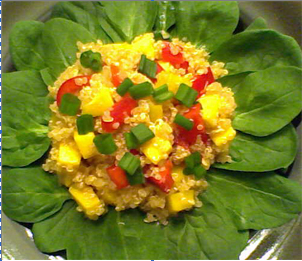
Quinoa Sunshine Salad with Asian Dressing

Ingredients:
Salad Ingredients
4 cups baby spinach
1 cup quinoa
1 cup red bell pepper, diced
1 cup yellow bell pepper, diced
1 cup mango, diced
½ cup green onion, chopped
Asian Dressing Ingredients
1/3 cup rice vinegar
¼ cup low-sodium soy sauce
1 tablespoon orange juice, freshly squeezed
2 teaspoons fresh garlic, minced
1 teaspoon fresh ginger, minced
1 teaspoon sesame oil
1 teaspoon sugar
¼ teaspoon orange zest

Directions:
1. Rinse quinoa thoroughly, place one cup quinoa in a sauce pan with two cups of cold water. Bring the mixture to a boil, cover and turn down the heat to a low simmer.
2. Let cook for about 15 minutes, or until all water is absorbed. Remove from heat. Fluff quinoa with a fork and set aside to cool.
3. In a small bowl combine all dressing ingredients and mix thoroughly.
4. In a large bowl combine quinoa, red bell pepper, yellow bell pepper and mango.
5. Pour dressing over salad and mix.
6. Let the salad sit for 15 minutes to allow the flavors to combine.
7. Serve salad on top of a bed of baby spinach and garnish with green onions.

Roasted Poblanos Stuffed with Cranberries, Pecans, and Quinoa

Ingredients:
8 poblano peppers
3 cups cooked quinoa
1/2 cup chopped pecans, toasted
1/2 cup dried cranberries
1/2 red onion, minced
1/2 cup cilantro, chopped
1 pound butternut or kabocha squash
2 Tablespoons maple syrup
1/4 cup nonfat sour cream
1-2 cups vegetable stock
1/2 teaspoon olive oil
Salt and freshly ground pepper

Directions:
1. Preheat boiler. Broil poblanos, turning once, until charred, about 10 minutes. Place them in a paper shopping bag or a bowl covered with plastic wrap to let them steam for about 10 minutes. Remove the charred skin when cool enough to handle. Slit lengthwise on one side, and remove the seeds.
2. Reduce the oven temperature to 400 degrees. Cut squash in half. Remove seeds. Brush the cut side with the olive oil. Roast it cut side down until tender, about 30 – 40 minutes.
3. Scoop the squash out of the skin. Puree in blender with maple syrup, sour cream, and vegetable stock. Add additional stock as necessary to reach a sauce-like consistency.
4. In a mixing bowl, combine quinoa, cranberries, pecans, onion, cilantro, and 1/2 cup of the sauce. Season to taste with salt and freshly ground pepper.
5. Stuff each pepper with a generous half cup of the mixture. Place in a baking dish, seam side down. Cover with aluminum foil and bake for 20 minutes.
6. Serve with the warm sauce.

Quinoa with Currants

Ingredients:
1/4 cup rinsed quinoa
1/8 tsp ground ginger
1/4 cup water
dash tumeric (optional)
Dash of salt
1/8 tsp pepper
1/3 red onion, finely diced
2 Tbs chopped fresh cilantro (or parsley)
1/8 tsp ground cumin
2 Tbs currants (or chopped raisins)
Dash ground cinnamon
1/4 tsp grated orange or lemon zest
Dash ground coriander

Directions:
1. Rinse quinoa with warm water and drain through a fine strainer.
2. Bring water and salt to a boil. Add the quinoa. Cover and reduce heat. Simmer for 10-15 min.
3. Meanwhile, heat a nonstick skillet. Add the onion, spices, and black pepper. Cook gently (low temp) until softened, about 5-10 minutes. Add a bit of water if needed to prevent burning.
4. Drain the quinoa when it's done and toss with the onion mixture along with the cilantro, currants, and orange or lemon zest. Serve hot or at room temperature.

1/18/11

Hitting Gray Matter.... Hard...

There is no known “safe” level of exposure to lead.  Obviously, a child sucking down lead-based paint chips like they were Oreos will suffer greater health impacts than would someone whose exposure is limited to occasional inhalation of industrially polluted air from a plant three hundred miles away; still, the point is, we have been poisoning ourselves for the three-thousand plus known years of lead mining, and there does not appear to be any sign of stopping any time soon.

The littany of dread associated with lead poisoning has always included symptoms usually associated with higher-dose exposures, although chronic lead exposure has also gained notoriety lately.  Those suffering headache, abdominal pain, memory loss, kidney failure, erectile dysfunction, pain or tingling in extremeties, loss of apetite, vomiting, weight loss, constipation, anemia, irritability, or learning disabilities are likely to be more obvious sufferers from lead toxicity than those with lower-key symptoms from chronic exposure.

Added to the above maladies is a newly discovered result of lead exposure, which may have farther-reaching consequences for our society – even for our species as a whole.

Recent research suggests that the development of the anterior cingulate is adversely affected by exposure to lead

The anterior cingluate cortex is the front portion of the cingulate cortex; it forms a ‘U’ shaped covering of the corpus callosum, the “middle” part of the brain, which connects the left and right hemispheres.  In addition to playing a significant role in a wide variety of autonomic functions such as regulating blood pressure and heart rate, the anterior cingulate also appears to have an important part to play in complex rational cognitive functions, such as reward anticipation, decision-making, empathy and emotion.

A smaller anterior cingulate cortex, as occurs in persons with more exposure to chronic sources of lead, such as air pollution (especially historically, prior to the removal of lead from petroleum), places more emphasis on stimulus processing in the amygdalla, frequently referred to as the “reptilian brain” because it is the portion of our brain responsible for more primitive responses, particularly fearful responses.

Fight or flight responses come from the amygdalla; subtle, nuanced responses come only from the cingulate.  This makes a lot of sense, because a subtle, nuanced response typically involves cross-chatter between the logos and mythos – between what “is”, determined rationally and mathmatically (ie, “left brain”) and what “ought to be”, determined emotionally, aesthetically, and morally (ie, “right brain”).  Knee-jerk reactions are reptillian; thoughtful responses which take some time to formulate, and also some time to explain, are more complicated.

Obviously, by reducing the size of the anterior cingulate, and emphasizing the amygdalla, we have created a problem which goes far beyond the scope of the individual patient.  We have collectively increased the likelihood of paranoid responses on the part of large segments of our population, and virtually no one is immune.

Lead is everywhere.  The best-known culprit for lead poisoning is paint, found particularly in homes built prior to 1978; lead-based paint is not isolated to any particular region – it may be found in the city, country, or suburbs, in apartments, single-family homes, and both private and public housing, both on the interior and the exterior.

Soil may be contaminated in neighborhoods where lead based paint was once used; it may stay in the soil indefinitely, and may actually be made worse by the removal of lead-based paint from homes, depending on the removal method.  Tracking of soil into and out of contaminated spaces make it likely that dust in many places also contains lead.

Lead pipes and lead solder mean that frequently concentrations of lead may be found in drinking water.  On occasion, municipal water supplies will be contaminated without notice because in between tests for lead, chlorine or chlordate concentrations will be changed, and the new chemical combinations will not be first tested for impact on lead pipes or lead solder – by the time changes in lead concentrations are noticed, it is too late to stop the exposure.

Lead-based batteries are slowly being replaced by other technologies, but they are still the cheapest and most efficient sources of battery power for most applications; lead pollution comes from each phase of their lives – production, use, and disposal of lead batteries all give ample opportunity for exposure to lead.

Foods and liquids may be contaminated by storage in lead crystal or lead-glazed pottery or porcelin.  Lead smelters and other industries release lead into the air.  Hobbyists using lead may not even be aware that pottery, stained glass, or furniture refinishing may contribute to lead poisoning.

Lead is, quite literally, everywhere.  Nor is it likely to go away any time soon – it is simply too important economically for us to practically advocate its eradication.

However, there are several steps we can take to minimize the collective damage we are doing to ourselves.
  • Check for lead-based paints in and around your home; a specialized inspector can tell you whether you have lead accumulations in your house.  The National Lead Information Center (NLIC) can provide a list of contacts where you live.
  • Distill your drinking water.  Filtering is good, but distilling is even better.
  • Keep as many plants in your home as you are capable of keeping alive; several varieties are especially good at filtering the air of heavy metals, but make sure you emphasize keeping varieties which will survive your environment and skill level – we recommend pothos ivy as a hardy and hard-to-kill indoor favorite.
  • Clean floors, window frames, window sills and other surfaces weekly.  Use a mop, sponge or paper towel with warm water and a general all-purpose cleaner.
  • Thoroughly rinse sponges and mop heads after cleaning dirty or dusty areas.
  • Wash children’s hands often, especially before they eat and before they go to sleep.
  • Keep play areas clean.
  • Eat right and exercise; a good diet, particularly one high in fiber, prevents the absorption of lead.  A healthy liver can expunge more lead, as well, so eating right is critical, especially for those who cannot limit exposure.
  • Look for alternatives to lead-based products.  If you can choose batteries, for example, which do not use lead-acid technology, do so.  If you can avoid using lead-based solder, do so.  If you can avoid using lead pipes, do so.
There is a political subtext to all of this, with irony which does not escape Myrtle’s notice.  Conservatives notoriously oppose virtually all government initiatives designed to protect the environment at the expense of business, and lead abatement would certainly fill the bill.  Recently, studies have suggested that the smaller one’s anterior cingulate, the more conservative one is likely to be in one’s voting behavior.  A vicious circle, no doubt – lead poisoning causes a person to be less concerned about lead poisoning.

In any event, Myrtle is less concerned with whether or not her state is red or blue, just so long as it avoids a dull pewter color.

Happy farming!

1/16/11

When less is more, do more with less

Versatility is king for small operators.  “It slices, it dices, it juliennes!”  Every tool on a half-acre homestead has to do more than one thing, including the plants.  Our grape vines, for example, produce grapes, but they also provide shade in summer, cutting our cooling costs by soaking up the sun before it has a chance to hit our western exposures.  Our blackberry vines provide copious quantities of fruit, and also provide a thorny border demarcating our property line – an important consideration in a neighborhood which used to treat our property as a pedestrian highway.

There are all sorts of other multi-functional plants, many of which we have in our garden.  Legumes (beans and peas) provided tasty meals, but also bind nitrogen to the soil for following crops in future seasons; amaranth provides grain, but it also chokes out the grass which is the natural enemy of our anti-turf family.  Sunflowers provide seeds, and they also feed our native bee population; we are putting in bees this year, which will provide us with honey, and will also pollinate many of our plants.

January means seed-catalog time, and we have spent our fair share of time going over heirloom seed catalogs with a fine-toothed comb, looking for just the right combination of productivity, versatility, health and vitality on the part of those things we are going to add to our garden this year.

The major addition, of course, will be several varieties of amaranth, which we have spoken about at length for many months now.  A couple of other interesting new crops, however, we have only mentioned in passing, and we did not find either in our catalogs.  We have had to special order mucuna pruriens, better known as velvet beans, or cow itch.  We are also planting cyclanthera pedata, better known as caigua in Peru, or lady’s slipper in Britain.

Neither of these delectable veggies is a mainstream crop in this country yet, but we hope to change that one seed at a time.

Velvet beans will serve several important functions in our garden.  First and foremost, this plant has historically been a significant ground-cover in the Florida tomato industry, only having lost favor in the last several decades as a caterpillar specifically attracted to the mucuna vine gained prominence, and then began attacking several other cash crops in Florida.  Having reviewed the literature, we believe the risk of pests was overstated, exaggerated by the tendency to monocrop, rely on pesticides, and just generally mess with Mother Nature.

On the other hand, using a vigorous leguminous vine like mucuna not only adds nitrogen to the soil, it chokes out unwanted weeds, provides groundcover to hold topsoil in place, regulates soil temperature, nourishes beneficial soil microbes, chokes out harmful soil microbes, and gives shade to tender leafy vegetables during the harshest times of day during the hottest parts of the growing season.

In addition to all of these agricultural benefits, mucuna has the advantage of being a tasty source of protein and several essential nutrients, in addition to being useful as a medicinal herb.  Mucuna seeds contain from 20-35% crude protein.  The ‘itch’ from ‘cow itch’ comes from the hairy seedpods (which are also where the ‘velvet’ in ‘velvet bean’ comes from).  These hairy seedpods are high in serotonin and mucanain, which, in addition to being neurologically significant, also cause a mild allergic reaction – in fact, itching powder used to be manufactured with velvet bean seed pods.

The beans themselves also contain high concentrations of levodopa (L-DOPA), a direct precursor of the neurotransmitter dopamine.  This makes velvet beans a potentially important part of the diet for anyone battling depression, parkinson’s disease, erectile dysfunction, low libido, or anxiety disorders.  Lucid dreamers have also recently taken a fancy to mucuna, which complicated our search for seeds greatly – most of the mucuna for sale on the market is not in seed form, it is in herbal supplement form, which does a gardener no good whatsoever.

Caigua is another vine we will be growing this year, and it has a lot to offer, as well.  Curcurbits do very well in southeast Texas, and Caigua is essentially just another cucumber, so we expect it to flourish.  What makes caigua special, however, is its potent blend of phytochemicals – peptin, galacturonic acid, dihydroxitriptamine, pierine, resins, phosphorous, thiamine, ascorbic acid, lipoproteins, systosterol and 3 beta D glucoside, low density lipoproteins, and God only knows what all else.

Inca-period pottery and artwork often depicts caigua; it has been an important vegetable for a long, long time.  Taken in conjunction with the herbal supplement Hercampuri, caigua reduces blood cholesterol levels, rejuvenates skin, and reduces cellulite.

What makes caigua less popular outside of Latin America is uncertain, although it is a little unusual as a cucumber – the closer it gets to being ripe, the more “hollowed-out” the fruit becomes.  The seeds end up clinging to an internal membrane that looks suspiciously like that of a bell pepper.  And by a remarkable coincidence, that is basically what caigua tastes like.  In fact, one of the more popular ways of serving this vegetable is in the form of a caigua rellena – similar to the tex-mex dish chili rellenos.

We think there will probably be a lot of other things we can do with it, however, limited only by our imaginations.  After all, vegetable gardeners in England have recently fallen all over themselves acquiring cyclanthera pedata seeds, and if an English cook can think of something to do with it, surely anyone can do so.  Finding seed, in fact, was fairly easy because even though caigua has not yet hit the market in the U.S. in any major way, enough growers worldwide are interested in this vegetable that we found a variety of sources to order from.

We will be curious how it grows, though, because scouring the web for samples, we encountered several distinct varieties.  Some look benign enough, like small squash leaves on a trellised vine.  Some, however, have sharp multi-folate leaves that look… um…. well… a little ‘irie’, if Jah know what we mean…

Which brings us to the plant we will not be growing in our garden any time soon, though it has many multifunctional qualities which leave every other plant we have ever heard about completely in the dust.  In our collective shortsightedness, our society has demonized this plant, which has the potential to singlehandedly resolve our national debt crisis, close the trade deficit, reduce greenhouse gas emissions, sequester many tons of carbon, improve nutrition, save forests by providing a cheap new source of paper, give new life to the domestic textile industry, and a whole host of other beneficial things.

We are talking, of course, about cannabis.  There are actually three different species of plants which could be called ‘marijuana’ – cannabis sativa, cannabis indica, and cannabis ruderalis.  All three contain some amount of the psychoactive substance tetrahydrocannabinol, or “THC”.  However, while this has become the focal point for how this plant is utilized by humans, it is really the tip of the iceberg.

By attempting to legislate the plant out of existence, though, most nations of the world have instead merely incentivized the breeding of plants with higher and higher concentrations of the very substance which they were attempting to outlaw.  Even so, as the graph you see here shows, there are plenty of substances both more addictive and more dangerous than marijuana – many of them are legal.  Can you say “hypocrisy”?

In colonial America, virtually every significant farming operation involved the production of massive quantities of cannabis, typically just called “hemp”, for industrial use.  Highly adaptable as a material to make rope, cloth, and even bricks, pressboard, and other construction materials, cannabis was in part quite literally responsible for the making of our nation.  Thomas Jefferson’s plantation owed much of its profitability to this plant, as did the farms of many of our other founding fathers.

We wonder, in addition to the many industrial and pharmacological uses of this plant, what might be done with it in the kitchen, if only it weren’t illegal and therefore too expensive to use.

Cannabis sativa has both sweet and savory overtones which, we think, would make it great in salads, in addition to being a pretty good seasoning.  It would unquestionably provide good silage for livestock.  It grows densely, but without being too demanding on the soil.  It is not a water hog; it provides plenty of shade, and is an excellent groundcover.

And legalizing it would turn a lot of criminals into gardeners.  We can’t think of any single measure that would be more beneficial to our society than removing pot from the category of ‘gateway to violent criminal school’ into ‘introduction to the wonderful world of backyard farming’.

Ah, well.

We’ll stick to the weird plants you don’t get in trouble for growing.

Happy farming!
Enhanced by Zemanta

1/5/11

Two Washtubs, a Hand-cranked Wringer, and the Truth...

"Fortunately for those doing the laundry, during the 1930s people didn't have as many changes of clothing as they do now. The boys had one pair of 'good' overalls or 'Levis' which they wore to school every day. When washday came, usually on Saturday, they put on the 'old' pair used for work and chores while the new ones were washed. Nor did they wear a different shirt every day...And you used fewer changes of underwear when you bathed only on Saturday night.
Although the girls undoubtedly had more variety, and may have changed oftener, still they had limited wardrobes. As the thirties began, chances are that most of their dresses were home-sewn. They usually had a new dress for Christmas...and perhaps for their birthday. The point is that nobody required the large volume of clothes that each person feeds to the washer [today]. If that were not so, no one could have stayed even with the laundry.”

Miriam B. Murphy, History Blazer May 1996

There are any number of reasons why laundry is an important consideration when it comes to conservation.  First and foremost, it can get expensive.  Depending on where you live, the water alone can get pricey; the electricity involved, however, is a whole other order of magnitude costly.

We discovered with pleasure that we can do without an electric dryer; line drying our clothes has proven to be far more efficient than we originally feared when we started doing it six months ago.  Necessity, we admit, drove us:  our dryer broke down just when we had no money with which to replace it.

So, we began hanging our wet laundry on the grape trellis just outside our back door.  The grapes, being only a year old, had not yet reached the top of the trellis, so we had all this empty space not being used; laundry seemed like a perfect fit.

Unlike Ms. Murphy’s 1930’s Utah pioneers, however, our family has considerably more in the way of daily changes of clothes.  This means that laundry has become a daily routine, involving plenty of heavy lifting on the part of Mrs. Myrtle Maintenance, though not excluding a lot of input on the part of everyone else in the family, folding and putting things in their respective closets, drawers, etc.

Still, with a little organization and teamwork, we have discovered that we can make this process run like clockwork, and, more to the point, we have cut into our electric bill to the tune of double-digit percentages.

Mrs. Myrtle Maintenance announced recently, as a consequence of this success, that she believes our enterprise ought to consider eliminating the washing machine in similar fashion, so that we may recoup even more energy savings by eliminating that expense as well.

Now, ordinarily, when embarking on a crazy venture, we find ourselves in the company of a legion of others who have considered our alternative solutions long before we, ourselves, take lunatic measures.

Not so this time.

There are, it turns out, only a handful of brave souls who hand-agitate their laundry and then run it through a wringer prior to hanging it on a line to dry.

There are several reasons why this obviously much greener alternative is viewed less favorably than motorized washing machines by all but the hardiest of green-adventurers:
  • Handling wet laundry can be cumbersome.  Wet laundry weighs considerably more than does dry laundry; even when it has been run through a washing machine, and wrung out through the spin cycle, anyone who has ever simply moved laundry from the washing machine to the dryer can attest to the fact that any water at all causes cloth to become much, much heavier.
  • Trust in cleanliness is lacking.  The same paranoia (fed by companies selling us power, water, washing machines, detergents, and speciality fabric treatments) which causes us irrationally to use hot water when cleaning laundry also causes us to distrust the ability of our own hands to get cloth clean.  People view the washing machine as a sort of ‘magic box’ where dirty things go in, and clean things come out.
  • Wringing out wet laundry takes skill.  If you’ve ever toured an old mansion, if the scullery is properly equipped you will see an old wringer sitting against one wall – it is a specialty piece of equipment, and running through a load of laundry is not something any old fool can do; it takes a fool who has practiced many times, and gotten stuck on many buttons, hooks, lapels, etc. before acquiring the talent of running things through quickly and efficiently.
  • Architecture is against the old ways – modern laundry rooms and bathrooms are simply not designed with anything in mind other than the modern washer and dryer arrangement.
All of these objections, of course, have the weight of inertia on their side.

We hate inertia.

We already had a pretty long list of things to do this year, not the least of which is our intention to finally get some bee hives, as well as to start making blackberry port this summer, not to mention growing our own grain… well, you get the idea.  Our “to do” list is no small affair.

Still, we have just about decided ourselves on a new course altogether when it comes to laundry.  And we think we have the answers to each objection:
  • Handling wet laundry can be cumbersome, but less so if you handle less of it at a time.  This means wearing the same pair of pants more often.  We may still need to do a lot more unmentionables than did the rural folk of the 1930’s, but unmentionables don’t actually weigh all that much.  And our day jobs (software support for money, childcare and homemaking for moral value) are not really all that dirty – we are fairly sure we can tolerate getting an extra day or two out of our daily wear.
  • Trust in cleanliness is not a problem for us.  Myrtle Maintenance personell have plenty of elbow grease we are willing to apply as solvent.  And if there’s a stain we can’t get out, well, we’ll just shred the garment and add it to the attic as insulation.  As for whether this process really works or not, hey, think about all those period-piece romances you’ve ever watched like a vicarious lord or lady of the era… all those frilly laces and frocks spent some time in the basement being scourged by a scullery maid prior to being worn by the high and mighty.
  • Wringing out wet laundry takes skill; we like learning new skills.  The list of things we’ve never done before is getting shorter all the time.
  • Architecture is against the old ways, but we’ve proven ourselves willing to knock down walls no one else would have knocked down plenty of times before.  Heck, we may be able to work around the city’s graywater reuse rules without even having to get a permit – research will be required, of course, but the point is, just because no one else does it has nothing to do with whether or not we will do it.
There are plenty of details to be worked out, of course.   Lehman’s, for example, sells a couple of different varieties of hand-wringing washers, but we aren’t willing to shell out the kind of money they charge.  We’ll probably be rigging up a chassis to hold a couple of old-fashioned wash tubs waist high or so, and buying a hand-cranked wringer, and devising some kind of agitating post to manually crunch and grind all the clothes in the hopper.

Of all our crazy schemes, this one actually sounds far crazier, but in some ways is more practical than others.  There will be some initial investment in equipment, and a fairly significant learning curve.  There will need to be some procedural adjustments to our daily routines.  But overall, there looks to be nothing but upside, at least for us.  The utility company will probably lose out in a big way.  Boo-hoo.

Happy farming!

12/8/10

In Praise of Good Eggs

“Value of all egg production in 2009 was $6.16 billion, down 25 percent from the $8.22 billion in 2008. Egg production totaled 90.4 million eggs, up slightly percent from the 90.0 million eggs produced in 2008. In 2009, all eggs averaged 81.7 cents per dozen, compared with $1.09 in 2008.”
–Poultry Production and Value, 2009 Summary USDA  April 2010
Pulletpalooza was a rip-roaring success, considering that we did everything in our power to keep people from showing up, and about 30 intrepid chicken fans showed up anyway.  Part of the reason, we suspect, is that even though prices for factory farmed eggs have been coming down of late, dissatisfaction with factory farmed eggs (or, indeed, with any factory farmed foods at all) is driving a larger number of folks to consider backyard birds.

One of the most common questions we received related to production costs and return on investment.  This was a practical question, indeed, given that it was asked while small children were gleefully tossing popcorn at our hens and squealing “Chickie like popcorn!”  Clearly, backyard chicken ownership comprises both a practical and an emotional component.

Practically speaking, the biggest investment vis-à-vis backyard flocks relates to housing.  Areas that allow free-ranging your birds give a tremendous advantage in this respect, since in such places, the only coop you need is a small cabinet-like space where you can lock them up at night.  This is traditionally what a chicken coop looked like, many years ago when practically every home had chickens; you’d let the birds out in the morning, and at night, your children would be responsible for searching your yard for eggs, and then just before dark, you’d put the birds back in the coop and lock it.

At Myrtle’s place, however, we have to keep the birds caged all day long, so we needed a bigger coop.  our structure is 10’ x 12’, with a large nesting box elevated on one end, and a 10’ x 2’ ‘run’ on top, giving our birds a total of 140 square feet in which to roam.  Our roosting poles are about 6’ each, and our birds have a choice of two on which to sleep at night.

All told, we have about $200 in materials invested in our coop.  We initially believed that this cost would be dwarfed by feed expenditures, and in fact, when we first started our little venture, that seemed like a reasonable assumption, since we would go through three to four $7 bags of lay pellets each month; throw in the gas we burned driving to Producer’s Coop ever week, and they seemed awfully expensive right out of the gate.

However, these costs were grossly exaggerated due to our inexperience.  We were totally unaware of how much we could save by feeding our birds table scraps and weeds.  Toss in the occasional grubworm, caterpillar, dragonfly, or (saints preserve us!) cockroach, and Myrtle and the girls are down to only a bag of lay pellets every month or so.  Given that an hour of sitting, sipping coffee, and watching the birds scratching in the leaves replaces a month of psychotherapy, and the $70 or $80 a year we spend on feed really seems pretty paltry.  I’m sure the American Association of Liscensced Professional Counselors would agree.

The flip side of the cost question is the question of return on investment (ROI).  This is harder for us to measure, of course, given how many benefits we get from the chickens apart from their primary output, eggs.  As alluded to, our chickens are also our primary means of composting kitchen leftovers, in addition to being excellent disposers of yard waste.

Still, the simplest means of evaluating ROI is to calculate expenses per egg.  This, of course, leads to another common question – “How many eggs do you get?”

The rate per bird varies wildly, as does the rate in each given season.  We have noticed numerous trends worth mentioning – first off, our chickens lay larger, healthier, tastier and more numerous eggs the more we ply them with weeds.  Lay pellets are fine, they seem to be telling us, but weeds are much, much better.  They also like stalks of sunflowers, broccoli, tomatoes, and the like, but even these tasty consumables pale in comparison to good old fashioned weeds.

We get, on average, 200 eggs per year, per bird.  Some parts of the year, every bird is laying virtually every day; some parts of the year, each bird only lays every other day or so.  On the whole, though, we are getting 0.55 eggs per day, per bird.

This comes to 1,400 eggs per year total for our flock of 7 birds.  Given that we are paying at most $84 per year on lay pellets, that comes to $0.06 per egg at a maximum, not counting initial capital outlay.  This puts one dozen low cholesterol, high Omega-3, hormone free eggs at $0.72 in production costs. 

This is cheaper than the nasty chemical laced factory farmed eggs with their potential salmonella infections and god only knows what other health hazards.  We are paying far less for our eggs than for the equivalent healthy eggs from a natural foods store, where you might expect to pay anywhere from $3 to $5 per dozen for eggs as healthy as those we get from Myrtle and the girls.

If you want to throw in the capital outlay for the coop, then we would be paying $284 in the first year, bringing the cost of each egg to $0.20, or about $2.43 per dozen.  This, obviously, is less than $3 to $5, and it is only capitalizing for one year.  Our coop will more likely last for at least ten years, and hopefully more like twenty, which would drop our cost-per-egg back down to anywhere from $0.08 to $0.10.

On the whole, then, we would argue that there is a fairly significant ROI on backyard chickens just from measuring their primary output – eggs.  We don’t really have the analytical tools to calculate the ROI on their secondary output, but we are fairly confident that the value of chicken-poop compost is at least as profitable as the eggs.  Given how much every plant in our yard loves the stuff, we suspect it is probably actually much greater.

And then there is the tertiary benefit of avian psychoanalysis.  Maybe we should replace our lawn chairs with outdoor couches.  “Myrtle will see you now…”

Happy farming!

12/1/10

"Here we go, a-wassailing, whatever that might mean!"

December is a strange month for chickens and for gardens.  Virtually every Texas gardener has abandoned fruits and veggies this month in favor of pansies.  Weeds for the chickens are as hard to come by as are peaches or plums for the people.

Yet, it is the time of year when every table is topped with delectable goodies, and every kitchen smells of ginger and cinnamon.

We are hosting our share of festivities at Myrtle’s place this year, and will be serving our share of sugar.  In lieu of gardening advice, or pontifications about poultry, let us offer you a serving suggestion.  Wassail is not just a word in a Christmas carol.  It is also a tasty beverage.  And it explains why, even in warm climates like ours, Santa is so jolly in spite of his heavy suit, and his nose is still a bright cherry red!

Traditionally, wassail was a hard cider warmed in a turreen full of sugar, cinnamon, nutmeg, ginger and topped with pieces of toasted bread to serve as ‘sops’.  If you live somewhere with a copious quantity of sweet and tart apples, and have access to good hard cider, may we suggest you go traditional – there is absolutely nothing in the world as tasty as home grown cider spiced and warmed over a fire and drunk with a host of friends in a cozy room with windows overlooking a frozen garden.

Many of those ingredients are not available at Myrtle’s place – we would have to import the hard apple cider, we don’t have an indoor fireplace, and our garden is far from frozen.

Modern recipes for wassail, however, are somewhat forgiving, and so long as your group of friends doesn’t contain any picky purists, you can get away with calling a good old-fashioned mulled wine “wassail”.  It’ll do in a pinch, anyway.  Take a large quantity of any good sweet red wine (the cheaper, the better, in our book), toss in sugar, cinnamon, ginger, nutmeg, apples, oranges, raisins, etc. to taste, maybe a splash or two of cinnamon schnapps if the mood strikes you, and heat the whole thing up.

A cauldron over a fire is a nice touch, of course, but barring that, a crock pot will suffice.  If you don’t have a crock pot, try a stew pot and your kitchen stove.

This year, we may experiment with putting in some pomegranate arils, since in future years we hope to be celebrating a fruit harvest in late fall.  We also hope to have a field of flowering quinoa as a backdrop to future wassail parties.  For this year, though, we’ll settle for a firebowl, a few flowers, and a good sit.

Winter festivals mean many different things to different folk, but one thing they all have in common is the theme of lights in the darkness, and of warmth in the midsts of cold.  We hope you can find your own island of warmth and light in the coming month.

Happy farming!

11/28/10

Old Man... Winter? Sorta...

We told you last week about the changing needs of winter gardeners in our little corner of the world.  Since that time, we have eaten too much turkey, and had a borderline frost/freeze. 

It is an exceedingly bittersweet time of year when we finally have a drop in temperature sufficient to keep the tomatoes from ripening on the vine, and worse still, when we get a freeze deep enough (which is to say, any sort of freeze at all) to kill off many of our producing vines.

Some varieties of tomato are hardy enough to take our little snippet of cold air, of course.  We allow volunteers to go crazy in our garden, so we can't tell you for sure which varieties they are -- we just know they aren't the Brandywines you see here all nice and green.

Still, we had some vines make it through, including some volunteers in the potting soil we were using in our little black current experiment.  With a little bit of luck, we might actually manage to get a few more ripe tomatoes later this season.

We had mixed results with basil, as well -- for some reason, our sweet basil did better than many of our exotics -- the thai, for example, and the apple basil both froze to the ground.  Our purple curly-leafed basil plants had some leaves crimple, and others keep going strong.

Evidently, we were just exactly at the threshold temperature for winter mischief.

Still, we know what to do now.  First, we hoe down all the frozen plants (or, better still, get our daughter to do it!); next, we cover the bed with a fresh layer of leaves.

In mid-February, we will add a layer of compost from the chicken coop, and work it in with a pitchfork.  Then, in late February or early March, we will start seeding this bed with new plants.

Sometime next spring, after volunteer basil has started cropping up all over the yard, we will transfer a few of those plants to this bed, and any volunteer tomatoes which choose to join our newly seeded tomatoes will happily join forces to turn this plot into a wild tangle of solanaceous goodness.  We'll probably mulch it, as well, sometime next April or May or so.  And undoubtedly we'll put some sunflowers and nasturtiums on the borders as trap crops.

Much the same treatment will meet our other garden beds, in their own times, and with their own particular combinations of plants.

We could put more seed in the ground now, of course.  Our cabbage, spinach, kale and broccoli all acted as if this week's dip in temperature was manna from heaven, and kale and cabbage can both go into the ground all the way up to the end of December according to the planting calendar available at Producer's Co-op.

And next year at this time, we will be planting more quinoa seeds, as part of a rolling quinoa planting season.

But for now, we are getting ready for the First Annual Brazos Valley Pulletpalooza, and we really feel fairly satisfied with how the garden is growing.  In future years, we have plans to install rebar reinforced PVC hoops over the top of our tender veggies, and cover the contraption with greenhouse plastic prior to our first frost, so as to extend our season.  Today, though, we'll be enjoying the fruits of our present labors, and cleaning up Myrtle's place for next weekend's show-and-tell.

Happy farming!

11/23/10

Thanksgiving in Texas... Climate is Changing and So are We

Vernalization, stratification, weatherization, whatever you want to call it, the concept is one we hadn’t really bothered ourselves with much until this fall at Myrtle’s.

However, several events have conspired to make us pay even as much attention to climate as we do to weather.  This is a subtle distinction, but one which will become increasingly more important as as climate change takes fuller hold over the course of the next several decades.

The Brazos Valley is not quite in the wettest region of Texas, roughly defined as the greater Houston area eastward.  We joke in our family that if there is a 40% chance of rain, “Sure hope they enjoy it over in Huntsville.”  Houston gets over 50 inches of rain a year; College Station gets just under 30 inches a year, for now.  This makes us wetter than most of the state, even if not quite putting us in the rice-growing marshes of the eastern sliver of Texas.

We are likely to get less rain in coming years, though.  A wide variety of climate change models suggest that we will increasingly look less like a sub-tropical climate, and more and more like a semi-arid climate, with some suggesting that in as few as ten years, we may see our precipitation averages drop by 1/3rd.  That would mean that instead of getting around 30 inches per year, we will likely get roughly 20 inches per year.

Our normal precipitation pattern is changing, too.  Not only will rain be less abundant in the Brazos Valley, it will also come at different times.  Normally, we have a wet season in May and June, followed by a dry summer, with mild fall and winter months.  In future years, however, winter will be our wettest time of year; May and June will only see significant rain when we get moisture from tropical storms.

And then there will be fluctuations such as those caused by El Niño and La Niña.  This year is a strong La Niña year, so our fall and winter are proving to be excessively dry.  In fact, some models show that tropical moisture during El Niño years will be so prevalent that we may actually on average get more rain, even as soil moisture disappears during our rain-free months – we’ll be both wetter and drier, like some sort of crazy climatic performance art piece.

So what does this have to do with seeds, and planting, and Myrtle’s place?

As it turns out, quite a lot. 

We have spoken before of our strong preference for collecting rainwater; we have spent the last several months working on our collection system.  Roughly 80% of the rain running off our roof will now be collected – first, into two 50 gallon barrels, and next, after the barrels are full, into our fish pond.  These preparations are vital – the fact that our pond is currently sitting dry really stands as the only evidence you need that we just don’t get enough rain here to grow crops without supplemental watering.  We are now prepared to do supplemental watering without relying on the city’s untrustworthy water.

There are other elements of our little experiment in self-sufficiency which are also heavily affected by climate change.  Not only how we are watering, but what we are watering.  Traditionally, the Brazos Valley has two basic growing seasons, spring and fall.  There are winter gardens with greens, but typically very few local gardeners even bother with these tender plants – usually broccoli, kale, spinach and maybe radishes or potatoes, but very little else.  No, for the most part, gardens in Bryan/College Station run from March through June, and August/September through November.

However, while the July/August heat will continue to make that the one time of year when nothing gets planted, and what little is still growing must be tended very carefully to keep it alive, the rest of the year is changing ever so slightly to make our climate a year-round growing season.  The traditional spring and fall veggies won’t change – corn, squash, cucumbers, beans, tomatoes, peppers – these are timeless and are likely to be grown here as long as there are people with garden hoes to grow them.

But there is now more than ever a need to diversify, and our changing climate has provided not only a greater need, but also a greater opportunity.  We have spoken before of our desire to branch out into grains.  We started our experiment in grains this fall, with a small planting of quinoa.  While our planting was somewhat small (only about fifty seeds total), our crop will prove even smaller, as only a handful of the seeds actually germinated.

Concerned that perhaps we overestimated the ability of this crop from the colder climates and higher elveations of the Andes mountains to thrive in the still-subtropical Brazos Valley, we did a little research.  What we discovered made us slap our heads in self-accusation, yet also gave us tremendous hope.

As it turns out, in Colorado, several farmers have been experimenting with quinoa for years.  This makes a lot of sense, as they are farming in a mountainous region with much more in common climatologically to the Andes than our own garden can boast.  The planting season in Colorado starts in late May, when the ground has warmed enough, with a harvest in September and October, just before the freezing precipitation begins.

The limiting factor which has prevented quinoa from becoming a major cash crop for this region is the fact that sometimes the summer heat is too much.  When the temperature is in the 80s or 90s for an extended period of time, the quinoa doesn’t go to seed – the heat stress doesn’t always kill the plant, but for all practical purposes, at that point it is not a grain crop any more, it is a greens crop, and in a nation of carnivores, that really isn’t a great sales pitch.

However, several elements of this story stand out to us as hopeful – first, we need a stronger period of vernalization.  We planted our quinoa in late september, when ambient temperatures were still in the mid 80s in the Brazos Valley, and goodness only knows how hot the ground still was.  Next fall, we will wait until early October, and we will have had our seeds in the refrigerator for a week before we put them in the ground.

Second, we are hopeful that our growing season for quinoa may be, in most years, a full six months long – from October to March, there is a risk of temperatures above 90 degrees, but in most years, it will not happen.  Thus, we can stagger planting from October through December, and guarantee ourselves that in most years, we will get grain from our quinoa.  There is also a slight risk of killing frost early in the season, but not much.  Once it gets to flowering – typically somewhere between 45-60 days – quinoa will survive temperatures into the low 20s, which are already extremely rare in the Brazos Valley, and are becoming even more rare as each year passes.

This means that we will be able to rotate several of our newfound favorite crops from a variety of places of origin in such way that we will always – spring, summer, autumn, winter – have a green, a legume, or a grain, and in many cases a combination of the three, growing in one patch or another.  Amaranth will sometimes have delayed germination if the ground has not sufficiently warmed, but even so, a staggered planting from March through May will overlap nicely with the staggered quinoa plantings.  Interspersing velvet beans, cow peas, and maize in these plots will give us a colorful and tasty year round edible landscape.

The coming era of permanent drought in the greater part of the State of Texas will cause hardship for many, and will lead to social and economic unheaval unprecedented in this part of the country, but it needn’t be the end of the story for us.  The time to adapt is upon us.  Ironically, as winter warms up, it is the time of year we need to start leaning on.  We have some heretofore unavailable opportunities coming our way.  Quinoa is just the tip of the iceberg.

When approached calmly and rationally, the problems presented by climate change on a microeconomic level do not represent any particularly terrifying difficulties – finding climates which currently have limits roughly approximating those projected to be likely in the future gives a pretty good indicator of what needs to be done. 

In future years, the Brazos Valley will get roughly the same amount of rain as is experienced in a good portion of southwest Texas today, on a line from roughly Kerrville to Uvalde.  This is excellent territory in which to raise crops only slightly different from what we currently grow. 

Rio Grande peaches have low chilling requirements and thrive with hot and dry summers.  Pomegranates produce exceptionally sweet fruit under these circumstances.  Blackberries and plums also excel in this semi-arid climate.  One particular species of wild black cherry does exceptionally well in this region, even thriving southward into the arid reaches of northern Mexico.  The most prolific olive orchard in Texas sits in the middle of this region.  Corn and okra are ubiquitous here; imported grains like amaranth and millet could (and if we have anything to say about it, will) grow like weeds in our new climate.  And in our mild, wet winters, we will be growing short-day cool weather vegetables that elsewhere only grow at altitude on the shaded slopes of mountainsides in summer.

If the world is going to evolve as a result of humanity’s collective bad behavior, it is only right that our behavior and culture, including agriculture, should evolve right back.  This means things like making the kinds of good friends who will help you replace a burned out stove at a moments notice (thank you Browns!) to collecting all the rainwater that falls on your little tin roof, to planting crops you've never heard of before if that's all that will grow in your new climate.  This ain’t your grandaddy’s farm.  With a little forethought, though, and a for us, a newfound attention to winter gardening, it could belong to our grandchildren.  As long as we can still work a garden hoe, we can adapt... for which we give thanks.

Happy farming!
Enhanced by Zemanta

11/22/10

Ideas for Good

We won't go into all the details, because, frankly, Toyota is a giant multinational corporation and, in general, that means they are the epitome of evil.  Still, we think they got a bum rap on the supposed "unintended acceleration" controversy about a year ago.

User error, that's all that turned out to be.

We believe that Toyota has found a way out of the morass of bad publicity, though, with their latest promotion, "Ideas for Good".

Myrtle has submitted her ideas; we recommend you submit yours, too.

We'll be back soon with "real" Myrtle postings, but for now, check out what an evil megaconglomerate is doing that might actually be "For Good".

Happy farming!

10/18/10

The Year Democracy Died in America

"The twentieth century has been characterized by three developments of great political importance: the growth of democracy, the growth of corporate power, and the growth of corporate propaganda as a means of protecting corporate power against democracy.”

–Alex Carey, “Taking the Risk out of Democracy:  Propaganda in the U.S. and Australia”

The decision in Citizens United v. Federal Election Commission will go down in history as the decision which killed the possibility of real democracy in the United States.  Assuming, of course, that at some future date, it is still possible to write history books, rather than tomes of propaganda supporting the corporatist-statist idolatry which will be left, should a cultural and social revolt fail to materialize, and soon.

Basically, the Supreme Court held in a 5-4 decision that electioneering communications may be paid for by corporate entities without any oversight whatsoever.  Conservatives claim that this is an evenhanded application of existing law, and that labor unions are also allowed to spend unlimited amounts of money, so what’s the big deal?

The big deal, of course, is that a) corporate entities – including labor unions – are not people, and ought not be granted personal rights, such as free speech; b) corporate entities are uniquely capable of cooption by unknown and unknowable economic and social forces, including forces outside this country, and with ill-intent for our Constitution and its associated freedoms,  and c) unlimited access to electioneering media means that only the very rich will be able to afford to influence election outcomes.

“That’s just class warfare!” cry the conservatives, conveniently sidestepping the first two objections through a sleight-of-hand whose demogoguery is just a harbinger of things to come.

Hmmm…..  One class cleanly and neatly defines itself into permanent political power… and its opponents are guilty of class warfare?

Let there be no delusions of corporatist “good intentions”.  The entirety of the political debate, under Citizens United, will now be framed by institutions with no motivation whatsoever other than corporate profits.  What does this mean?
  • Weakened enforcement of the Clean Air Act.  Smog, air pollution, sudden infant death syndrome, and lung cancer?  Deal with it – government intervention to prevent air pollution “Creates deficits and costs American jobs!”  That’s the new conventional wisdom, as bought and paid for by the Coal Powered Electrical Plants of America.
  • Weakened enforcement of the Clean Water Act.  Infertility, diabetes, metabolic disorder, liver diseases and hepatic disorders?  Deal with it – government enforcement of limitations on pesticide and herbicide runoff “Creates deficits and costs American jobs!”  That’s the new conventional wisdom, as bought and paid for by Archer-Daniels-Midland, Monsanto, and Dow Chemical.
  • No action whatsoever on climate change.  Famine, water shortages, third world hunger, disease?  Deal with it – “Global warming is a myth.”  That’s the new conventional wisdom, as bought and paid for by Exxon-Mobil, Halliburton, Sonic Automotive, and a host of others.
  • Infant mortality?  Inner city crime?  Lower standard of living – especially for marginal populations such as migrant workers, children of single mothers or from broken homes, or from historically impoverished communities?  The solution to all these problems is tax cuts for the wealthy.  That’s the new conventional wisdom as bought and paid for by AIG, CitiCorp, Goldman Sachs, and a host of others.
The ability to manipulate public opinion on the part of a small corporatocracy – less than one tenth of 1% of the American public is part of the influential decision-making class responsible for the management of publicly held corporations – ought not to be underestimated.  As Noam Chomsky pointed out in “Manufacturing Consent:  The Political Economy of the Mass Media”, the filter of corporate ownership of the media is virtually impossible to overcome.

ABC, NBC, CBS, and CNN really are biased, just as the right-wing zealots of Fox News would have you believe.  But they are not biased in favor of Liberalism.  They are biased in favor of Disney, General Electric, and God-only-knows what other corporate entities.  They are biased in favor of profits and in favor of stable advertising revenue.  They are no more interested in genuine investigative journalism than they are in taking vows of celibacy and poverty.  They are not “news” organizations, they are “sales” organizations.

Even “oppositional” media is typically vulnerable to cooption by corporate sponsorship.  One of our personal favorite bloggers is Nate Silver, whose fivethirtyeight.com often comprises a lonely objective outlet of political reporting; however, Mr. Silver’s pet project has been subsumed by the New York Times in the past few months; thus far, there have been no obvious or evident changes in the way the site operates… but the very nature of corporate sponsorship means it is inevitable that eventually some form of substantive lack will appear in fivethirtyeight.com (or rather, not appear), which will be a direct result of being a subset of corporate culture.

There are some limited reasons for optimism, in spite of the overwhelming strength of the forces arrayed for self-interested exploitation of everything and everyone.  There is very little reason to believe that anything will be accomplished in the federal government for the foreseeable future, of course.  Democrats had fairly overwhelming control of the legislative and executive branches for the past two years, and only managed to worsen the corporate stranglehold on government.  Republicans are about to wrest at least one house of the legislature from the Democrats, and not only do Republicans not have a solution to this problem, they actively seek to make the problem worse.  Tea Party slogans about “taking back our country” are rife with Orwellian irony, as the “typical American” who purportedly comprises the Tea Party will have less, not more, power in a Tea Party political universe.

Nevertheless, there are means to lessen the stranglehold of corporatism, and those means lay squarely in the provence of creative individuals – corporations may emulate, but may never fully coopt the creativity of human beings.  Keeping truth alive in the public conversation, even when it may not be heard by everyone over the din of propaganda, will eventually lead to acceptance – too late, in some cases, to be sure, but it will eventually be heard.  In the case of global warming, for example, the State of Texas will have to accept, in spite of the oil industry’s opposition, that in 2035, with higher temperatures and not enough water for businesses or residences, let alone agricultural users, maybe, just maybe, there was something to all those scientists’ warnings way back when…

Corporate ownership of media ought not be confused with the notion of corporate control of media – the pervasiveness of internet usage, as an example, means that even where corporations coopt outlets which were once free, such as youtube.com, or nominally independent sites, such as drudgereport.com (on the right) or dailykos.com (on the left), there will be someone somewhere who catches them in the middle of their shenanigans, and the truth will out. 

The number of times FoxNews.com has posted an embarrassingly revelatory bit of propaganda, only to have it taken down minutes later, and yet have the damage done by some clever blogger somewhere with MWSnap and a free minute or two to post the evidence, is now beyond count.  Pervasiveness of a medium may overwhelm the perverseness of that medium.  There is just too much interactive media out there for even the most diligent censor to excise it all.

The danger is that it is fairly easy to drown out a single voice.  It doesn’t take a secret police force to silence a voice of reason – another of Chomsky’s favorite sayings is that “propaganda is to a democracy what the bludgeon is to a totalitarian state.”  The ability of corporatist media to generate a mob slobbering and salivating with the bloviations of a demagogue like Rush Limbaugh can only be countered by the creation of an equal and opposite mob of bespectacled intellectuals, dripping with witticisms and understanding, and maybe the sweat of their brows, particularly if they have been gardening, and harvesting, and gossiping with their fellow farmers’ market attendees.

We would much prefer to be members of a community whose convictions are formed over tea, or barbecue, or mutual fence repairs.  That may not be the vision of Justices Roberts, and Scalia, and Thomas, but we can’t help but feel contempt for them as being modern day incarnations of Justice Taney.  Only, instead of sending Dred Scott back to slavery, Roberts et al. have opted to have their judicial robes sized for corporate logos.

One logo they will not be wearing is that of Big Myrtle’s Tea Shoppe and Egg Emporium.

Happy farming!

10/14/10

Onward Through the Fog (or, hopefully, lack thereof...)

As a preliminary step to putting solar panels on our house, we have received an energy audit from the City of College Station.  The city has a wonderful program whereby they pay a considerable portion of the cost of installing solar panels and the necessary equipment to connect the photovoltaic system to the current electrical grid.  Naturally, to guarantee that this investment is properly assured of success, they want to confirm we are not wasting energy anywhere else in the house.

We expected a huge laundry list of things we would have to change; in fact, we don’t expect to go solar until next year at this time at the earliest.  We wanted to give ourselves plenty of time to fix not only the ‘low hanging fruit’ (things like weatherstripping, etc., which we have been slowly but surely handling on a weekly basis), but also any major structural problems.

We were pleasantly surprised by how short this list of necessary fixes really is.

Our air-conditioner, perhaps the most important piece of equipment in a Texas home, is in good shape.  We need to repair the ceiling of the A/C closet, because it is basically open air to the attic, which the inspector estimated is costing us roughly 150 kilowatts a month.  That’s the sum total of major repairs necessary, though.  Everything else falls under the category of tweaks.

Some of the more interesting suggestions:
  • Heat the chicken coop in winter with a passive solar water heater.  This actually could be part of our rainwater collection system, although we are going to have to think long and hard about how to make this work correctly.  Basically,  the principle would be to place a large black water tank alongside the chicken coop; the sun will warm the water (even in the middle of February), and this in turn will keep the coop warm.
  • Solid barriers for walls of the chicken coop.  This is actually something we were thinking about for summer cooling, as well – we are thinking along the lines of some kind of open-and-close contraption like the lean-to closing of a roadside kiosk, where we could provide additional shade for the ladies in summer, and perhaps make the coop more critter-proof at night.
  • Digital monitor for the Air Conditioner.  At a cost of roughly $25, the estimated savings are significant, because we have a less-than-reliable analog monitor at present.
  • A new grape arbor for the western exposure.  We actually intended to do this already, but our intrepid inspector assured us that there will be a significant energy savings from having vines (like our trusty muscadines!) soak up the sun’s energy before it ever reaches the house.  In winter, the deciduous vines will actually allow sunlight through, so there will not be any problem in terms of extra heating costs – it’s an all-season arrangement!

Between these small changes and the institution of our rainwater collection system, we figure we have plenty to accomplish between now and next October (when we hope to go solar).  That’s not even taking into account the gardening, or the organizing of Pulletpalooza, or the rearing of two junior Myrtle Maintenance personell.  We’ll keep you posted.

Happy farming!

10/4/10

The Spice of Life

There are two related aphorisms by which we check our overexuberance from time to time.  First, ‘You can be a fundamentalist anything,’ a reminder that a tendency to extremism is possible regardless of what philosophy you espouse.  And second, ‘Just because something is indigenous does not necessarily mean it is healthy,’ a reminder that going for the novel and recreating the past ought not replace doing solid research and making appropriate choices.

We recently got very excited by the discovery of a series of books about “The Lost Crops of Africa”, not least because one of the first vegetables mentioned in volume 2 was Amaranth, which is one of the plants we are experimenting with this year.  “Lost Crops” goes on at great length in rather excitable prose about the benefits of Amaranth as a nutritious potherb, about how it grows in sun or shade, elevation or the plains, humid or arid climates, how easy it is to grow… by the time we were done reading the glowing evaluation of Amaranth, we were ready to sell the stuff door-to-door.

Then we read an equally glowing account of Marama, and the adrenaline came back to proportionally healthier levels; that stuff ain’t growin’ in our yard.  Sorry.  We are exceptionally happy for the Khoisan peoples of the Kalahari Desert that there is a plant like this to provide seeds and tubers with high protein and moisture content, but honestly, there is just no way we could possibly grow every exciting new thing to come along, especially when it isn’t being actively cultivated anywhere in the world.  Myrtle likes experimentation, but sometimes somebody somewhere has to be even-tempered enough to say “Whoa, Bessie!”

Ultimately, every gardener has to make some fairly basic choices regarding what to plant.  We like variety, and this is well represented on our “to do” board.  We have categories for “Planning”, “On Order”, “Germinating”, “In Production”, and “Dormant”, covering the gamut of things we’d like to plant but have not found sources for, things we have already purchased and will soon plant, things we have planted, things currently fruiting, and perennials and fruit which are currently out of season. 

We only have a half-acre lot, but even so, we are at 60 varieties and counting on the big board in all categories.  Part of this is by design – we wish to avoid the perils of mono-cropping at all costs, to the point of trying to not plant even two tomato plants of the same variety next to each other whenever possible, although that degree of pickiness may not be practicable on the macro level.

Part of this cornucopia of variety, however, is due purely to enthusiasm.  We see something new or different, and we want it.  Like everything else in life, this has its ups and downs.  The advantages to giving in to such impulses are obvious – if you are excited about a plant, you are more likely to be careful in tending it.  We just planted currants, for example, and even though they are just seedlings, they are getting far more attention than our native muscadine grapes receive.  Every advantage these out-of-region specialty plants can get, we intend to give.

The flip side, however, is serious and important.  Because excitement can lead to the procurement of plants which are unique, it often means getting plants which are not well adapted.  The aforementioned currants, in our case, are a dicey proposition.  They may do well because our yard represents a microclimate they would not encounter elsewhere in Texas – we have sufficient moisture available from collected rainwater to offset the drought which would shrivel them even fifty feet away from their new home, and plenty of shade to protect them from the noonday sun of August and September – but then again, they may do very poorly due to the undeniable fact that they are Zone 5 plants and we are Zone 8, verging on 9.

To counterbalance our enthusiasm, we remember some general principles learned from a lifetime of overcoming obstacles.  The first principle in avoiding catastrophe while doing something risky is to counterbalance your risk with something equally safe.  This is part of why we have so many fruit vines around the place, particularly the native Muscadines.  We couldn’t kill those off if we wanted to.  Between blackberries (which grow wild in the Brazos Valley on every fence bordering every borrow ditch) and wild grapes, we will always have success with something, even if our crazy new ideas don’t go over so well.

Then, too, there is the basic fact that old standby crops like tomatoes, peppers, cowpeas and broccoli all thrive in chicken poop compost.  We can afford to take a chance on a few harebrained schemes like currants, given that the success rate with the staples will remain fairly steady, so long as we are willing to muck out the chicken coop.

So, we won’t be planting all of the “Lost Crops of Africa”, nor will we plant every exotic from the Arctic Circle, nor every colorful plant we hear about from the Amazon basin, but we will occasionally take a stab at something out of the ordinary.  We tend to think of cayenne as the spice of life, but variety comes in a close second.

Happy farming!
Languagesfr>en GoogleDicCE
fréquemment, souvent