Showing posts with label wringer. Show all posts

3/8/11

Wherein a Good Idea is Laid to Rest....

“An expert is a man who has made every mistake which can be made in a narrow field.”
Niels Bohr

We have a very fine solar-powered textile dehydration unit (aka “clothesline”) in our backyard.  It’s painted the same blue color as the trim on our house, so it is very inconspicuous, even for those who can see it, and thanks to some clever landscaping, that does not include very many people.  Our next door neighbors can see this contraption, but that will soon change, as our new black currants,  blackberries and grapes on the eastern side of the house reach maturity.

So, that part of our laundry de-mechanization has gone according to plan.

However, as we reviewed the budget (both fiscal and physical) this spring, we came to the realization that now just is not the time to invest in a hand-cranked laundry ringer.  The calculus is simple – we have approximately $5,000.00 in capital improvements we can make each year, so we have to budget that money very carefully, with an eye towards return on investment (ROI).  In addition, we are operating at a deficit on time available to work on our various projects.  If we are going to invest more money, it needs to be for something which will give us more produce, or barring a financial ROI, it must give us more time.

Put simply, Mr. Myrtle Maintenance has a day job; between home, chickens, and children (not to mention various friends, acquaintances, and stray needy folk, oh and a home delivery herb business) Mrs. Myrtle Maintenance has three day jobs.  Neither of us has the time or energy at the end of the day to hand-crank that blasted manual laundry contraption.  And the cheapest one we found would have run us several hundred dollars.  Several hundred dollars, and it will increase our time deficit?  No thank you!

We suspect that our willingness to put our money where our laundry is will increase dramatically once our youngest farm hand is old enough to turn the crank.  Child labor laws, after all, only apply to those who would pay their under-aged assistants.  Room and board don’t count, right?  So, don’t expect us to follow through on our manual laundry experiment for at least six or seven more years.

That having been said, our failure to launch on this particular project is an excellent example of balancing personal values with the scientific method in action on a small-scale sustainability project.  Science, remember, is not the art of explaining what we ought to do; it is the art of explaining what is observably true – there are some major caveats to that definition, of course, but we needn’t be concerned with precision here.  Our point is that we must continually balance what is true with what we ought to do about it.

The ancient Greek philosophers were the first recorded rhapsodizers about the tension between mythos and logos – between passions and reason, between Dionysus and Apollo, between DeForrest Kelley and Leonard Nimoy.  However, because the Greeks had their heads in the clouds (or, at the very least, in their wineskins), they pondered all sorts of ridiculous questions which had nothing to do with home and garden.  Plato’s “Allegory of the Cave”?  Puh-lease.  How was that supposed to make someone a more productive farmer?

We kid, of course; there is much to be gained from reading Plato, Aristotle, Demosthenes, and the gang.  However, there is a kernel of truth in the notion that the Greeks hid as much wisdom as they uncovered.  Prior to the rise of the Greek pantheon, the most prominent Mediterranean deities had strikingly different personalities from those we know as “Olympian”.  And even the Olympian gods and goddesses we think we know are filtered through 2,500 years of literary interpretation, and may bear little resemblance to the gods and goddesses the Greeks actually worshipped.  For evidence see:  Percy Jackson and the Olympians, or Disney’s Hercules.

Many heavenly job duties were reassigned when the military might of the hellenic peoples overcame the more pastoral sensibilities of the predecessors of the Greeks – and yes, we know, there were some powerful military predecessors, too – just look at the surviving Minoan artifacts on Santorini, provided you’ve got a clear enough head after too many shots of ouzo.  The point, though, is that the number of Greek gods and goddesses imbued with martial zeal and skill far outweighs Greek gods and goddesses imbued with knowledge of home economics, agronomy, or poultry science.

And those who do represent non-military ideals are far different from their predecessors.

Aphrodite, for example, is often considered a hellenized version of Ishtar or other manifestations of prehistoric “Earth Mother” goddesses.  So, too, with Demeter.  And many scholars attribute to the Eleusinian Mysteries – rites related to worship of Demeter and Persephone – ritual elements which seem strangely out of place for a mere “garden goddess” like Demeter – eroticism practiced underground for the purpose of ensuring crop fertility – these folk were clearly cut from a different cloth than the protestant west of modern America.

The division of divine job duties can provide countless hours of fun for those of us who enjoy watching scholars of obscure subjects get into nasty debates no one else can understand, because every classics scholar worth his or her salt is absolutely sure of the position they have painstakingly researched, in spite of the fact that equally qualified scholars with opposing points of view are fairly easy to find; the aforementioned Aphrodite – Demeter – Ishtar comparison, for example, for which of course there is only conjecture, not proof, could get a Greek specialist and a Sumerian specialist spitting at each other by their third respective glasses of wine.

Pardon the tangent – what does this have to do with our decision to keep our electric washing machine, even in the face of our own strong arguments against doing so?

Just this – we struggle constantly not to be trapped by ideology, particularly of our own creation.  Far too often, people are trapped by strong-armed arguments about what ought to be, even when those visions fly in the face of what is.  We have often said “You can be a fundamentalist anything,” and it is true.  We would love to have the perfectly independent “off-the-grid” homestead, but we don’t live in a perfect world. 

Compromises must be made which ensure that the larger vision is retained.  Eventually, civilization as it is crosses the borders of our dream worlds as we think they ought to be.  Ted Kaczynski faced this dilemma when loggers invaded the woods where he had built his survivalist shack; we think he picked the wrong solution to this intrusion on his dream world.  If he’d just swallowed some pride and kept grading papers at Berkeley instead of trying to divide himself from the human race, he’d have a lot more garden space now than he currently enjoys.  As Spinal Tap reminds us, “It’s a thin line between clever and stupid.”

In the case of the Greeks, in the grind of time and changing tides of civilization, we lost the poetry of Sappho, but we retained the recipe for baklava.  You win some, you lose some.  At Myrtle’s place, we have given up on quickly getting rid of all of our electrical appliances; it’s a mistake we have learned and moved on from.  We’re still investing time, sweat, and money in other environmentally friendly ideas, though.  We hope you do, too.

Happy farming!

1/5/11

Two Washtubs, a Hand-cranked Wringer, and the Truth...

"Fortunately for those doing the laundry, during the 1930s people didn't have as many changes of clothing as they do now. The boys had one pair of 'good' overalls or 'Levis' which they wore to school every day. When washday came, usually on Saturday, they put on the 'old' pair used for work and chores while the new ones were washed. Nor did they wear a different shirt every day...And you used fewer changes of underwear when you bathed only on Saturday night.
Although the girls undoubtedly had more variety, and may have changed oftener, still they had limited wardrobes. As the thirties began, chances are that most of their dresses were home-sewn. They usually had a new dress for Christmas...and perhaps for their birthday. The point is that nobody required the large volume of clothes that each person feeds to the washer [today]. If that were not so, no one could have stayed even with the laundry.”

Miriam B. Murphy, History Blazer May 1996

There are any number of reasons why laundry is an important consideration when it comes to conservation.  First and foremost, it can get expensive.  Depending on where you live, the water alone can get pricey; the electricity involved, however, is a whole other order of magnitude costly.

We discovered with pleasure that we can do without an electric dryer; line drying our clothes has proven to be far more efficient than we originally feared when we started doing it six months ago.  Necessity, we admit, drove us:  our dryer broke down just when we had no money with which to replace it.

So, we began hanging our wet laundry on the grape trellis just outside our back door.  The grapes, being only a year old, had not yet reached the top of the trellis, so we had all this empty space not being used; laundry seemed like a perfect fit.

Unlike Ms. Murphy’s 1930’s Utah pioneers, however, our family has considerably more in the way of daily changes of clothes.  This means that laundry has become a daily routine, involving plenty of heavy lifting on the part of Mrs. Myrtle Maintenance, though not excluding a lot of input on the part of everyone else in the family, folding and putting things in their respective closets, drawers, etc.

Still, with a little organization and teamwork, we have discovered that we can make this process run like clockwork, and, more to the point, we have cut into our electric bill to the tune of double-digit percentages.

Mrs. Myrtle Maintenance announced recently, as a consequence of this success, that she believes our enterprise ought to consider eliminating the washing machine in similar fashion, so that we may recoup even more energy savings by eliminating that expense as well.

Now, ordinarily, when embarking on a crazy venture, we find ourselves in the company of a legion of others who have considered our alternative solutions long before we, ourselves, take lunatic measures.

Not so this time.

There are, it turns out, only a handful of brave souls who hand-agitate their laundry and then run it through a wringer prior to hanging it on a line to dry.

There are several reasons why this obviously much greener alternative is viewed less favorably than motorized washing machines by all but the hardiest of green-adventurers:
  • Handling wet laundry can be cumbersome.  Wet laundry weighs considerably more than does dry laundry; even when it has been run through a washing machine, and wrung out through the spin cycle, anyone who has ever simply moved laundry from the washing machine to the dryer can attest to the fact that any water at all causes cloth to become much, much heavier.
  • Trust in cleanliness is lacking.  The same paranoia (fed by companies selling us power, water, washing machines, detergents, and speciality fabric treatments) which causes us irrationally to use hot water when cleaning laundry also causes us to distrust the ability of our own hands to get cloth clean.  People view the washing machine as a sort of ‘magic box’ where dirty things go in, and clean things come out.
  • Wringing out wet laundry takes skill.  If you’ve ever toured an old mansion, if the scullery is properly equipped you will see an old wringer sitting against one wall – it is a specialty piece of equipment, and running through a load of laundry is not something any old fool can do; it takes a fool who has practiced many times, and gotten stuck on many buttons, hooks, lapels, etc. before acquiring the talent of running things through quickly and efficiently.
  • Architecture is against the old ways – modern laundry rooms and bathrooms are simply not designed with anything in mind other than the modern washer and dryer arrangement.
All of these objections, of course, have the weight of inertia on their side.

We hate inertia.

We already had a pretty long list of things to do this year, not the least of which is our intention to finally get some bee hives, as well as to start making blackberry port this summer, not to mention growing our own grain… well, you get the idea.  Our “to do” list is no small affair.

Still, we have just about decided ourselves on a new course altogether when it comes to laundry.  And we think we have the answers to each objection:
  • Handling wet laundry can be cumbersome, but less so if you handle less of it at a time.  This means wearing the same pair of pants more often.  We may still need to do a lot more unmentionables than did the rural folk of the 1930’s, but unmentionables don’t actually weigh all that much.  And our day jobs (software support for money, childcare and homemaking for moral value) are not really all that dirty – we are fairly sure we can tolerate getting an extra day or two out of our daily wear.
  • Trust in cleanliness is not a problem for us.  Myrtle Maintenance personell have plenty of elbow grease we are willing to apply as solvent.  And if there’s a stain we can’t get out, well, we’ll just shred the garment and add it to the attic as insulation.  As for whether this process really works or not, hey, think about all those period-piece romances you’ve ever watched like a vicarious lord or lady of the era… all those frilly laces and frocks spent some time in the basement being scourged by a scullery maid prior to being worn by the high and mighty.
  • Wringing out wet laundry takes skill; we like learning new skills.  The list of things we’ve never done before is getting shorter all the time.
  • Architecture is against the old ways, but we’ve proven ourselves willing to knock down walls no one else would have knocked down plenty of times before.  Heck, we may be able to work around the city’s graywater reuse rules without even having to get a permit – research will be required, of course, but the point is, just because no one else does it has nothing to do with whether or not we will do it.
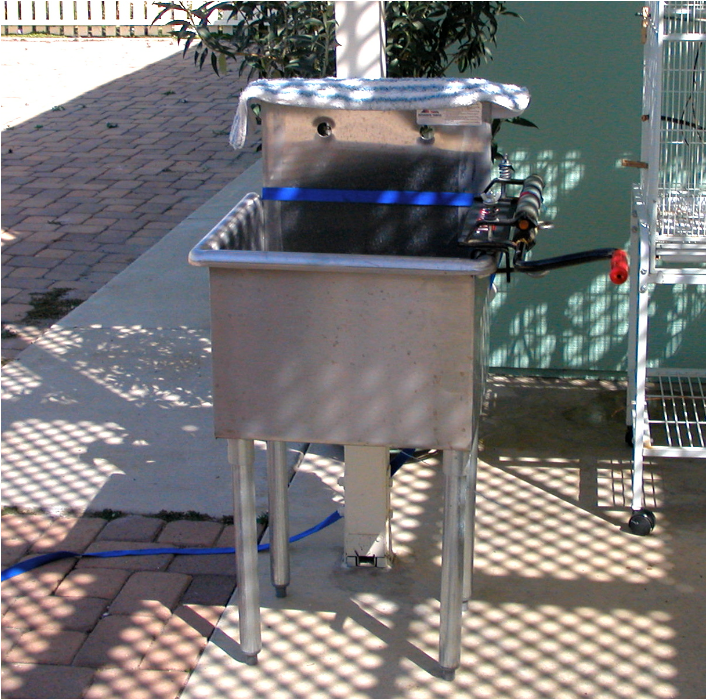
There are plenty of details to be worked out, of course.   Lehman’s, for example, sells a couple of different varieties of hand-wringing washers, but we aren’t willing to shell out the kind of money they charge.  We’ll probably be rigging up a chassis to hold a couple of old-fashioned wash tubs waist high or so, and buying a hand-cranked wringer, and devising some kind of agitating post to manually crunch and grind all the clothes in the hopper.

Of all our crazy schemes, this one actually sounds far crazier, but in some ways is more practical than others.  There will be some initial investment in equipment, and a fairly significant learning curve.  There will need to be some procedural adjustments to our daily routines.  But overall, there looks to be nothing but upside, at least for us.  The utility company will probably lose out in a big way.  Boo-hoo.

Happy farming!