Showing posts with label quinoa. Show all posts

1/21/11

Myrtle is Keen for Quinoa

We harvested our meager quinoa crop this week.  We say “meager” because we only had about fifteen plants total growing this winter, and we only got enough grain from them to justify saving as seed – we could have served one meal with what we threshed by hand, but we prefer to wait for next winter and a much bigger crop before we start consuming our own.

Still, we feel very encouraged by the results.  We planted one small packet of fifty seeds – without weatherizing the seeds first, which was a pretty substantial mistake, automatically reducing our yield by over fifty percent before anything had even sprouted – and yet we got enough seed out of that initially disappointing result to densely plant roughly an eighth of an acre of quinoa next fall.  We should get enough next winter to supply ourselves with enough of this wonder grain to last our family most of the year – particularly when coupled with our summer harvest of amaranth, which will serve us in roughly the same dietary capacity.

We were surprised after planting quinoa last fall to discover just exactly how popular it has become while we weren’t looking.  We didn’t mean to be trendy – it just sort of happened.  We knew we had hit something big when one of our favorite competitors on Bravo Network’s “Top Chef” (Carla, the vegetarian chef) cooked a stuffing dish with black quinoa which she referred to as “undone-te”, since it was woefully undercooked (manfully admitted, Carla!), and which the celebrity judge stated would make a good breakfast cereal, even if in its uncooked form it was an awful stuffing.

In fact, a quick search for quinoa recipes yields an almost limitless variety of possibilities for everything from aforementioned breakfast cereal, and Thanksgiving stuffing substitutes, to a substitute for rice, polenta or hummus, to soups, salads, breads, breading for meats, and gude kens what.

Preparing quinoa has become a more interesting process than we initially appreciated.  We probably harvested some of our crop a little too soon, since some of it was dry on the stalk, but other plants were still damp from recent rains.  It could hardly be expected that we would get it right our first time out, since this is the first grain crop we have ever planted, and it is not a native plant to Texas, and nobody we know has ever grown it before, so we didn’t really have anybody to ask about it.

Native Americans did frequently gather a similar plant, chenopodium berlandieri, otherwise known as lambsquarters, or pigweed.  However, even though this plant has a nearly 4,000 year culinary history, it is new to Myrtle.  We have had to reinvent the wheel, coming up with a means of drying the too-green seed heads we collected, and then threshing by hand to remove the actual seeds from the seed-heads, storing them in a paper bag with a steady breeze from a fan turned on low to dehydrate them, hopefully without destroying their ability to germinate next fall.


For those who wish to prepare quinoa without actually going through the trouble of growing it and harvesting it themselves, the steps are usually a little simpler.  Quinoa sold in bulk at your local grocer probably needs to be soaked before cooking, because the seeds are coated fairly heavily with saponins, which are the plant’s natural defense against predation by birds.  Saponins give foods a fairly intense bitter taste, so most commercially available quinoa in this country – that is, the kind you can buy in a box – has been presoaked to remove the saponins.

In South America, the removal of the mildly toxic glycoside saponin actually serves multiple purposes.  In addition to making the quinoa more palatable, the bitter quinoa residue makes an excellent detergent for clothing or handwashing, and also a good antiseptic for skin injuries.  The chemical content is similar to that of the root of the soapwart plant, historically used an alternative to lye-based soaps.

Once you have a quantity of well-rinsed and clean quinoa to cook with, you have almost limitless possibilities.  It would be difficult to imagine a more nutritious grain with which to form the basis for a meal; as one might expect from any whole-grain food source, quinoa is, of course, high in fiber, and is also a starchy energy source.  However, it is also high enough in protein to rival many legumes and even some meats; additionally, quinoa provides a host of B-vitamins, vitamin E, iron, calcium, magnesium, phosphorous and zinc.  A list of the phytochemical components of quinoa would take far more space than Myrtle is willing to devote, and more studies are being done every day.

All told, quinoa gets two thumbs up (or would, if chickens had thumbs).  Here is just a handful of some of the better recipes we have found for this wonder grain:

Quinoa, Shiitake Mushrooms and Adzuki Beans

Ingredients:
½ cup sliced carrots
3 thinly sliced scallions
¼ cup shiitake mushrooms sliced (can substitute slightly crushed oyster mushrooms)
2 cups cooked adzuki beans, drained
1 cup washed quinoa
1 tablespoon olive oil
2 cups chicken broth (vegetable broth works just fine for a vegan alternative)
salt, pepper

Directions:
1. Sauté vegetables until tender.
2. Add broth, beans and quinoa. Bring to a boil.
3. Reduce heat to low and simmer for about 20 minutes, until liquid evaporates.
4. Add salt and pepper and mix with a fork or wooden spoon.

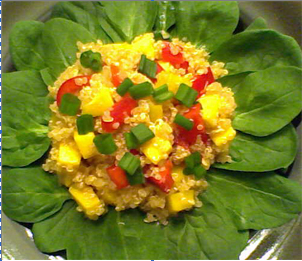
Quinoa Sunshine Salad with Asian Dressing

Ingredients:
Salad Ingredients
4 cups baby spinach
1 cup quinoa
1 cup red bell pepper, diced
1 cup yellow bell pepper, diced
1 cup mango, diced
½ cup green onion, chopped
Asian Dressing Ingredients
1/3 cup rice vinegar
¼ cup low-sodium soy sauce
1 tablespoon orange juice, freshly squeezed
2 teaspoons fresh garlic, minced
1 teaspoon fresh ginger, minced
1 teaspoon sesame oil
1 teaspoon sugar
¼ teaspoon orange zest

Directions:
1. Rinse quinoa thoroughly, place one cup quinoa in a sauce pan with two cups of cold water. Bring the mixture to a boil, cover and turn down the heat to a low simmer.
2. Let cook for about 15 minutes, or until all water is absorbed. Remove from heat. Fluff quinoa with a fork and set aside to cool.
3. In a small bowl combine all dressing ingredients and mix thoroughly.
4. In a large bowl combine quinoa, red bell pepper, yellow bell pepper and mango.
5. Pour dressing over salad and mix.
6. Let the salad sit for 15 minutes to allow the flavors to combine.
7. Serve salad on top of a bed of baby spinach and garnish with green onions.

Roasted Poblanos Stuffed with Cranberries, Pecans, and Quinoa

Ingredients:
8 poblano peppers
3 cups cooked quinoa
1/2 cup chopped pecans, toasted
1/2 cup dried cranberries
1/2 red onion, minced
1/2 cup cilantro, chopped
1 pound butternut or kabocha squash
2 Tablespoons maple syrup
1/4 cup nonfat sour cream
1-2 cups vegetable stock
1/2 teaspoon olive oil
Salt and freshly ground pepper

Directions:
1. Preheat boiler. Broil poblanos, turning once, until charred, about 10 minutes. Place them in a paper shopping bag or a bowl covered with plastic wrap to let them steam for about 10 minutes. Remove the charred skin when cool enough to handle. Slit lengthwise on one side, and remove the seeds.
2. Reduce the oven temperature to 400 degrees. Cut squash in half. Remove seeds. Brush the cut side with the olive oil. Roast it cut side down until tender, about 30 – 40 minutes.
3. Scoop the squash out of the skin. Puree in blender with maple syrup, sour cream, and vegetable stock. Add additional stock as necessary to reach a sauce-like consistency.
4. In a mixing bowl, combine quinoa, cranberries, pecans, onion, cilantro, and 1/2 cup of the sauce. Season to taste with salt and freshly ground pepper.
5. Stuff each pepper with a generous half cup of the mixture. Place in a baking dish, seam side down. Cover with aluminum foil and bake for 20 minutes.
6. Serve with the warm sauce.

Quinoa with Currants

Ingredients:
1/4 cup rinsed quinoa
1/8 tsp ground ginger
1/4 cup water
dash tumeric (optional)
Dash of salt
1/8 tsp pepper
1/3 red onion, finely diced
2 Tbs chopped fresh cilantro (or parsley)
1/8 tsp ground cumin
2 Tbs currants (or chopped raisins)
Dash ground cinnamon
1/4 tsp grated orange or lemon zest
Dash ground coriander

Directions:
1. Rinse quinoa with warm water and drain through a fine strainer.
2. Bring water and salt to a boil. Add the quinoa. Cover and reduce heat. Simmer for 10-15 min.
3. Meanwhile, heat a nonstick skillet. Add the onion, spices, and black pepper. Cook gently (low temp) until softened, about 5-10 minutes. Add a bit of water if needed to prevent burning.
4. Drain the quinoa when it's done and toss with the onion mixture along with the cilantro, currants, and orange or lemon zest. Serve hot or at room temperature.

11/28/10

Old Man... Winter? Sorta...

We told you last week about the changing needs of winter gardeners in our little corner of the world.  Since that time, we have eaten too much turkey, and had a borderline frost/freeze. 

It is an exceedingly bittersweet time of year when we finally have a drop in temperature sufficient to keep the tomatoes from ripening on the vine, and worse still, when we get a freeze deep enough (which is to say, any sort of freeze at all) to kill off many of our producing vines.

Some varieties of tomato are hardy enough to take our little snippet of cold air, of course.  We allow volunteers to go crazy in our garden, so we can't tell you for sure which varieties they are -- we just know they aren't the Brandywines you see here all nice and green.

Still, we had some vines make it through, including some volunteers in the potting soil we were using in our little black current experiment.  With a little bit of luck, we might actually manage to get a few more ripe tomatoes later this season.

We had mixed results with basil, as well -- for some reason, our sweet basil did better than many of our exotics -- the thai, for example, and the apple basil both froze to the ground.  Our purple curly-leafed basil plants had some leaves crimple, and others keep going strong.

Evidently, we were just exactly at the threshold temperature for winter mischief.

Still, we know what to do now.  First, we hoe down all the frozen plants (or, better still, get our daughter to do it!); next, we cover the bed with a fresh layer of leaves.

In mid-February, we will add a layer of compost from the chicken coop, and work it in with a pitchfork.  Then, in late February or early March, we will start seeding this bed with new plants.

Sometime next spring, after volunteer basil has started cropping up all over the yard, we will transfer a few of those plants to this bed, and any volunteer tomatoes which choose to join our newly seeded tomatoes will happily join forces to turn this plot into a wild tangle of solanaceous goodness.  We'll probably mulch it, as well, sometime next April or May or so.  And undoubtedly we'll put some sunflowers and nasturtiums on the borders as trap crops.

Much the same treatment will meet our other garden beds, in their own times, and with their own particular combinations of plants.

We could put more seed in the ground now, of course.  Our cabbage, spinach, kale and broccoli all acted as if this week's dip in temperature was manna from heaven, and kale and cabbage can both go into the ground all the way up to the end of December according to the planting calendar available at Producer's Co-op.

And next year at this time, we will be planting more quinoa seeds, as part of a rolling quinoa planting season.

But for now, we are getting ready for the First Annual Brazos Valley Pulletpalooza, and we really feel fairly satisfied with how the garden is growing.  In future years, we have plans to install rebar reinforced PVC hoops over the top of our tender veggies, and cover the contraption with greenhouse plastic prior to our first frost, so as to extend our season.  Today, though, we'll be enjoying the fruits of our present labors, and cleaning up Myrtle's place for next weekend's show-and-tell.

Happy farming!

11/23/10

Thanksgiving in Texas... Climate is Changing and So are We

Vernalization, stratification, weatherization, whatever you want to call it, the concept is one we hadn’t really bothered ourselves with much until this fall at Myrtle’s.

However, several events have conspired to make us pay even as much attention to climate as we do to weather.  This is a subtle distinction, but one which will become increasingly more important as as climate change takes fuller hold over the course of the next several decades.

The Brazos Valley is not quite in the wettest region of Texas, roughly defined as the greater Houston area eastward.  We joke in our family that if there is a 40% chance of rain, “Sure hope they enjoy it over in Huntsville.”  Houston gets over 50 inches of rain a year; College Station gets just under 30 inches a year, for now.  This makes us wetter than most of the state, even if not quite putting us in the rice-growing marshes of the eastern sliver of Texas.

We are likely to get less rain in coming years, though.  A wide variety of climate change models suggest that we will increasingly look less like a sub-tropical climate, and more and more like a semi-arid climate, with some suggesting that in as few as ten years, we may see our precipitation averages drop by 1/3rd.  That would mean that instead of getting around 30 inches per year, we will likely get roughly 20 inches per year.

Our normal precipitation pattern is changing, too.  Not only will rain be less abundant in the Brazos Valley, it will also come at different times.  Normally, we have a wet season in May and June, followed by a dry summer, with mild fall and winter months.  In future years, however, winter will be our wettest time of year; May and June will only see significant rain when we get moisture from tropical storms.

And then there will be fluctuations such as those caused by El Niño and La Niña.  This year is a strong La Niña year, so our fall and winter are proving to be excessively dry.  In fact, some models show that tropical moisture during El Niño years will be so prevalent that we may actually on average get more rain, even as soil moisture disappears during our rain-free months – we’ll be both wetter and drier, like some sort of crazy climatic performance art piece.

So what does this have to do with seeds, and planting, and Myrtle’s place?

As it turns out, quite a lot. 

We have spoken before of our strong preference for collecting rainwater; we have spent the last several months working on our collection system.  Roughly 80% of the rain running off our roof will now be collected – first, into two 50 gallon barrels, and next, after the barrels are full, into our fish pond.  These preparations are vital – the fact that our pond is currently sitting dry really stands as the only evidence you need that we just don’t get enough rain here to grow crops without supplemental watering.  We are now prepared to do supplemental watering without relying on the city’s untrustworthy water.

There are other elements of our little experiment in self-sufficiency which are also heavily affected by climate change.  Not only how we are watering, but what we are watering.  Traditionally, the Brazos Valley has two basic growing seasons, spring and fall.  There are winter gardens with greens, but typically very few local gardeners even bother with these tender plants – usually broccoli, kale, spinach and maybe radishes or potatoes, but very little else.  No, for the most part, gardens in Bryan/College Station run from March through June, and August/September through November.

However, while the July/August heat will continue to make that the one time of year when nothing gets planted, and what little is still growing must be tended very carefully to keep it alive, the rest of the year is changing ever so slightly to make our climate a year-round growing season.  The traditional spring and fall veggies won’t change – corn, squash, cucumbers, beans, tomatoes, peppers – these are timeless and are likely to be grown here as long as there are people with garden hoes to grow them.

But there is now more than ever a need to diversify, and our changing climate has provided not only a greater need, but also a greater opportunity.  We have spoken before of our desire to branch out into grains.  We started our experiment in grains this fall, with a small planting of quinoa.  While our planting was somewhat small (only about fifty seeds total), our crop will prove even smaller, as only a handful of the seeds actually germinated.

Concerned that perhaps we overestimated the ability of this crop from the colder climates and higher elveations of the Andes mountains to thrive in the still-subtropical Brazos Valley, we did a little research.  What we discovered made us slap our heads in self-accusation, yet also gave us tremendous hope.

As it turns out, in Colorado, several farmers have been experimenting with quinoa for years.  This makes a lot of sense, as they are farming in a mountainous region with much more in common climatologically to the Andes than our own garden can boast.  The planting season in Colorado starts in late May, when the ground has warmed enough, with a harvest in September and October, just before the freezing precipitation begins.

The limiting factor which has prevented quinoa from becoming a major cash crop for this region is the fact that sometimes the summer heat is too much.  When the temperature is in the 80s or 90s for an extended period of time, the quinoa doesn’t go to seed – the heat stress doesn’t always kill the plant, but for all practical purposes, at that point it is not a grain crop any more, it is a greens crop, and in a nation of carnivores, that really isn’t a great sales pitch.

However, several elements of this story stand out to us as hopeful – first, we need a stronger period of vernalization.  We planted our quinoa in late september, when ambient temperatures were still in the mid 80s in the Brazos Valley, and goodness only knows how hot the ground still was.  Next fall, we will wait until early October, and we will have had our seeds in the refrigerator for a week before we put them in the ground.

Second, we are hopeful that our growing season for quinoa may be, in most years, a full six months long – from October to March, there is a risk of temperatures above 90 degrees, but in most years, it will not happen.  Thus, we can stagger planting from October through December, and guarantee ourselves that in most years, we will get grain from our quinoa.  There is also a slight risk of killing frost early in the season, but not much.  Once it gets to flowering – typically somewhere between 45-60 days – quinoa will survive temperatures into the low 20s, which are already extremely rare in the Brazos Valley, and are becoming even more rare as each year passes.

This means that we will be able to rotate several of our newfound favorite crops from a variety of places of origin in such way that we will always – spring, summer, autumn, winter – have a green, a legume, or a grain, and in many cases a combination of the three, growing in one patch or another.  Amaranth will sometimes have delayed germination if the ground has not sufficiently warmed, but even so, a staggered planting from March through May will overlap nicely with the staggered quinoa plantings.  Interspersing velvet beans, cow peas, and maize in these plots will give us a colorful and tasty year round edible landscape.

The coming era of permanent drought in the greater part of the State of Texas will cause hardship for many, and will lead to social and economic unheaval unprecedented in this part of the country, but it needn’t be the end of the story for us.  The time to adapt is upon us.  Ironically, as winter warms up, it is the time of year we need to start leaning on.  We have some heretofore unavailable opportunities coming our way.  Quinoa is just the tip of the iceberg.

When approached calmly and rationally, the problems presented by climate change on a microeconomic level do not represent any particularly terrifying difficulties – finding climates which currently have limits roughly approximating those projected to be likely in the future gives a pretty good indicator of what needs to be done. 

In future years, the Brazos Valley will get roughly the same amount of rain as is experienced in a good portion of southwest Texas today, on a line from roughly Kerrville to Uvalde.  This is excellent territory in which to raise crops only slightly different from what we currently grow. 

Rio Grande peaches have low chilling requirements and thrive with hot and dry summers.  Pomegranates produce exceptionally sweet fruit under these circumstances.  Blackberries and plums also excel in this semi-arid climate.  One particular species of wild black cherry does exceptionally well in this region, even thriving southward into the arid reaches of northern Mexico.  The most prolific olive orchard in Texas sits in the middle of this region.  Corn and okra are ubiquitous here; imported grains like amaranth and millet could (and if we have anything to say about it, will) grow like weeds in our new climate.  And in our mild, wet winters, we will be growing short-day cool weather vegetables that elsewhere only grow at altitude on the shaded slopes of mountainsides in summer.

If the world is going to evolve as a result of humanity’s collective bad behavior, it is only right that our behavior and culture, including agriculture, should evolve right back.  This means things like making the kinds of good friends who will help you replace a burned out stove at a moments notice (thank you Browns!) to collecting all the rainwater that falls on your little tin roof, to planting crops you've never heard of before if that's all that will grow in your new climate.  This ain’t your grandaddy’s farm.  With a little forethought, though, and a for us, a newfound attention to winter gardening, it could belong to our grandchildren.  As long as we can still work a garden hoe, we can adapt... for which we give thanks.

Happy farming!
Enhanced by Zemanta

8/17/10

Pigheaded for Pigweed

One of the limiting factors in turning an urban homestead into a completely self-sufficient ecological niche is the fact that most grain crops require an inordinate amount of space.  In fact, this is part of why organic cereal crops are so rare – the investment of time and space involved in raising grain crops is substantial, and most farmers who are interested in organics are also interested in saving money.  They therefore opt for less spatially intensive products, like fruits and vegetables, or eggs, or dairy.

So, those of us trying to scratch out an edible living on a half-acre in the city are left holding the empty cereal bag.

Which is why we are curious about a new possibility.  Our research on world foods has led us to an admiration of the staple of the Inca diet, a little pseudocereal called quinoa.  Foodies have long been familiar with quinoa, but it is not part of the general public’s culinary vernacular, and with good reason.  Although this is almost the perfect grain – the approximation of complete proteins in quinoa is closer than in any other starchy crop besides the potato – it is also very clearly a specialty crop.

The outer covering of the quinoa grain is heavily laced with saponins, which give it an exceedingly bitter flavor.  This is bad news for anyone who wants to eat it raw, of course, but good news for farmers who have to worry about avian intrusions.  Birds do not poach a quinoa harvest the way they do with corn or even wheat.

“But Myrtle,” you may be asking, “why would we want to eat something at which the birds turn up their prim little noses?”

Good question.  The answer?  You don’t have to eat quinoa with the saponins still attached, silly goose.  You soak it before cooking it.  Most boxed quinoa you might find at your local grocery store will come pre-soaked to remove the saponin content for you.  Those of us who are used to soaking our pinto or black beans prior to cooking will not find this extra step all that tedious.

So, well and good, we have established that there is this grain which is bird-proof and high in protein.  How do you grow it, and what do you use it for?

These are excellent questions, and unfortunately, this is where our research takes a bit of a left turn off the expected path.  Being a native of the Andes mountain range, as you might expect, Quinoa prefers weather a tad more temperate than what we experience on the Texas coastal plain.  There are some successful quinoa producers in Colorado and New Mexico, but we fear if we were to try the plant in any serious sort of way, we would have to limit ourselves to fall and winter production, and even then, the growing season might not be long enough before the return of hot weather, sometimes as early as late March, never later than mid-May.  Quinoa takes a while to reach maturity, and we just don’t have the pleasant cool weather you find in Peru or Ecuador.

However, never being prone to dispair for long, we continued to dig after hearing these discouraging words, and we found that there is a relative of quinoa called “pigweed” which was cultivated in North America until as recently as the middle of the 18th century.  In fact, in Mexico, it is still being raised as a cash-crop.

Known variously as “pigweed”, “pitseed”, “goosefoot”, “huauzontle”, or “lambsquarters”, Chenopodium berlandieri is an annual herbaceous plant widely regarded as a weed.  However, several varieties are grown for food, utilizing different characteristics of the plant, which has many characteristics of the better known Chenopodium album or, of course, its relative with which the conversation got started, Chenopodium quinoa.  Varieties of pigweed are grown for the broccoli-like seed heads; other varieties are grown for grain; still others are grown because the leaves of the plant are much like spinach.

Quinoa is almost exclusively grown at altitude, although we suspect it might thrive at lower elevations provided the other climate requirements were met.  However, we are more likely to experiment with the other Chenopodiae simply because we suspect we will have more success with them.

While scrounging for information about what grain crops we might reasonably expect to be able to grow at our altitude and in our hardiness zone, we stumbled upon another pseudocereal which, like quinoa and pigweed, is far more nutritious and versatile than the more popular wheat and corn alternatives.  Amaranth is, like the Chenopodiae, considered a weed by most American farmers.  However, in most of the rest of the world, and more particularly, in those parts of the world where drought in spite of high humidity is a very real concern, Amaranthacea Celosia is considered a wonder crop.  The leaves and flowers are edible, tasting much like spinach, and the seed is another lysine-rich close-to-complete protein food.  And in some quarters, amaranth, like lambsquarters, is called "pigweed" because it only grows where the pigs forage!

Amaranth seeds were popular with Native Americans from the plains states; in Mexico, you can still see a candy made with amaranth grain called alegría at festivals in some communities; in India, amaranth is called rajgira and is served popped and mixed with jaggery (a south Asian sugar) to form a dish called laddus, which is a staple in school cafeterias throughout the subcontinent.  And in sub-Saharan Africa, farmers are viewing amaranth as manna from heaven, because many of their traditional crops are failing with increased climate change induced variability in the local weather patterns; amaranth thrives in conditions other grain crops abhor, which goes a long way to explaining how several varieties have taken hold in the U.S. as pernicious weeds, resistant to many herbicides.

And like another crop we have come to appreciate more each year, the sunflower, amaranth plants are just plain attractive.  The bright red varieties in particular have the potential to transform even a small garden plot into a vibrant, velvety canvass.  One of the chief complaints about vegetable gardens is that they lack the aesthetic sensibilities of herbs or flowers; this does not have to be true.  The inclusion of trap crops like sunflowers and nasturtiums was our introduction to this fact; now, we learn that the floral attractions can themselves be on the menu, and we are overjoyed with the discovery.

This will be part of next year’s veggie garden revamp – in the Spring, we will plant amaranth, and in the Fall, we will plant lambsquarters.  And if we can get a good grain crop out of that mix, then we’ll see what kind of homegrown breads we can turn out; Mrs. Myrtle Maintenance -- we don’t mean to brag but can’t help ourselves -- is perhaps the best baker we know.  Her challenge will be to turn out good product with nothing but what comes from our yard.  If we were tending ten acres instead of a half of one, it would be no challenge.  But, as the inimitable (if fictional) Jimmy Duggan says, “It’s the ‘hard’ that makes it great!”

Happy farming!