"Fortunately for those doing the laundry, during the 1930s people didn't have as many changes of clothing as they do now. The boys had one pair of 'good' overalls or 'Levis' which they wore to school every day. When washday came, usually on Saturday, they put on the 'old' pair used for work and chores while the new ones were washed. Nor did they wear a different shirt every day...And you used fewer changes of underwear when you bathed only on Saturday night.
Although the girls undoubtedly had more variety, and may have changed oftener, still they had limited wardrobes. As the thirties began, chances are that most of their dresses were home-sewn. They usually had a new dress for Christmas...and perhaps for their birthday. The point is that nobody required the large volume of clothes that each person feeds to the washer [today]. If that were not so, no one could have stayed even with the laundry.”
Miriam B. Murphy, History Blazer May 1996

There are any number of reasons why laundry is an important consideration when it comes to conservation. First and foremost, it can get expensive. Depending on where you live, the water alone can get pricey; the electricity involved, however, is a whole other order of magnitude costly.
We discovered with pleasure that we can do without an electric dryer; line drying our clothes has proven to be far more efficient than we originally feared when we started doing it six months ago. Necessity, we admit, drove us: our dryer broke down just when we had no money with which to replace it.
So, we began hanging our wet laundry on the grape trellis just outside our back door. The grapes, being only a year old, had not yet reached the top of the trellis, so we had all this empty space not being used; laundry seemed like a perfect fit.
Unlike Ms. Murphy’s 1930’s Utah pioneers, however, our family has considerably more in the way of daily changes of clothes. This means that laundry has become a daily routine, involving plenty of heavy lifting on the part of Mrs. Myrtle Maintenance, though not excluding a lot of input on the part of everyone else in the family, folding and putting things in their respective closets, drawers, etc.
Still, with a little organization and teamwork, we have discovered that we can make this process run like clockwork, and, more to the point, we have cut into our electric bill to the tune of double-digit percentages.
Mrs. Myrtle Maintenance announced recently, as a consequence of this success, that she believes our enterprise ought to consider eliminating the washing machine in similar fashion, so that we may recoup even more energy savings by eliminating that expense as well.

Not so this time.
There are, it turns out, only a handful of brave souls who hand-agitate their laundry and then run it through a wringer prior to hanging it on a line to dry.
There are several reasons why this obviously much greener alternative is viewed less favorably than motorized washing machines by all but the hardiest of green-adventurers:
- Handling wet laundry can be cumbersome. Wet laundry weighs considerably more than does dry laundry; even when it has been run through a washing machine, and wrung out through the spin cycle, anyone who has ever simply moved laundry from the washing machine to the dryer can attest to the fact that any water at all causes cloth to become much, much heavier.
- Trust in cleanliness is lacking. The same paranoia (fed by companies selling us power, water, washing machines, detergents, and speciality fabric treatments) which causes us irrationally to use hot water when cleaning laundry also causes us to distrust the ability of our own hands to get cloth clean. People view the washing machine as a sort of ‘magic box’ where dirty things go in, and clean things come out.
- Wringing out wet laundry takes skill. If you’ve ever toured an old mansion, if the scullery is properly equipped you will see an old wringer sitting against one wall – it is a specialty piece of equipment, and running through a load of laundry is not something any old fool can do; it takes a fool who has practiced many times, and gotten stuck on many buttons, hooks, lapels, etc. before acquiring the talent of running things through quickly and efficiently.
- Architecture is against the old ways – modern laundry rooms and bathrooms are simply not designed with anything in mind other than the modern washer and dryer arrangement.
We hate inertia.
We already had a pretty long list of things to do this year, not the least of which is our intention to finally get some bee hives, as well as to start making blackberry port this summer, not to mention growing our own grain… well, you get the idea. Our “to do” list is no small affair.
Still, we have just about decided ourselves on a new course altogether when it comes to laundry. And we think we have the answers to each objection:
- Handling wet laundry can be cumbersome, but less so if you handle less of it at a time. This means wearing the same pair of pants more often. We may still need to do a lot more unmentionables than did the rural folk of the 1930’s, but unmentionables don’t actually weigh all that much. And our day jobs (software support for money, childcare and homemaking for moral value) are not really all that dirty – we are fairly sure we can tolerate getting an extra day or two out of our daily wear.
- Trust in cleanliness is not a problem for us. Myrtle Maintenance personell have plenty of elbow grease we are willing to apply as solvent. And if there’s a stain we can’t get out, well, we’ll just shred the garment and add it to the attic as insulation. As for whether this process really works or not, hey, think about all those period-piece romances you’ve ever watched like a vicarious lord or lady of the era… all those frilly laces and frocks spent some time in the basement being scourged by a scullery maid prior to being worn by the high and mighty.
- Wringing out wet laundry takes skill; we like learning new skills. The list of things we’ve never done before is getting shorter all the time.
- Architecture is against the old ways, but we’ve proven ourselves willing to knock down walls no one else would have knocked down plenty of times before. Heck, we may be able to work around the city’s graywater reuse rules without even having to get a permit – research will be required, of course, but the point is, just because no one else does it has nothing to do with whether or not we will do it.
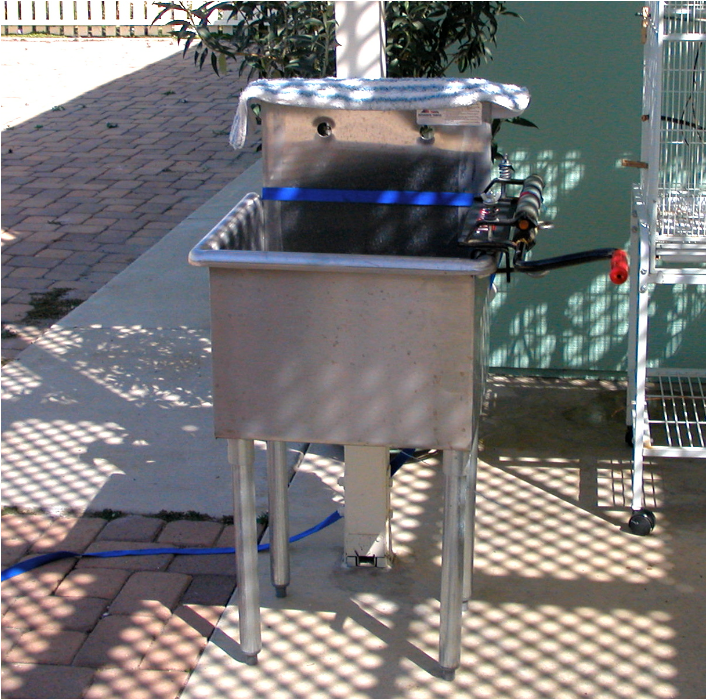
Of all our crazy schemes, this one actually sounds far crazier, but in some ways is more practical than others. There will be some initial investment in equipment, and a fairly significant learning curve. There will need to be some procedural adjustments to our daily routines. But overall, there looks to be nothing but upside, at least for us. The utility company will probably lose out in a big way. Boo-hoo.
Happy farming!


 Posts
Posts


