Showing posts with label harvest. Show all posts

9/28/14

Almost Time for Ghoulies, Ghosties, Gremlins and... Gardeners?

“The basis of optimism is sheer terror.”--Oscar Wilde, ‘The Picture of Dorian Gray’
Scholars from a variety of fields including anthropology, theology, linguistics, history and literature will debate practically anything, including whether or not Halloween is merely a Christianized version of Samhain, or if it evolved independently.

As is the case in many such scholarly disagreements, they’re all being silly – the important thing about Halloween is that it is fun.  We don’t mean to demean anyone’s deeply held convictions, of course, but if your deeply held convictions lead to a drab, dreary, colorless, somber life of drudgery… well, maybe you ought to consider shopping for a new set of beliefs, beliefs which include the idea that being human should be enjoyable, not miserable.  There’s enough troubles that happen to us without bringing unhappiness on ourselves.

Which makes Halloween a perfect holiday, when you think about it – ghosts and ghouls and creepy-crawlies represent all the horrors of our imagination… and Halloween places all of those creepy-crawlies in an ironic and humorous context.  We cringe and cower in fear on a typical Monday morning when our bosses, or supervisors, or teachers (or students), or customers, or suppliers, or whomever, load us down with a laundry list of complaints and problems with which we are ill equipped to cope.  However, if we have a freaky automated rubber hand reach up at us out of a candy dish, our hearts pound with fear… but we laugh.

We laugh because we know the fear is not real, and that knowledge equips us to rise above our fears of those things which are real – it gives us the hope and courage necessary to face harsh realities, whether they be in the form of the coming of winter and desolation (oh so important to farmers for as long as there have been farmers, and even more important to hunter-gatherers before that), or more modern fears, whether of problems at work, school or in our personal lives.

Not all of the traditions associated with Halloween speak to this psychological reality, of course; some are simply festive.  Candy corn, caramel apples, bonfires, costumes of all sorts (frightening and – more and more frequently – not so frightening), silly songs, silly movies, and silly decorations form the centerpiece of what is really just one extended party marking the end of summer, and the beginning of something else.

Samhain was the Celtic New Year for a reason; harvest marked the dying of the old year, when the plants have given their bounty and are returning to the dust from whence they came.  There are equivalent harvest festivals in most of the world, and even in places where religious fanaticism drowns out the individual freedom to get freaky on Halloween, something takes its place.

The Puritans, for example, strongly discouraged recognition of All Hallow’s Eve (the evening before All Saint’s Day) – not because of any sort of direct satanic influence, as is frequently the case among extremist fundamentalist Christians in our own era, but because the holiday was seen as essentially Catholic.  (Though, to be fair, they considered Catholics little better than Satanists, but why quibble?  One flavor of crazy intolerance is as good as another.)

In spite of their innate problems with All Hallow’s Eve (and associated harvest festival traditions, Celtic or otherwise)… the Puritans brought us Thanksgiving, which is nothing more than a dressed-down Protestant version of Halloween.  Simple clothes and formal dining (or at least as formal as working-class families get) take the place of free-wheeling frivolity… but the basic message is the same:  the time has come to give thanks for the bounty we have received, that we may be prepared for what follows.

There is plenty of room for both ways of celebrating the harvest; most people never even stop to consider the subtle tension between the perspectives offered by these two intimately related holidays – the vast majority of Americans celebrate both Halloween and Thanksgiving without giving it a second thought.

Halloween is not a uniquely American holiday, of course, but what Americans have done with the day says a lot about why it is important to us.  Historian Nicholas Rogers writes that “some folklorists have detected its origins in the Roman feast of Pomona, the goddess of fruits and seeds, or in the festival of the dead called Parentalia,” but that “it is more typically linked to the Celtic festival of Samhain,” which comes from the Old Irish words meaning “summer’s end”.

The mish-mash of traditions in modern American Halloween festivities have stripped virtually all of the religious overtones of the holiday and replaced them with purely secular meanings and traditions – even where religious or mystical festivals such as Día de los Muertos are celebrated alongside Halloween, they are clearly seen as two separate entities.  You celebrate the one the night of October 31st, and the next day you move on to the festival honoring the dead.  Where there is overlap, it feels very much like a meeting of friends from different backgrounds at Yule, some of whom are celebrating Chanukah, others are celebrating Christmas, Kwanzaa, or some other festival.  (Except maybe Festivus, because those people don’t get along with anybody.  But we digress.)

Much of the mish-mash of American Halloween is to be expected, based simply on the idea that the American melting pot is itself a mish-mash; we are the mongrels of the world, a mix of ethnicities, races, religions, cultures, languages and traditions so diverse we often lose track even within our own families within a generation or two of just exactly who we are.  It makes perfect sense, then, that what we do will not have the same degree of continuity you would find in places in the world where families have been in residence for hundreds or even thousands of years.

But the strongest influences on the holiday also tend to make it a particularly prone set of traditions to have evolved over time.  The Celtic celebration of Halloween is not altogether easy to enumerate – yes, we know that “Samhain” was the fall harvest/New Year celebration… but exactly what early Celts did during this time is a matter of conjecture.  Many of the traditions passed down as “pagan” actually originated during the long and influential era of Celtic Christianity, and how to draw distinctions between which Irish traditions date from the first millennium C.E., and which came from before then is an almost completely pointless exercise, both intellectually, and philosophically.

Is your Jack O’Lantern carved from a turnip really more authentic than one carved in a Boston Squash or some other kind of pumpkin?  And even if it were, would it be any more fun?  Probably not.  Probably, you’d get to display your “authentic” Jack O’Lantern at the kind of party where no one else was much fun to be around, either.  (But hey, that’s just us.  We like candy corn, so what do we know?)

And ultimately, that is the American contribution – while many bemoan the crass commercialism of Halloween (and make no mistake, there is clearly a lot of that on display), this is missing the point.  Commercialism is the manifestation of a vibrant truth, one which is not so negative:  If life is a game, then whoever throws the best parties wins.  We prefer the kinds of parties where everything is homemade… but make no mistake, the reason Halloween sells is because whoever makes “the stuff,” it is stuff people want.  And even if life isn’t “a game,” learned optimists know that you frequently only get where you’re trying to go if you treat it like a game.

This is the optimistic American contribution to All Hallow’s Eve – some are frightened by the idea, because it smacks of the kind of licentiousness which at its worst brings us things like Detroit’s “Devil’s Night” – but that is just one extreme.  At the other end of the spectrum, this spirit of freedom (best represented by the tradition of wearing costumes, and freeing our identities from our workaday selves, which, after all, are just another disguise we wear, albeit on a regular basis) helps us escape the fears and troubles which all too easily overwhelm us.

We have nothing against other harvest festivals:  Jewish Sukkot, Turkmen Hasyl toýy, Persian Mehregan, Russian Dozhynki, Yoruban Ikore, and Korean Chuseok all have unique stories to tell, and each contribute in their way to the succor of the human spirit.  Some are more closely tied to the simple life which we advocate on a regular basis, and there is much to be said for celebrating traditions in a more agrarian manner, as a means to encourage people to return to the land… but in America, Halloween is what it is because people have become what they are.  As such, we approve.  Strongly.

We’re a little over a month away, but the supply of pumpkins and other strangely shaped winter squash and gourds has started making its way to the vegetable stands around town.  It’s almost time to break out the black and orange, string up some “ghosts” in the trees in the front yard, and hang “Witchy-Poo” on our front door.  Because, you know…. fun!

Happy farming!

10/26/11

Time, as it relates to everything Myrtlish...


"In fact, entropy can grow both into the far future and into the far past; the overall multiverse can be completely symmetric with respect to time. Think of two particles moving on straight lines in an otherwise empty three-dimensional space. No matter how we choose the lines, there will always be some point of closest approach, while the distance between the particles will grow without bound sufficiently far in the future and the past."
--Sean M. Carroll
The certainty displayed by advocates of religion and of politics have always been the starting point for a marriage of those two unhappy disciplines.  Most of the the world’s worst social experiments, and all of the world’s pestilential wars, have been brought about by people who just “knew” things that were so self-evident and “common sense” that anyone who questioned them was somehow deranged – never mind that such “common sense” assumptions are all too often utter poppycock.  How could it be otherwise when two opposing camps each describe their mutually exclusive ideas to be “common sense”?

Science, when done right, avoids this trap by insisting that no question is truly settled – even our most basic assumptions, that 1 + 1 = 2, that up is up and down is down, that day follows night and vice-versa, are falsifiable, and if and when evidence is presented which disproves our most basic of premises, we must change premises.

Time itself is a wonderful example.  California Institute of Technology physicist Sean Carroll argued in a whimsical essay entitled “What if Time Actually Exists?” that the notion that the universe has a beginning (and, specifically, time as an aspect of the universe has a starting point) is a product of our limited imagination.

For physicists, a “starting line” is a natural assumption based on what little we know with any certainty about how time seems to function.  Basically, we only know that time goes from past-to-present-to-future because the one measurable element we can observe is entropy – systems “move through time” by transitioning from a state of lower entropy to a state of higher entropy.

Think of a game of pool – the first player breaks the racked billiard balls, and from a state of having one ball at one end of the table and a bunch of balls in a tight triangle at the other end of the table (a state of low entropy), moving from past-to-present-to-future the game quickly proceeds to a state where all the balls are randomly scattered about the table (assuming the break is a good one, of course), placing the system in a state of higher entropy.

But this explanation is no explanation at all, because the physicists who advocate it have set up a circle of meaning – “entropy” only means something based on the idea that it relates to distribution of matter and energy through space and… wait for it… time.

Carroll’s solution to this problem is way over the head of most lay persons, and, frankly, is over the head of most physicists, too.  It does, however, lend itself on a very practical level to logical minimalists.  Carroll’s solution is to describe the universe as infinite.  Space and time, we know thanks to Einstein, are two different ways of looking at the same entity (“SpaceTime”) much as electricity and magnetism are the same energy described from different mathematical points of view.  An infinite universe, therefore, has space going on forever in all directions… and time going on forever in all directions, too.

If there was a state of minimum entropy at some point (the mythical “start of time”), then logically, before that point, there was a state of even less entropy than the state of minimum entropy.

How does that work?  Myrtle hasn’t got the foggiest.  She’s just a chicken, after all.  “Negative Entropy” would be a cool band name, though.  If we had to guess, they would probably end every show with the “One Note Samba”.  (Free eggplant to anyone who both gets that joke and thinks it’s funny…)

Moreover, this notion of eternal time lends some new piquancy to the question of “Which came first, the chicken or the egg?”  In the context of cyclical endeavors such as backyard chicken raising, or gardening, or just getting through life, the most important step is always some combination of “the one you just did” and “the next one you have to do” – very seldom allowing you to concentrate entirely on what you might be doing at present.  The cycle may or may not have started at some point, but once you are in it, it hardly matters – the last thing you did leads to the next thing you must do, which leads to other tasks that seem to roll on forever, repeating themselves just the same way the seasons repeat.

In Myrtle’s case, the autumn harvest of velvet beans, pumpkins, honeydew melon, squash, jalapeños, fall tomatoes, etc., is also the time of planting winter vegetables.  Garlic, broccoli, fava beans, kohlrabi, carrots, spinach, quinoa – all go in the ground right around the time we traditionally think of as “harvest time”.

Samhain, the Celtic New Year celebration we have morphed into Halloween, marked the death of the old year and the birth of the new for the residents of cold, foggy reaches of ancient Europe.  They may not have grown as much in the winter time as we do here in Brazos County, but they had their own winter tasks which had to be performed if they had any hope of a successful garden the next Spring.  Garden beds need attention even (perhaps especially) when nothing is growing in them.  Weeding, mulching, turning in of compost – these are things best done well in advance of the season in which one wishes to grow tasty veggies.

The chickens, too, will soon be requiring some special attention.  We raise Barred Rocks for a variety of reasons, not the least of which is that as a heavier breed, they are more winter-hardy than many of the lighter Bantams which have become popular in Texas backyards.  “More” however does not mean “completely”.  We will be adding new leaves as insulation, and preparing to enclose their coop with wind barriers, and should the need arise, we will have to put a heater in the coop – the girls don’t complain much about getting down into the 30°ish range, but 5-10° cooler than that (which happens once or twice a year), and we pretty much have chicken-cicles instead of egg layers, so that’s when the heater comes out.

And while we will be planting plenty of vegetables which thrive in what passes for “cold” in our part of the world – broccoli, onions, garlic, etc. – we will still have to tend to our perennials with some loving attention.  We will be mulching the fruit trees and berry vines, in addition to adding a new layer of leaf-mulch to our perennial herbs.  It is also prime time for cilantro/coriander in Texas, so we will have to work a few patches of less-deeply mulched soil in the herb beds, where this 2-3 month project can thrive at peak efficiency.  A winter garden is really a jigsaw puzzle of odd tasks like this – and in the context of a year round garden, that makes sense, because “the rules” only apply to a small portion of what we are attempting at any one point.

How far back in time the concept of a year round garden goes, is anybody’s guess.  Whether you are asking for the sake of asking, in the spirit of a good scientist, or whether you are asking because you want to know what to plant right now, in the spirit of an eternally optimistic gardener, you really ought to take a break, have a pumpkin pasty, and maybe a swig of some good hard apple cider.  Happy Halloween!  And…

Happy farming!

6/19/11

Thanksgiving in June

We get all kinds of visitors at Myrtle's place, from the curious-but-not-on-board, to the gung-ho and ready-to-roll.  Recently, one of the latter came to see our little project, and she brought her charming father, who brought a wealth of experiences which would interest the most casual of observers.  He graduated from Texas A&M in the early 1940's, and spent three years in World War II fighting in the Far East.  The daughter wanted to talk plants; Mrs. Myrtle Maintenance, however, upon discovering that the father grew up on a farm in West Texas during the Great Depression, would not allow him to speak of anything else; we feared a lack of hospitality on our own part, but more, we feared not getting to hear his fascinating stories.

Among other things, our esteemed visitor discussed all the food his family produced which they could not eat, since they collected eggs and cream for the purpose of trading -- rather than selling -- said produce in exchange for things they couldn't grow themselves.  He smiled when we talked of our own grandparents' fondness for peaches and cream -- getting to keep the cream, after all, would have been a remarkable treat, only reserved for special occasions.  We were, needless to say, all attention.  We were also thankful.  "The Greatest Generation" set an example which our society has lamentably forgotten, of sacrifice, of work-ethic, and of long-term thinking.

These were the thoughts foremost in our minds as we set about our other task for the day, harvesting the grain from our amaranth.  Harvesting amaranth is really unlike any other harvest we have made to date.  It involves three discrete steps:
  • Separate the seed heads from the stalk
  • Dry the seed heads
  • Remove the seeds from the husks
Step one is fairly self-evident; the stalks of our grain amaranth plants were as much as an inch-and-a-half thick, so a good pair of hand clippers was necessary.

To dry the seed heads, we hung them on the grape arbor in our driveway, the grapes being currently six months old, and therefore not having yet climbed the trellis.  We don't know where we'll dry next summer's crop, but then, that is a problem for next summer, not now.

Removing the seeds from the husks will, we imagine, be much the same as it was for our quinoa crop last winter -- we shall have to make a party of it in the kitchen, everyone rolling the dry husks between our hands and collecting the grain as it falls into a bowl.  Fun for the whole family, we expect.

We gave the stalks to the chickens, the leaves now being too bitter for use as potherbs (although we imagine we might not have thought so in 1933!), and much as with our corn harvest, the stalks will also give the birds a much-needed break from the western sun... at least, it will do so until they eat their own sunscreen, bless their little bird-brains.

We then turned the remaining stubble in the garden plot back into the soil with a vigorous hoeing.  After adding a bit of chicken-poop compost, we planted our Halloween pumpkins and a variety of winter squash where our amaranth had been.  The calendar pushes relentlessly forward, even for those who take the time to look however fleetingly backward.

Meanwhile, most folk rightly associate harvest with autumn festivals, most notably the American holiday known as "Thanksgiving".  For a year-round garden, though, harvest happens on a fairly regular basis.  What a shame, then, that "Thanksgiving" only happens once a year, particularly when we have so much to be thankful for.  The hunger felt by the vast majority of Americans in the 1930s is unparalleled in contemporary society, and where it does occur, it fills us with outrage.  It was simply another day, though, for so many who struggled and suffered through it at the time.

We don't often get visitors who remind us of such things, but when we do, we remember them.

Happy Thanksgiving!

1/21/11

Myrtle is Keen for Quinoa

We harvested our meager quinoa crop this week.  We say “meager” because we only had about fifteen plants total growing this winter, and we only got enough grain from them to justify saving as seed – we could have served one meal with what we threshed by hand, but we prefer to wait for next winter and a much bigger crop before we start consuming our own.

Still, we feel very encouraged by the results.  We planted one small packet of fifty seeds – without weatherizing the seeds first, which was a pretty substantial mistake, automatically reducing our yield by over fifty percent before anything had even sprouted – and yet we got enough seed out of that initially disappointing result to densely plant roughly an eighth of an acre of quinoa next fall.  We should get enough next winter to supply ourselves with enough of this wonder grain to last our family most of the year – particularly when coupled with our summer harvest of amaranth, which will serve us in roughly the same dietary capacity.

We were surprised after planting quinoa last fall to discover just exactly how popular it has become while we weren’t looking.  We didn’t mean to be trendy – it just sort of happened.  We knew we had hit something big when one of our favorite competitors on Bravo Network’s “Top Chef” (Carla, the vegetarian chef) cooked a stuffing dish with black quinoa which she referred to as “undone-te”, since it was woefully undercooked (manfully admitted, Carla!), and which the celebrity judge stated would make a good breakfast cereal, even if in its uncooked form it was an awful stuffing.

In fact, a quick search for quinoa recipes yields an almost limitless variety of possibilities for everything from aforementioned breakfast cereal, and Thanksgiving stuffing substitutes, to a substitute for rice, polenta or hummus, to soups, salads, breads, breading for meats, and gude kens what.

Preparing quinoa has become a more interesting process than we initially appreciated.  We probably harvested some of our crop a little too soon, since some of it was dry on the stalk, but other plants were still damp from recent rains.  It could hardly be expected that we would get it right our first time out, since this is the first grain crop we have ever planted, and it is not a native plant to Texas, and nobody we know has ever grown it before, so we didn’t really have anybody to ask about it.

Native Americans did frequently gather a similar plant, chenopodium berlandieri, otherwise known as lambsquarters, or pigweed.  However, even though this plant has a nearly 4,000 year culinary history, it is new to Myrtle.  We have had to reinvent the wheel, coming up with a means of drying the too-green seed heads we collected, and then threshing by hand to remove the actual seeds from the seed-heads, storing them in a paper bag with a steady breeze from a fan turned on low to dehydrate them, hopefully without destroying their ability to germinate next fall.


For those who wish to prepare quinoa without actually going through the trouble of growing it and harvesting it themselves, the steps are usually a little simpler.  Quinoa sold in bulk at your local grocer probably needs to be soaked before cooking, because the seeds are coated fairly heavily with saponins, which are the plant’s natural defense against predation by birds.  Saponins give foods a fairly intense bitter taste, so most commercially available quinoa in this country – that is, the kind you can buy in a box – has been presoaked to remove the saponins.

In South America, the removal of the mildly toxic glycoside saponin actually serves multiple purposes.  In addition to making the quinoa more palatable, the bitter quinoa residue makes an excellent detergent for clothing or handwashing, and also a good antiseptic for skin injuries.  The chemical content is similar to that of the root of the soapwart plant, historically used an alternative to lye-based soaps.

Once you have a quantity of well-rinsed and clean quinoa to cook with, you have almost limitless possibilities.  It would be difficult to imagine a more nutritious grain with which to form the basis for a meal; as one might expect from any whole-grain food source, quinoa is, of course, high in fiber, and is also a starchy energy source.  However, it is also high enough in protein to rival many legumes and even some meats; additionally, quinoa provides a host of B-vitamins, vitamin E, iron, calcium, magnesium, phosphorous and zinc.  A list of the phytochemical components of quinoa would take far more space than Myrtle is willing to devote, and more studies are being done every day.

All told, quinoa gets two thumbs up (or would, if chickens had thumbs).  Here is just a handful of some of the better recipes we have found for this wonder grain:

Quinoa, Shiitake Mushrooms and Adzuki Beans

Ingredients:
½ cup sliced carrots
3 thinly sliced scallions
¼ cup shiitake mushrooms sliced (can substitute slightly crushed oyster mushrooms)
2 cups cooked adzuki beans, drained
1 cup washed quinoa
1 tablespoon olive oil
2 cups chicken broth (vegetable broth works just fine for a vegan alternative)
salt, pepper

Directions:
1. Sauté vegetables until tender.
2. Add broth, beans and quinoa. Bring to a boil.
3. Reduce heat to low and simmer for about 20 minutes, until liquid evaporates.
4. Add salt and pepper and mix with a fork or wooden spoon.

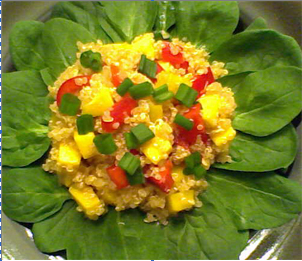
Quinoa Sunshine Salad with Asian Dressing

Ingredients:
Salad Ingredients
4 cups baby spinach
1 cup quinoa
1 cup red bell pepper, diced
1 cup yellow bell pepper, diced
1 cup mango, diced
½ cup green onion, chopped
Asian Dressing Ingredients
1/3 cup rice vinegar
¼ cup low-sodium soy sauce
1 tablespoon orange juice, freshly squeezed
2 teaspoons fresh garlic, minced
1 teaspoon fresh ginger, minced
1 teaspoon sesame oil
1 teaspoon sugar
¼ teaspoon orange zest

Directions:
1. Rinse quinoa thoroughly, place one cup quinoa in a sauce pan with two cups of cold water. Bring the mixture to a boil, cover and turn down the heat to a low simmer.
2. Let cook for about 15 minutes, or until all water is absorbed. Remove from heat. Fluff quinoa with a fork and set aside to cool.
3. In a small bowl combine all dressing ingredients and mix thoroughly.
4. In a large bowl combine quinoa, red bell pepper, yellow bell pepper and mango.
5. Pour dressing over salad and mix.
6. Let the salad sit for 15 minutes to allow the flavors to combine.
7. Serve salad on top of a bed of baby spinach and garnish with green onions.

Roasted Poblanos Stuffed with Cranberries, Pecans, and Quinoa

Ingredients:
8 poblano peppers
3 cups cooked quinoa
1/2 cup chopped pecans, toasted
1/2 cup dried cranberries
1/2 red onion, minced
1/2 cup cilantro, chopped
1 pound butternut or kabocha squash
2 Tablespoons maple syrup
1/4 cup nonfat sour cream
1-2 cups vegetable stock
1/2 teaspoon olive oil
Salt and freshly ground pepper

Directions:
1. Preheat boiler. Broil poblanos, turning once, until charred, about 10 minutes. Place them in a paper shopping bag or a bowl covered with plastic wrap to let them steam for about 10 minutes. Remove the charred skin when cool enough to handle. Slit lengthwise on one side, and remove the seeds.
2. Reduce the oven temperature to 400 degrees. Cut squash in half. Remove seeds. Brush the cut side with the olive oil. Roast it cut side down until tender, about 30 – 40 minutes.
3. Scoop the squash out of the skin. Puree in blender with maple syrup, sour cream, and vegetable stock. Add additional stock as necessary to reach a sauce-like consistency.
4. In a mixing bowl, combine quinoa, cranberries, pecans, onion, cilantro, and 1/2 cup of the sauce. Season to taste with salt and freshly ground pepper.
5. Stuff each pepper with a generous half cup of the mixture. Place in a baking dish, seam side down. Cover with aluminum foil and bake for 20 minutes.
6. Serve with the warm sauce.

Quinoa with Currants

Ingredients:
1/4 cup rinsed quinoa
1/8 tsp ground ginger
1/4 cup water
dash tumeric (optional)
Dash of salt
1/8 tsp pepper
1/3 red onion, finely diced
2 Tbs chopped fresh cilantro (or parsley)
1/8 tsp ground cumin
2 Tbs currants (or chopped raisins)
Dash ground cinnamon
1/4 tsp grated orange or lemon zest
Dash ground coriander

Directions:
1. Rinse quinoa with warm water and drain through a fine strainer.
2. Bring water and salt to a boil. Add the quinoa. Cover and reduce heat. Simmer for 10-15 min.
3. Meanwhile, heat a nonstick skillet. Add the onion, spices, and black pepper. Cook gently (low temp) until softened, about 5-10 minutes. Add a bit of water if needed to prevent burning.
4. Drain the quinoa when it's done and toss with the onion mixture along with the cilantro, currants, and orange or lemon zest. Serve hot or at room temperature.

11/28/10

Old Man... Winter? Sorta...

We told you last week about the changing needs of winter gardeners in our little corner of the world.  Since that time, we have eaten too much turkey, and had a borderline frost/freeze. 

It is an exceedingly bittersweet time of year when we finally have a drop in temperature sufficient to keep the tomatoes from ripening on the vine, and worse still, when we get a freeze deep enough (which is to say, any sort of freeze at all) to kill off many of our producing vines.

Some varieties of tomato are hardy enough to take our little snippet of cold air, of course.  We allow volunteers to go crazy in our garden, so we can't tell you for sure which varieties they are -- we just know they aren't the Brandywines you see here all nice and green.

Still, we had some vines make it through, including some volunteers in the potting soil we were using in our little black current experiment.  With a little bit of luck, we might actually manage to get a few more ripe tomatoes later this season.

We had mixed results with basil, as well -- for some reason, our sweet basil did better than many of our exotics -- the thai, for example, and the apple basil both froze to the ground.  Our purple curly-leafed basil plants had some leaves crimple, and others keep going strong.

Evidently, we were just exactly at the threshold temperature for winter mischief.

Still, we know what to do now.  First, we hoe down all the frozen plants (or, better still, get our daughter to do it!); next, we cover the bed with a fresh layer of leaves.

In mid-February, we will add a layer of compost from the chicken coop, and work it in with a pitchfork.  Then, in late February or early March, we will start seeding this bed with new plants.

Sometime next spring, after volunteer basil has started cropping up all over the yard, we will transfer a few of those plants to this bed, and any volunteer tomatoes which choose to join our newly seeded tomatoes will happily join forces to turn this plot into a wild tangle of solanaceous goodness.  We'll probably mulch it, as well, sometime next April or May or so.  And undoubtedly we'll put some sunflowers and nasturtiums on the borders as trap crops.

Much the same treatment will meet our other garden beds, in their own times, and with their own particular combinations of plants.

We could put more seed in the ground now, of course.  Our cabbage, spinach, kale and broccoli all acted as if this week's dip in temperature was manna from heaven, and kale and cabbage can both go into the ground all the way up to the end of December according to the planting calendar available at Producer's Co-op.

And next year at this time, we will be planting more quinoa seeds, as part of a rolling quinoa planting season.

But for now, we are getting ready for the First Annual Brazos Valley Pulletpalooza, and we really feel fairly satisfied with how the garden is growing.  In future years, we have plans to install rebar reinforced PVC hoops over the top of our tender veggies, and cover the contraption with greenhouse plastic prior to our first frost, so as to extend our season.  Today, though, we'll be enjoying the fruits of our present labors, and cleaning up Myrtle's place for next weekend's show-and-tell.

Happy farming!