4/28/10

People Should Be Better Than Chickens

One of these men does not look like the others.  He doesn't talk like the others, he doesn't dress like the others, he did not grow up going to the same schools, he did not go to the same churches, his life was not modeled on 'Leave it to Beaver', nor did he ever get described as "the All-American Boy".

The other two did.  They were golden children, as far as you can be in this country.  The fella in the middle there was high up in Republican Party politics in Washington State in the early 70's, before he ran into a little trouble with the law.  You might want to read about his story some time in Ann Rule's gripping The Stranger Beside Me.  Fascinating reading.

Recently, the State of Arizona enacted legislation which gives the police broad powers to stop people suspected of being illegal aliens.  The problem, of course, is that the Governor of Arizona refused point blank to answer the question "What does an illegal alien look like?"

Why would she refuse to answer that question?  Because she doesn't want to admit the obvious:  an illegal alien looks hispanic.  Oh, sure, there are illegal immigrants from Russia, Serbia, Germany, Canada, Botswana, Yemen, and probably even a few countries the proprietors of Myrtle's place have never even heard of.  But everyone in this country with a pulse knows who you're talking about when you say "illegal aliens".  You're talking about immigrants who come into this country over the Mexican border without following statutory methods.

So what's the big brouhaha about?

Proponents of harsh tactics claim illegal immigrants do all sorts of nasty things -- commit a lot of crime, sign up for welfare, drive down property values, etc. etc. etc.

Problem is, they can't prove a single one of those claims.  The act of coming into this country, true, breaks one of our laws.  For the most part, though, those laws need breaking.  If you've never seen the poverty in the colonias in the border states, you're missing something; however, even the colonias are preferable to starvation in the slums of central Mexico.  We know several illegals personally, and every last one of them is supporting their families, often heroically, against pretty long odds.  They are having to break the law to do so, which is a shame, but it is hardly unethical.  Under similar circumstances, we would do exactly the same thing.

No, the problem is not law-breaking; it's not taxation (illegals pay taxes, including social security taxes, that they will never recoup).  The problem is the amygdala - the reptilian portion of the human brain.

Some people are afraid of change.  The very word change sends them into paroxysms.  And the changing socio-cultural dynamic of this country is frightening the willies out of them.  The problem is, they have not reconciled themselves to the notion that in a melting pot, the stew tends to get a little darker.

Myrtle can relate.

Why?  Because chickens are racists.  Mix a bunch of breeds of chickens together, you'll find Barred Rocks preferring Barred Rocks, Bantams hanging with Bantams, and Jersey Giants acting like they own the joint.  They live in the amygdala because their brains don't have a huge frontal cortex like those of homo sapiens.  Trouble is, when people act out of fear, they abandon the frontal cortex, and flee to the amygdala, and start ranting about "them Mexicans are taking our jobs".  Right.  How many Arizonans for this law really want to pick vegetables, or tile roofs, or wash dishes for a living?  Hint:  none.

Myrtle may have our affections, but we are of the opinion that people should be better than chickens.  So long as somebody is willing to pick up a shovel, or a hammer, or an apron -- we say let 'em.  This American experience is only truly American so long as it's a party with an open invitation.  Cesar Chavez knew that; we are only sorry that even as an explanatory idiom, we sullied his memory by associating him with Timothy McVeigh and Ted Bundy.  But it needs saying:  nice guys don't always look like Wally and The Beav; sometimes they look "different".  And you shouldn't always trust Wally and The Beav -- they might be hiding something.

Happy farming!

4/26/10

Spring Training is Officially Over

This evening, we are in the middle of a "storm".  Which is to say, there are sufficient drops of moisture falling from the sky to slightly dampen our garden.

We think of little teaser rains like this as rites of passage:  we'll be hitting 90° in the next week or so, which most of the country thinks of as summer weather.  Before actual summer, with weeks on end of 100°+ temperatures, Mother Nature likes to give us a mild little April shower to make us think we live somewhere inhabitable.

We are not fooled.  The easy days of delightful Spring weather are over.  Soon, the pond will be dry enough to dredge, and we will be calculating just exactly how long the vegetables can go between waterings with the hose.  We'd like to forgo the hose altogether, of course, because tap water has chlorine and fluorine and bromides galore in it, but we have not yet sufficiently collected rainwater enough to exclusively water with it.  Maybe by this fall... if we get a tropical storm or hurricane in July or August.  Thanks to ENSO neutral or even La Niña conditions coming soon to a Pacific Ocean near you, we're not likely to get any tropical moisture this summer.

No, for the next four to five months, the only truly happy plants on the place will be our cacti.  They aren't really a major crop for us, but no Texas garden would truly be complete without nopalitos.  That is particularly true when looking forward to a long, hot, dry spell.

We don't want you to get the wrong impression, however.  We have plenty of plants about the place which are doing quite nicely, thank you.  The corn is getting taller by the day, and there are blooms on our zucchini and cucumbers.  We are about 3-4 weeks away from blackberry harvest, and our tomatoes and peppers are thriving.  We aren't complaining about the impending drought months; we are merely chronicling.

In fact, as difficult as the summer months are going to be, they are vitally important to the kinds of production we intend to create around here.  Sure, the veggies (like our zucchini here) will have to be harvested long before the truly awful weather starts, but there are other things besides harvesting going on in the blistering days which begin around the middle of June and last until well into September.

Peppers, for example, have a very difficult time surviving the heat, but if and when they do, the torturous treatment causes them to produce truly remarkable fruit.  Not only are jalapeños grown under harsh conditions hotter than normal, they are also tastier.  You haven't had great salsa unless you have had salsa made with home grown peppers with that extra piquancy which only comes from near-dehydration.

Our grapes, too, must undergo harsh conditions.  We are not master vintners by any stretch of the imagination, but we do pay attention as much as possible.    If you want intense flavors, you have to have concentrated growing conditions.  We'll see just how well we balance those conditions as we gain more experience.

We suspect the same will prove true for our blackberry crops, as well.  The berries themselves are harvested in late May/early June, but we then have that blast-furnace summer to deal with, when the vines on which the following year's berries will grow are doing their thing.  They have to be kept hydrated enough to continue to thrive, and to grow strong enough not only to last through next winter, but also to produce another copious quantity of berries for next year.

And how sweet will those berries be?  It depends on a lot of factors, not the least of which is how hot the previous summer was.  As with everything else we are doing, it is a catch-22.  It'd be easier on us if we knew that the water we used were all from the pond, but... that's a project for a later date.

Maybe we can water everything with sweat this summer?  It's something to think about....

Happy farming!

4/24/10

The Eve of the EV Evolution

We want a farm truck.  We have wanted a farm truck since even before we wanted a farm.  Why?  We don't know, probably because we're Texans.  Texans drive trucks.  It's part of our identities.  Trucks replaced horses, and since it's generally frowned upon to tie up a horse outside one's workplace, we've allowed parking lots to grow up where pastures are supposed to be, and since we're driving everywhere, cars have gradually creeped in to replace trucks, and now some of us, yes, even some Texans, are left wanting trucks.

It's sad, really.

So, wanting a truck, how did we end up with "not a truck" parked in our driveway?

Fuel economy.

The best in class pickup trucks currently struggle to get right at 20 or so miles per gallon.  And at 20 mpg, the lifelong costs of a $20,000 vehicle are just too high.  We can't justify it.  We ended up buying a 2006 Toyota Yaris a few years ago instead.  It gets 30 mpg city, 39 mpg highway.  It cost us $14,000 but over the course of the life of the vehicle we are ending up saving between $50,000 and $75,000 when compared to the most efficient truck we could have purchased.  That is a considerable amount of money when spread out over the 10-15 year life of a vehicle.

  Phoenix Motorcars, enter stage left!  A few years ago, a California start-up engineered a great new vehicle, an all-electric SUT (Sport Utillity Truck) capable of highway speeds and with an extender pack for its battery, it is capable of a range of roughly 200 miles.  It has a 1,000 pound cargo capacity, which makes it perfect for the small urban microfarm.

Only two problems, really:  1) The distribution plan Phoenix Motorcars put together involved first selling their innovation as a fleet vehicle (the idea being to put thousands and thousands of these things into service for city and county governments eager to comply with CA's strict emission standards).  This meant we would be waiting a while before it was on sale to the general public.  And 2) They went bankrupt a little over a year ago.  They are evidently out of bankruptcy -- it's not even mentioned on their web site -- but on the other hand, they haven't been making a lot of announcements about impending public sales, either, so it's impossible to know when they will be back in the game.

Still, if they ever do roll into general production... their SUT lists at something like $45,000 which, with a $7500 credit from the U.S. government, makes it fully cost effective, particularly since electricity is orders of magnitude cheaper than petroleum.  Also factor in the smaller number of moving parts; over the life of the vehicle, you would be saving massive amounts of money. 

What about longer trips, you ask?  Surely Myrtle Maintenance Personnel travel on occasion?

Here's the beauty thing:  the whole country is about to go electric.  The EV Project is a federal grant to set up charging stations all around the country.   It will take some time... but not nearly as much as Exxon-Mobil or other such dinosaurs would have you believe.  The oil companies keep going on about a 2050 date for peak-oil, without realizing that we're not 40 years away from having to switch... we are three years away from making the switch!

The first commercially viable electric offering is actually coming out later this year.  By December of 2010, the Nissan Leaf will be hitting the streets of the good ol' U.S. of A., and things will never be the same again. 

There are plenty of other offerings coming soon, too.  Ford recently announced that they will be electrifying their Transit Connect urban delivery van; BMW is putting an all-electric model into the Chinese market in the next couple of years; Tata Motors from India will be electrifying their Nano when they release it in Europe, and that will most likely translate to the Americas when they finally enter this market.  And then there are the all-electric companies, most notably Tesla, whose Roadster is overpriced at $100k plus, but whose Model S is more modest (~$50,000, minus incentives) and which seats a family of 7 comfortably.

Still, only Phoenix has a truck in their marketing literature.  Sigh.  We may end up having to get one of those electric Transit Connect delivery vans.  Giddyup.

Happy farming!

4/20/10

Down on the Farm

Incarcerating a criminal for a year costs more than sending a student to college.  Anyone who has actually sent a student to college for a year, you can take a second to breathe before continuing to read.  Myrtle will wait for you, she's got nothing better to do at the moment.

Prison, make no mistake, is expensive.  The following is not, per se, an endorsement of a movie, since the movie in question is not particularly family friendly, but it is provoking.  Perhaps even provoking of thought, if you care to think about such things (or, can get past the Barry White stuff...)


Basically, only the 'Law and Order' conservatives of the world think we ought to continue with this bizarre system.  And if you find yourself of that ilk, let Myrtle dissuade you.

There has never, in the 7,500 recorded historical years in which government has been tracked, been a public policy decision based on fear which has not turned out to be a losing proposition.  Fear is, let us be blunt, stupid.  Fear for one person is useful; picture a bipedal mammal of small strength, dexterity and minimal speed on the veldt, being chased by a saber-toothed cat; fear gives such a creature heightened awareness, which may be the difference between life and death.  But fear for two or more persons, in a deliberative capacity?

It leads such persons to make major mistakes, which compound the original problem.

Incarcerating non-violent drug offenders, for example, is done because our more conservative citizens are afraid of those whose moral development requires a little additional attention.  However, the fearful turning-away from the real problem -- people who have not a single hope that following the rules will result in anything positive -- turns out hardened, violent, antisocial personalities beyond the hope of repair.

No, prison, for the most part, is a waste of taxpayers money.  It postpones the life of crime for the incarcerated, but it doesn't end it.  It exacerbates it.

So, should we just, as Mr. Lypshytsky suggests, simply let them keep our car stereos?

No, that wouldn't work, either.

But there is an idiomatic expression about prison, which Myrtle believes we would do well to remember:  "Down on the farm" might be a cliche'd expression of remembrance of yesteryear's chain-gangs, but the chain-gang mentality ain't all bad.  We have a serious problem in this country -- most of our food is contaminated, overpriced, and grown far too far from its final destinations.

Why don't we turn our prison population loose on a series of microfarms?  Halfway houses for those who need to learn skills, need to be productive, and need to have better nutrition and personal habits?  A series of 5 acre plots all across the country responsible for producing 10 tons of produce per year for local grocers, in addition to providing their own sustenance.  Apart from the initial outlay for land, and the investment in training for guards/mentors, it would pay for itself in less than a decade, without even accounting for the decrease in recidivism which would surely follow.

Myrtle's just sayin'.  If y'all want to continue subsidizing a system which has devolved into nothing better than a training ground for tomorrow's violent felons, you are more than welcome.  Myrtle thinks that's a losing proposition, but hey, she's just an incarcerated chicken.  What would she know?

Happy farming!

4/17/10

Bees are like Rock Stars

Okay, so Sue Foley is a blues legend, not really a "rock star".  But we love her, so we're planting her in the middle of this musing on our backyard bees:


We currently have a wild hive about 15 feet high in one of our massive oaks on the east side of the house.  Our real question is how to get from the wild hive to the box hive.  Honey we can't get to, to honey we can.

That's next Spring's project, but we can't help but think about it.... a lot.... every time we work in the yard.  Our bees love our yard, and we intend to keep it that way.  There are more, and more fragrant, blooms here than they probably know what to do with.

What kind of honey will we get, we wonder, with blackberries, and clover, and plums, and dandelions, and corn, and basil, and rosemary, and autumn sage, and.... the list goes on and on.  Hopefully, so will the subtle flavors in the honey.

When we get to that point, however, we will have to handle our little moneymakers with care.  They really are like rock stars, you see.  Listen to these words of wisdom about beekeeping, handed down through generations:

Don't bother them until midday
Require cool white smoke to relax
Don't stand in their sun
Handle bees gently
Don't make them watch you work; use sleight of hand
When you're done, put it back exactly the way they like it
Don't breathe on them, but do tell them not to freak out
     We suppose you could add, be very careful when renting them a room in your posh hotel, but that one probably goes without saying, right?

    Anyway, we're also working on a butterfly garden, but that just doesn't have the same excitement factor to it.  Butterflies are equally picky, but they don't make honey, and they just don't seem quite so urban-farmish.

    Those are our ponderings for the weekend; we'll get back to work soon.  More mulching to do, and such, you know.

    Happy farming!

    4/15/10

    Once More, From The Top...

    Those of you who have been reading Myrtle's doings for long enough may be wondering whether we ever intended to compensate our flock for the loss of Duck the Drake due to the onset of obnoxious rooster behavior.

    The answer, until this week, was going to be a resounding 'No!' but we thought better of it.  Since our family is mourning a loss, we thought it might be a good time to make a new beginning in other ways.

    So, we've got some new chicks.  They are, naturally, Barred Rock chicks, though at this age, they look an awful lot like three or four other breeds; they're a little older than the last batch we got from the same supplier -- they were already feeding and drinking when we got them, so we didn't have to do the weird routine of forcing their little beaks into the proper dishes.  They are in every other respect as dependent as can be, however.

    We're keeping them in a box in the bathroom at present; we have to keep the heater on in there, and we're keeping a lamp on them.  We'll move them to a bigger cage (a converted compost bin, if truth be told) in a week or so, and then, when they are mature enough, we'll make a cage-within-the-coop to acclimate the bigger birds to the smaller, and vice-versa.

    We have other new beginnings going on, too.  Our wild grapes (of both the Mustang and the Muscadine variety) are fruiting this season, and between that happy news and the cornucopia of blackberry blooms on the vines this Spring, it looks like we're going to be more than ready to start on the more pleasurable part of our self-sufficiency program, the making of jams, jellies, and wine.

    In addition to these utilitarian motives, of course, is the fact that grape vines are exceedingly attractive.  Our borders are soon to be demarcated by lush green vines bearing beautiful bluish-black fruit, and judging by the quantity and the nature of the clusters seen here, they will be bearing quite a lot of it.  This is one plan which is turning out to be far more successful than we ever dreamed it would be.

    To top it all off, of course, the vegetables are coming up quite nicely.  We've thinned out our corn, the zucchini is ridiculously happy, as are our four varieties of tomatoes, five varieties of peppers, three varieties of basil, our cucumbers, etc. etc. etc.

    We only regret that Papa Dave won't be around at harvest time to enjoy it.  However, we do intend to have quite a party when the corn comes in, so all Friends of Myrtle, be on notice.  Keep a date open some time in late May, early June.  We'll expect you to come hungry!

    Happy farming!

    4/10/10

    Trout Fishing in the Great Beyond

    David Oliver McGee (1931-2010) was our father, for a little while.  He lived an interesting life, full of vexations, small triumphs, and major malfunctions.  All in all, he would rather have been fishing on some small stream somewhere, preferably in the mountains of Virginia.

    We did not actually meet him until adulthood, due to his having divorced our mother while we were still very, very young.  And the fact that he even lived that long is, frankly, astonishing.  He was diagnosed in the 1960's as "paranoid schizophrenic", which was the psychiatric equivalent at the time of, "Dang, we don't get it.  This dude sure is messed up, though."   We strongly suspect that he was actually suffering from an acute combination of thyroid malfunction, malnutrition as a child, environmental toxicity sensitivity, and being an introverted and sensitive man in a world dominated by patriarchal (even Roman) militant sensibilities.

    Our current little nuclear family owes its fatherhood dynamic to literature and PBS children's television programming, because David Oliver McGee was, sadly, not present; and even if he had been present, he may not have been the best role model.

    He was, however, an outstanding grandparent.  After having met him 14 years ago, he was all attentiveness and adoration.  He was proudest, we think, of being able to regale his fellow residents of the retirement community where he lived his final years with stories of his granddaughter's unflappable opposition to conformity and authority.  He never met the grandson who bears his middle name, but we're pretty sure he would have loved taking him fishing some day.

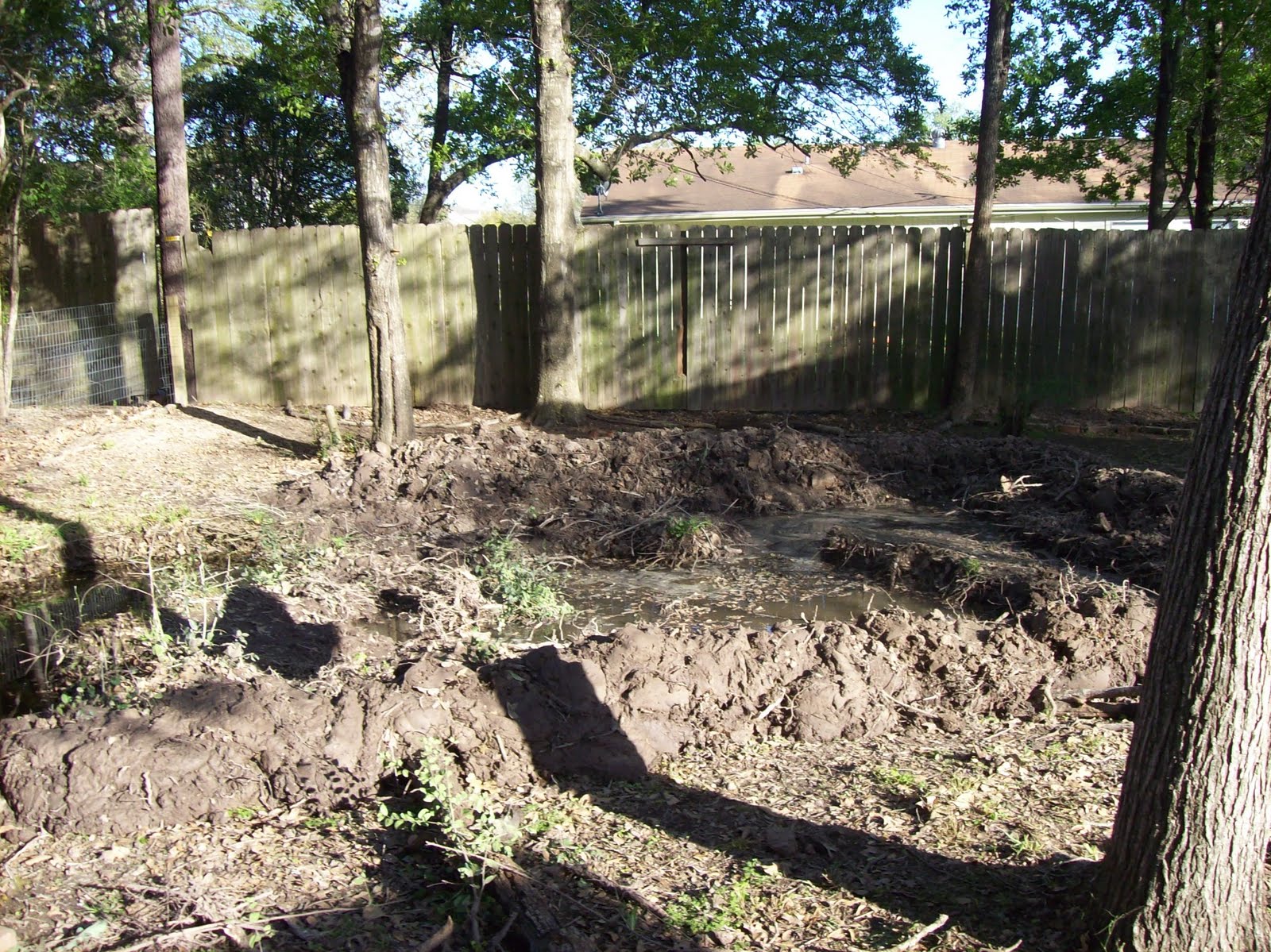
    In fact, our little excavation project (the pond, pictured to the left here), was in some measure an homage to David, with a nod to Hollis Jack Mints, who deserves his own post some day.  Granddaddy Mints had catfish in his pond, which is what we are also going to be growing, but Papa Dave (though he enjoyed catfishing) would have preferred trout.  We have no doubt he would have loved hanging out by our backyard pond, though, helping his grandson with a cane fishing pole pull in a big fat yellow cat.

    It was not meant to be, though.  Papa Dave died this week.  We had been making arrangements to move him from San Angelo, Texas, to a nursing home facility here in College Station where we believed the nutritionist and the physical therapist were competent and could have gotten him up and fishing again.  A lifetime of hard living was just too much, though.  A man who survived homelessness in the cold northeast, and the rigors of oil field work in the hot Texas sun, could not survive the depression of burying his wife of the last 8 years this past December.  So it is with most elderly men -- they rarely survive their wives by even one calendar year.

    Papa Dave may have had the last laugh on the demons of despair, though.  Our friend Rosie, who is also worthy of her own post, though as varied as her life and interests are, we don't know what we would say, brought us dinner last night, after she heard the news.

    She's never met David, did not know anything about him. 

    But she brought us a beautiful dish of trout and polenta.

    Happy fishing!

    4/5/10

    Mulch Ado About Nothing

    Even our "afterthought" plantings (like the wild grapes you see here to the right) are starting to bud now, because the growing season has begun in earnest.

    As a consequence, we are faced with a number of interesting decisions.  None of these decisions are difficult, nor even difficult to predict, once you've gotten used to the Myrtle frame of mind, but they are informative.

    For example, all these plants need to be mulched, right?  I mean, that's what every single gardening authority will tell you.  They will then go on at great length about the wide variety of available mulches, and what the pros and cons of each might be, vis-a-vis the soil alkalinity or acidity (which you've been instructed to carefully get measured by the county extension agent, in association with Texas A&M University, of course!), and the mix of other elements (notably zinc, that's always a big one they talk about). 

    And, of course, there's also the question of cost, and environmental sensibility.  There are rubber mulches, after all, to go with the traditional cedar chips, and bark mulch, and cypress mulch, and peat moss, and on, and on, and on.

    So, what do Myrtle Maintenance Personnel do?

    Oh, come on, you didn't seriously think we'd spend money on mulch, did you?  And artificial mulch?  Why not just grow wax vegetables?

    No, we use what we have on hand, just like we do with everything else.  Fortunately, we recently moved our wood pile from the back yard (next to where the pond project is currently underway) to the front yard (as part of a screen in front of where the bee hives are going to go next year).  At the bottom of the wood pile?  Lots and lots of bark, rotten wood, leaves, and other yucky gunk that will work nicely as a mulch around our brand new trees and vines.

    We suppose in the interest of being faithful chroniclers, we should enumerate our new plants as of the last week.  We'll list the veggies and fruits next week, but here's what we planted over the weekend:
    • 2 Forsythia
    • 2 Pink Azalea
    • 4 Loblolly Pine
    • 5 White Pine
    • 2 Lodgepole Pine
    • 1 Red Maple
    So, why did we not choose a more traditional mulch for these plants?  Apart from the cost savings (which is considerable), there are a few key reasons:
    1. Natural mulch is essentially a new layer of "compost-in-place".  As the mulch rots, it nourishes the protected plant.
    2. Limiting weeds is, at Myrtle's, only partially desirable.  We obviously do not want weeds to take over completely, but neither do we want them completely eradicated.  We could do a whole series of posts on the health benefits to chickens of eating those plants which other gardeners poison in their race to conformity.
    3. Mulch naturally erodes; a readily available replacement-in-place is to be preferred to a mulch which can only be replaced by another special trip to the garden center.
    4. Recreating the natural cycle is to be preferred whenever possible.  Think about the biodiversity of the rainforest, as an example, and then think about where the nourishment for all of that comes from; it is almost entirely a closed system.  Very little rainforest nutrient comes from external sources.
    We'll show you how well the garden is doing sometime soon... as soon as we know ourselves how well it is doing!

    Happy farming!

    4/4/10

    New Growth

    "With Zeus's help, the mother retrieved her daughter; but Persephone had already eaten a pomegranate seed, food of the dead, at Hades' insistence, which meant she must come back to him.  In the end, a sort of truce was arranged.  Persephone could return to her sorrowing mother but must spend a third of each year with her dark Lord.  Thus, by the four-month death each year of the goddess of springtime in her descent to the underworld, did winter enter the world.  And when she returns from the dark realms, she always strikes earthly beings with awe and smells somewhat of the grave."

    We spent the day before Easter attending the funeral of our 101 year old grandmother.  She was a devout Southern Baptist, so naturally the eulogy was full of references to resurrection and rebirth in Jesus Christ.  She was also many other things, which did not get mentioned in the service, but so it is with a human life -- we are at one and the same time far more complicated, and yet far more reducibly simple, than any of us would care to admit.

    Grandmother loved to bake pies -- that is a simple fact.  Is it significant alongside her testament of faith?  We don't know.  We do know her garden was beautiful, and her pies were delicious; everything made with love has a tendency to be made a little better than anything not created in such fashion.

    There are other, older myths besides that of the Resurrection which it would behoove us to recall.  Our civilization has gotten so disconnected from the ground we walk on that we no longer think about the meaning of "returning to the dust".  Indeed, the proprietors of Myrtle's often joke about being "buried in the yard" because we never want to move again, but that is really only half a joke.  All living things have risen from the rotting shell of all dead things.  Any good botanist will tell you that you should include lots of "organic matter" in your compost.  What does that mean, really?  We have explained before that the best compost comes from rotting leaves "cooked" in the coop.

    Basically, everything that lived nourishes everything that lives, and everything that lives will die, and someday nourish everything that is going to live.  We are all not so much standing on the shoulders of giants as we are climbing the pile of corpses -- we can either allow ourselves to become maudlin and disturbed by that imagery, or we can honor those who have come before us by continuing to nourish the cycle of life.

    Today, we are planting new trees, and painting the chicken coop.  And as we dig in the earth, we will revel in how it smells slightly of the grave, knowing that it is because of this that we shall soon have a fruitful harvest.

    Happy farming!

    3/28/10

    Can You Dig It?

    We're getting closer and closer to realizing our vision.  A 900 square foot house sitting on a 9000 square foot lot -- you can see by our purchasing decision where our values lay. 

    Anyway, the creme-de-la-creme of our little project, the capstone, as it were, will be our 500 square foot, four-to-five foot deep fish pond.  We've finally got the 500 square foot part down; the depth is another matter.  We're planning on waiting for this August to dredge the portions which are currently underwater, but this weekend we managed to reach a milestone.  We have put up a bank around all 100 linear feet of the pond's perimeter, and have established where to plant the pine trees which will form the erosion barrier.  this week, we will be planting our mosquito-repelling herbs (basil, catnip, and anise) and we will begin research in earnest for our aeration project -- a windmill, hopefully from an engineering design circa 1850 or so.

    There are a lot of other goodies to show you this upcoming week, but they will have to wait.  Friends have invited us over for grilled shrimp and yummies from their winter garden.

    Happy farming!

    3/27/10

    By Their Fruits Shall Ye Know Them

    This whole self-sufficiency thing is a long term project.  Sometimes we are reminded of just exactly how long by the kinds of milestones we celebrate.

    This week, our plum trees are in bloom, the first time in the three years since we planted them.  You can't have fruit without first having flowers, so we consider this a pretty important event.  Of course, the trees are still only about four feet tall, so any fruit we actually get this year probably won't be all that impressive -- but it's a milestone event, nevertheless.

    There are other projects around Myrtle's place that are equally long-term.  We moved roughly 1,500 pounds of dirt out of the catfish pond today, and the digging is still only roughly 40% complete.  Which means we probably won't have fish in the pond until next March at the earliest; given that we started digging roughly 18 months ago, that makes this a fairly long-term event.  That first fish fry is going to be a doozy, let us tell you.

    Speaking of doozies, our corn crop this Spring ought to be fairly impressive.  In addition to planting in a couple of our traditional raised beds, we have this new 'S' shaped bed which marks the spot where we are putting more olive trees next year.  Since it was available and doing nothing at the moment, we thought "Why not?" and proceeded to plant more corn here.  Among other things, it will add to the privacy between us and the rent house you can see in the background here.  Corn, wild grapes, pomegranates and morning glories (on the trellis) ought to keep our Myrtle-related activities private from the sorority girls doing all their non-Myrtle related things.  Because really, who wants to see someone doing something non-Myrtle related?

    It has also come to our attention that in our discussion of Forsythia, which we have never planted before we slighted one of our favorite plants by saying we never plant ornamentals.  Irises grow practically like weeds in our yard; they spread via rhizome, and if they are growing where you don't want them, you practically have to dig up the entire yard to get rid of them.

    We, of course, don't want to get rid of them.  They don't actually produce anything to eat, which is our usual standard for whether we want something growing in our yard or not, but on the other hand, they don't demand any attention, and seem to take care of themselves under all kinds of circumstances, bouncing back even after harsh winters like the one we just went through.

    So, if and when you eventually visit Myrtle's place, you'll see these beautiful white flowers in the odd irregular bed around some of our shade trees.  They may not be producing yummy plums, but they make us enjoy the wait for all our fruit trees to come into production.

    Hopefully, for Myrtle's next update we can show you some sprouting spring veggies!  Until then....

    Happy farming!
    LangDetectzh>en GoogleDicC
    having beauty; pleasing to the senses or to the mind, very good or skilful, A , If you describe something as , You can describe something that someone does as

    3/21/10

    Hope Springs Eternal

    It's the first day of Spring.  So why did the temperature fall to 38° last night?  And why, oh why, a week after we planted all our veggies, given that we had passed the average date of last frost by a full week, is it supposed to get down to 34° tonight?

    We'll tell you why:  'cause that's the way the ball bounces.  Life is experienced in non-linear, fractal geometric fashion.  Things happen, then other things happen, and then something changes.  No observable cycle is any more circular than the Earth's orbit which, if we remember our 5th grade science at all, is actually elliptical, not circular.

    So.  We've got plants in the ground, we're going to cover them at night, and hope for the best.

    We've got other plants not yet in the ground because they weren't in stock -- most notably African Basil, which we have on order, and Goat's Rue, which should be coming any day now.

    And, we have ordered an abundance of new trees from The Arbor Day Foundation, including a slew of new Loblolly Pines, White Pines, and Bald Cypresses.  The perimeter of Myrtle's place, particularly around the fish pond, needs to be more forested, and we want an abundance of pine-needles on hand to mulch the blackberries every year.

    One unusual addition (unusual, at least, for us) is a Forsythia, which the Arbor Day folks threw in for free.  We don't usually go for ornamentals -- we planted some Raspberry Autumn Sage (Red Salvia, for those who may have heard it by another name), but that and our daughter's Morning Glories are the only inedible plants on the place (excepting a few of the trees, of course).

    The Forsythia is an interesting case.  Free is always good, naturally, but in addition, it has this going for it:  it's a member of the Olive tree family:  As an Oleacea, it naturally comes near and dear to our hearts.  We only have four Arbequina Olives on the place, but we're hoping that now they will feel a little less lonely.

    We're not yet sure what to make of the Forsythia's bright yellow flowers, but we're sure we'll adapt.

    In other news, we have moved garden plots around, expanded some, contracted others, but mostly we've gone about the business of getting as much good chicken-poop compost as possible in the places it needs to go.  Two of our 6'x6' garden beds are dedicated to sweet corn, in addition to a new 4'x20' "S" shaped bed which we placed where the 2nd Olive bed is going to go next year.

    Also, we replaced the chickens' plastic water feeder with a stainless steel variety.  It holds more water and, more importantly, is not a source of leached bromides.  Perhaps we are partly motivated by a sappy, syrupy-sweet fondness for our chickens, and we do not wish to poison them any more than any other member of our family.  But mostly, we just don't want getting bromides in our eggs.

    For the next couple of days, keep your plants and maybe even yourselves warm, and...

    Happy farming!

    3/16/10

    Never Leave 'em With a Problem, Always Leave 'em With a Solution!

    We recently advised our fellow Myrtlians that plastic food containers are little more than slow poison.

    Of course, some people are in no hurry, so this is not really any scarier a thought than any of the other alarming things we seem to hear on a daily basis, should we choose to log on to our favorite news blog of choice, or even (dare we dream anyone still does this?) read the newspaper.

    However, we discovered in daily interaction with many of you followers of Myrtle that we needed to do a little more than raise the alarm.  We needed to be a little more proactive in providing some solutions.  To that end, may we introduce to the western world a little item that many people living in developing nations take for granted?  It's called a "tiffin" in some circles, although in Wikipedia, the best information is in an entry on "Dabbawala", the etymology of which we won't bother to describe here, although it seems pregnant with pun possibilities.

    So, what exactly is this "tiffin" of which we speak?  A relatively inexpensive exemplar is in the Amazon.com link to your above left.  You can also find them at World Market.  Of course, if you live in a community of any size, there will be a half-dozen Indian food grocers or international bazaar style outdoor markets, etc. etc., from which it would be better to buy said item; still, for those of us who live in backwaters such as College Station, ordering online may be your best bet.

    Why are you ordering this "thing"?  Because it's a lunchbox and because it is convenient, in addition to being non-toxic! 

    In India, millions of workers all throughout the country rely on delivery persons to bring their hot fresh home-cooked meals to them in their tiffins; Myrtle Maintenance Personnel have a similar arrangement, although we must confess that we send refrigerated foods and rely on that most odious of modern conveniences, the microwave, to heat up said foods on a ceramic plate.  Still, we stay as true to the original intent of the tiffin as practical.

    And best of all, you buy this item once, you never need buy it again.  It doesn't go in a landfill, it doesn't sully your system, it doesn't block iodine.  And it encourages you to eat cool foods -- when is the last time you took kebabs with spinach dal to your workplace?  Myrtle might cringe at the thought, but we are sure you could even take tandoori chicken in one if you so desired.

    Happy lunchtime, and happy plastic-free farming!

    3/12/10

    Gardening at Night, and Other Absurdities

    Those of you who have been paying attention may have come to the conclusion by now that we're a little odd.

    No denying it.  The proprietors of Big Myrtle's Tea Shoppe and Egg Emporium do not care much about conformity; the surest way to make us yawn is to talk about a master-planned neighborhood, where every home on the platte is painted the same color, and none of the houses is allowed to have trees or shrubs at unauthorized heights.

    Which may go a long way to explaining why we're posting pictures of plants obviously taken at night, when the photographic capabilities of our cheap little digital camera are dwarfed by those of your average pinhole camera made by enthusiastic 3rd graders.  See, we planted our brand-spankin'-new olive trees at night.

    Why?  Because that's when we bought them, and we were so excited, we couldn't wait 12 more hours before putting them in the ground.

    We had assumed we were going to have to travel over 100 miles and pay much higher prices to purchase arbequina olive trees, and we were on the verge of despair because between gutting the lighting in the house, building a new bedroom for our daughter, and putting a new roof and new laying box on/in the chicken coop, funds for major improvements were beginning to run a little slim this spring, and we thought we may have to put off the olive tree purchase until next fall at the earliest.   Then, miracle of miracles, when we stopped at Farm Patch (a local produce stand which also sells garden plants), with the express purpose of buying african basil (much nicer plant than your standard "sweet" variety), we noticed a group of olive trees bunched in the corner.

    We naturally bought them all.

    So, our two big projects in the garden this year were pomegranates and olives.  We have now succeeded in installing the two plants in our garden which we have been expressly discouraged about by the priggish pessimists of the Brazos Valley gardening world.  And, more to the point, we have a solid plan, we're sure it will work, and we are executing the plan precisely.

    If we can't get the western side of our yard to grow into a sicilian paradise using chicken-poop compost and rancid pond water, then it can't be done.

    Tomorrow, we'll put in our traditional summer veggies and some more herbs, we'll weed, and we'll mulch.  But in the meanwhile, we have olives and pomegranates growing in our yard!

    Happy farming!

    3/9/10

    Pick Your Poison

    We've told you before about the importance of pure water.  We even mentioned parenthetically that it is important to store your distilled water in glass containers, not plastic.

    We've now gone guano-loco with the logical conclusion to this line of reasoning.  We are getting rid of plastic containers altogether.  There are a wide variety of reasons, but the most fundamental is this:  most plastics leach bromines and bromides in one form or another.  And together with fluorides, our body is so flush with these chemicals in our contemporary habitat that they have effectively blocked our iodine receptors more completely than any insidious plotter from Dr. Strangelove could have hoped.

    "Now, hold on a minute!" you might be saying.  "Isn't fluoride a good thing?"  Yes.  In moderation.  Fluoridation of water has dramatically improved dental health in this country for nigh on five decades now.  It's just that, along with out-gassing and leaching from plastics, fluoride and bromine/bromides have had disastrous unintended consequences.

    Hypothyroidism is the condition which first brought the importance of iodine to Myrtle's household  -- Myrtle Maintenance Personnel have been fighting this condition for over a decade now.  But this is only the tip of the iceberg; iodine deficiency has been linked to breast cancer, among other things; we would not at all be surprised to find that there are links to autism, ADHD, polycystic ovarian syndrome, and all sorts of other conditions which have been on the rise like some demented Vanity Fair review of uncomfortable conditions.

    Think about it... the onset of an "obesity epidemic" has only come in the last three to four decades.  "Super-Size me" has something to do with it, of course, but what else happened in the late 70's, early 80's?  Coca-Cola switched from glass bottles to plastic, that's what.  So did all sorts of other acidic foods (Tomato ketchup, anyone?), not to mention car upholstery no longer being cloth or even leather, for the most part.  We get out-gassed to the Nth degree in our cars.

    You want further circumstantial evidence?  The worst offenders for obesity are in the deep south.  Where there is no public transportation... and you have to drive a long time through the blazing hot sun every summer to get anywhere...  We would love to see an epidemiologist get a grant to thoroughly investigate this question.

    But we're not holding our breath.  Or, maybe we should....

    So, we're ditching plastic.  We'll keep you posted.

    Happy farming!

    3/7/10

    A New Place for Myrtle to Park Her Woozle...

    We're not quite ready to declare ourselves funky, but we have come quite a few steps beyond merely functional.  The latest addition is a new laying box for the girls, and in addition to giving them a fully protected eating and drinking area, it adds a good 10 square feet of laying space above and beyond what they had with their old re-designed IKEA dresser-drawers (hey, a girl's gotta rest her backside somewhere, right?), and, just as impressively, gives them fully 20 square feet more foraging space.

    Plus, it's an extra windbreak in winter and an extra 20 square feet of good shade in summer. 

    Of course, getting them to actually lay eggs in this new creation took a while.  You'd think architectural improvements would be enough to change even chicken temperaments to something grateful and cheery.  Sadly, no.  Quoth Myrtle:  "This is different.  Different is BAAAAAAAD!!!!"

    Sigh.

    Our next chicken-related improvements will be purely aesthetic.  We will be painting the exterior of the roof (top will be sun-reflective white, sides will be black, with biker-chicken related mural designed by our 11 year old daughter).

    There are a lot of non-chicken related improvements going on, too.  We have embarked, for example, upon a new line of inquiry related to the reduction of our plastic usage about the place.  This is a more complicated line of inquiry, and may take some time before we can report on what success would actually look like, let alone whether or not we have accomplished it.  When we realized early this week that the bromides leached from plastic affect numerous endocrine conditions (particularly hypothyroidism), we opened a new "Myrtle File" on plastic.  A "Myrtle File" is something we have decided we're no longer going to do simply because everyone does it this way, and that's the way it's done.

    It won't be easy.  We just got back from H.E.B. with as little plastic as we could manage on short notice (without having planned a non-plastic trip first), and we're stunned by how much plastic we brought into the house.  Eliminating it entirely, we have decided, will be impossible.  But as a first approximation, we believe we can reduce it by 90% over the course of the next year.  We'll keep you updated.

    Meanwhile.... herbs and raspberry autumn sage going into the ground this weekend, summer veggies next weekend.

    Happy farming!

    3/3/10

    A Rock and a Hard Place...

    We're stuck in waiting mode.  As we've mentioned before, the end of Winter and the beginning of Spring is a difficult thing to gauge in Texas.  There are so many plants which should not go in the ground until "the danger of frost is past".  The problem, of course, is that some years, the final frost is at the end of January, and other years, it isn't until sometime in April.  Average final frost is the first week of March here in College Station, but we take that with a grain of salt.

    We do have some indicators that it might be okay to plant our tomatoes and peppers this week; the Weather.com forecast for the next ten days shows us not getting below 40° anytime soon.  There is a lot to be said for this forecast's likelihood to be accurate, and it dovetails pretty nicely with the historical records around these parts -- a little chillier than usual, but not by a whole lot.

    Of course, it did snow just a week or so ago, so there may be some justifiable concern that perhaps... just maybe... it is too optimistically sunshiney and warm.  Maybe?

    The climate pages over at NOAA.gov tell a somewhat different story, even if not necessarily mutually exclusive.

    Basically, for the next month, we will be "blue for 'Brrrr!!!'" cooler than usual.  That does not necessarily mean that we will have any freezing temperatures... but one never knows.  The latest forecast for El Niño shows that the actual ENSO (El Niño Souther Oscillation) event will be subsiding within the next 30-45 days... but that the effects of the event will linger past the actual "end" date.

    So.  We are not going to plant peppers and tomatoes this weekend.  We are going to weed, turn over garden plots, and have guests over to sip wine, munch on cheese and crackers, and talk about religion and politics.  You've got to fertilize your garden at every available opportunity, you know, and nothing can do that better than heated discussion of religion and politics.

    Until the weather breaks...

    Happy farming!

    2/23/10

    Walking in a Winter Myrtleland (take two!)

    Every now and then, something happens which makes College Station, Texas, a little less bland, a little less "United States of Generica".  For example, later this year, construction will begin on our very own Chuy's restaurante y cantina. 

    We have friends who prefer only "local" restaurants, and Chuy's is a chain, but we fervently believe one trip to the Elvis Presley Memorial Nacho Bar, margarita in hand, will make converts of even the most fervent locavore.

    Then, there are the natural events.  Like snow.  We've had measurable amounts of snow four times in the past 22 months, which for College Station, is quite an event.  "Global Weirding" is here, as avid Myrtle readers will know from previous posts.  


    The fact that the very same scientists who tell us that the Earth is warming also predicted that we would have a cold, wet winter in College Station is all too easily lost for some pedestrian thinkers, but we suppose that is only understandable.  The world is a big place, and it is sometimes difficult to digest just exactly how interconnected it is, and it can also be frightening when you consider how much it is changing.  That which we always understood to be timeless and unchanging is not timeless, nor is it unchanging.

    Better than getting worked up about it, though, is getting out in it and enjoying it.  Revelling in it.  Owning it. 

    The slogan for everybody at Myrtle's place is "Do what you can with what you've got when you've got it."  We can't stop the Chinese from burning dirty coal, nor can we stop irresponsible drivers from purchasing gas-guzzling SUVs, nor can we convince all our fellow Texans that Adam and Eve did not ride dinosaurs to church.

    But we can grow as much of our own food as possible, reduce our consumption of shared natural resources (like getting off the city's water supply, for example, or converting to solar as soon as is practicable, or etc. etc. etc.), and in general live as free from the tyranny of desire as one can imagine doing while still being a part of the greater world.

    And when it snows, as it will occasionally do, especially in an El Niño year, we can get out and play in it.

    Two-and-a-half weeks to planting time!  Until then,

    Happy farming!

    2/21/10

    Raising the Roof at Big Myrtle's Place

    "Beware of muddle."  --E.M. Forster

    "Ouch!"  --The Proprietors of Big Myrtle's Place

    A clear vinyl corrugate roof seemed like such a clever idea when we started.  The circling hawks would be able to see the chickens, but not get to them, the slight tint of the plastic would keep out the summer heat, but let in the wan winter sun.  English majors are so cute when they start farming.

    We will say this on behalf of the plastic roof -- it stayed on through two hurricanes and three ice/snow storms.  It lasted through the longest, hottest, driest summer on record, and it almost lasted through the torrential rains of an El Niño winter.

    Plus, it kept out the raccoons and other predators who inhabit our neighborhood only slightly less thickly than political yard signs seem to these days.  (One wonders, with all the "True Conservative" county constable candidates how many "Fake Conservatives" must be roaming the Brazos County courthouse, but we digress...)

    We have managed, in one weekend, to swap out the plastic for the more tried-and-true heavy plywood.  And it's a good thing it only took one weekend, too, because the hawks have been circling all day today.  I think they viewed our activities as the prelude to the raptor equivalent of a blue-plate special at Luby's.

    Next phase?  Painting.  We plan to go with a black, white and red motif, to show off the Barred Rockiness of the place.  Once we reach a plateau of aesthetic quirkitude, we plan to organize a Brazos Funky Chicken Tour.

    Next week:  prepping the vegetable beds for Spring planting (in about two weeks!!!)

    Until then,

    Happy farming!

    2/18/10

    Is It Spring Yet? (Hint: NO!!!)

     Over at Mother Earth News, The Happy Homesteader ponders the inbetween time in Kansas and notes that they plant Irish Potatoes at Saint Patrick's time every year.  We have annually made a tradition of planting jalapeños on the anniversary of the Battle of the Alamo, which is invariably a week too early.  March 6th just sounds right to someone who puts up with balmy late February weather every year.

    In Texas, you get bikini and speedo weather in February (never mind that you also get a lot of people who shouldn't be wearing either item).  You also get bobsledding weather in March.  So don't get fooled!

    We have a long shopping list for when we do finally get to put stuff in the ground, and for lack of anything better to do, we hereby present "what we'll be putting in the ground at Myrtle's over the course of the next two months":
    • Sweet Corn
    • Nasturtiums
    • Sunflowers
    • Rosemary
    • Pole Beans
    • Cucumbers
    • Roma Tomatoes
    • Grape Tomatoes
    • Jalapeños
    • Serranos
    • Bell Peppers
    • Cantaloupe
    • Catnip
    • Goat's Rue
    • Red Clover
    • Wandering Jew
    • Raspberry Autumn Sage
    • Blackberries
    • Loblolly Pines
    • African Basil
    • Aloe Vera
    • Summer Squash

    This is in addition to what we already have growing, of course.  We currently have Brison Blackberries, and if we can do so, we'll stick with the same variety this year.  However, we have recently had a problem with trespassers thinking they can simply hop our fence on the western side of the yard; thorn bushes are clearly the best solution.

    Obviously, too, this list is in no particular order.  Some of these items can go in during the first week of March, some have to be started indoors this weekend, and some won't go in until April.  When you get to this level of ambition, you really have to do your homework, and graph things out.  Nasturtiums, for example, are a must have when you grow corn -- they are a combination deterrent for some bugs and trap crop for others.  If you don't know those terms, then I suggest gardening somewhere other than the Brazos Valley.  :)

    We'll keep you posted as our pseudo-Spring turns into the real thing.  Until then...

    Happy farming!