Showing posts with label microfarms. Show all posts

5/25/10

A Bit of Perspective

"The one thing people cannot afford to have," wrote Douglas Adams, "is a sense of perspective."  Given that we are all microscopic dots on a microscopic dot in the vastness of space and time, if we ever truly had a sense of our own insignificance, we would go mad.

There are those who would argue, of course, that we are already mad, and they may have a point.

Either way, we couldn't help but be struck by a strange sensation this past weekend when we were up on the roof blowing new insulation into our attic.  Myrtle's place looks a lot different from a bird's-eye point of view, and it got us thinking about our use of space in slightly different ways, which will hopefully bear fruit this fall when we begin reorganization of the garden along more ambitious lines of production.

One of these years, we may invest in a panoramic camera so we can give you a proper grasp of the wideness of our project; these broken glimpses don't do proper justice to what exactly is meant by 1/2 acre.  It's not as vast a space as a sprawling ranch, and yet... by comparison to the miniature strips of dirt and turf attached to most modern homes, it is a sprawling wilderness.

We've noticed, however, that by sticking with any kind of recognizable geometry, we have severely limited the practical growing spaces for our consumable crops.  We will get a full year's worth of salsa and pasta sauces from the tomatoes and peppers in the planters pictured here, and we will get a sizable quantity of corn, as well, but there is room to produce so much more.  We are therefore going to break up these spaces with fenced in areas and build micro- versions of the macro- schema.  The whole thing will take on some qualities of an agricultural equivalent of a fractal drawing.  The smaller pieces should reflect qualities of the whole project.

We have written many times about having to rely on personal experience, given the lack of specific science in the area of microfarming and this, we believe, is part and parcel of that paradigm.  There are, however, some pioneers who have gone before us in the realm of space optimization on smaller plots for the purposes of sustainable food production.
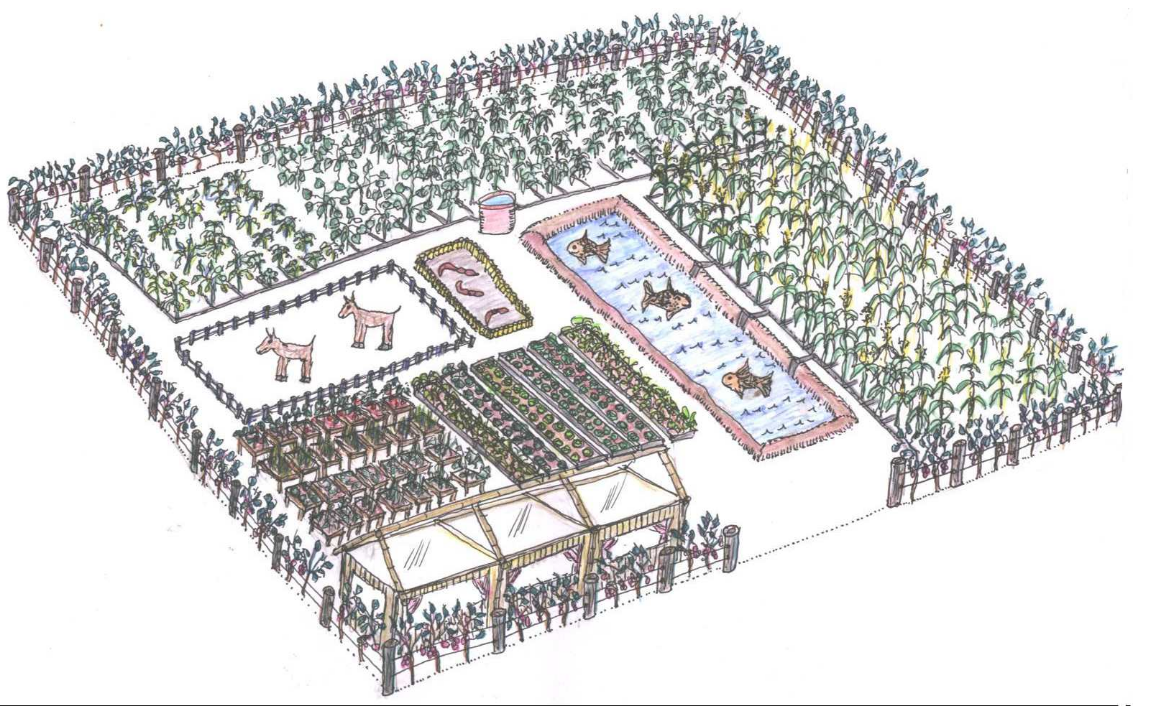

Surely if small-scale farmers can make a go of it on an acre of degraded land in Tibet or Uruguay, we can make it work on a half-acre in the middle of a town whose entire purpose is to support the largest agricultural university in the world.

Of course, the town whose entire purpose is to support the largest agricultural university in the world is, itself, deficient in many of the qualities of progressive thinking necessary to support ventures such as Myrtle's, but that is a whole other topic of conversation.  We will undoubtedly expound upon it when it comes time to start putting in facilities for a goat; we certainly discovered the limitations of the City of College Station when our friends Hugh and Linda first got their chickens.  One thing at a time, though.  Next project:  maximum veggie space.  Then dredging the pond.  Then goats?

Happy farming! 

4/20/10

Down on the Farm

Incarcerating a criminal for a year costs more than sending a student to college.  Anyone who has actually sent a student to college for a year, you can take a second to breathe before continuing to read.  Myrtle will wait for you, she's got nothing better to do at the moment.

Prison, make no mistake, is expensive.  The following is not, per se, an endorsement of a movie, since the movie in question is not particularly family friendly, but it is provoking.  Perhaps even provoking of thought, if you care to think about such things (or, can get past the Barry White stuff...)


Basically, only the 'Law and Order' conservatives of the world think we ought to continue with this bizarre system.  And if you find yourself of that ilk, let Myrtle dissuade you.

There has never, in the 7,500 recorded historical years in which government has been tracked, been a public policy decision based on fear which has not turned out to be a losing proposition.  Fear is, let us be blunt, stupid.  Fear for one person is useful; picture a bipedal mammal of small strength, dexterity and minimal speed on the veldt, being chased by a saber-toothed cat; fear gives such a creature heightened awareness, which may be the difference between life and death.  But fear for two or more persons, in a deliberative capacity?

It leads such persons to make major mistakes, which compound the original problem.

Incarcerating non-violent drug offenders, for example, is done because our more conservative citizens are afraid of those whose moral development requires a little additional attention.  However, the fearful turning-away from the real problem -- people who have not a single hope that following the rules will result in anything positive -- turns out hardened, violent, antisocial personalities beyond the hope of repair.

No, prison, for the most part, is a waste of taxpayers money.  It postpones the life of crime for the incarcerated, but it doesn't end it.  It exacerbates it.

So, should we just, as Mr. Lypshytsky suggests, simply let them keep our car stereos?

No, that wouldn't work, either.

But there is an idiomatic expression about prison, which Myrtle believes we would do well to remember:  "Down on the farm" might be a cliche'd expression of remembrance of yesteryear's chain-gangs, but the chain-gang mentality ain't all bad.  We have a serious problem in this country -- most of our food is contaminated, overpriced, and grown far too far from its final destinations.

Why don't we turn our prison population loose on a series of microfarms?  Halfway houses for those who need to learn skills, need to be productive, and need to have better nutrition and personal habits?  A series of 5 acre plots all across the country responsible for producing 10 tons of produce per year for local grocers, in addition to providing their own sustenance.  Apart from the initial outlay for land, and the investment in training for guards/mentors, it would pay for itself in less than a decade, without even accounting for the decrease in recidivism which would surely follow.

Myrtle's just sayin'.  If y'all want to continue subsidizing a system which has devolved into nothing better than a training ground for tomorrow's violent felons, you are more than welcome.  Myrtle thinks that's a losing proposition, but hey, she's just an incarcerated chicken.  What would she know?

Happy farming!