Showing posts with label backyard pond. Show all posts

6/30/10

Wetlands D'Amour

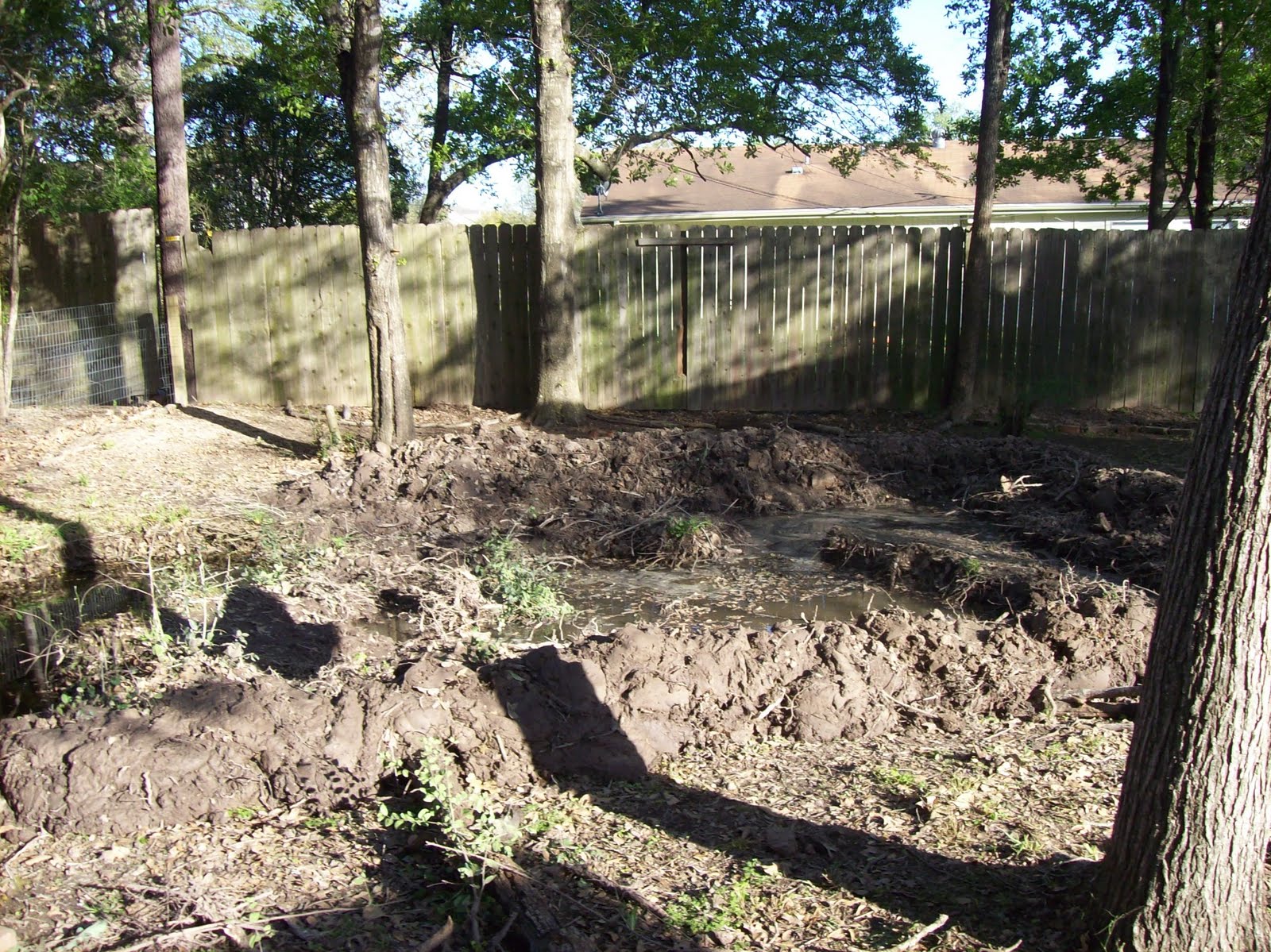
The long-term plan at Myrtle’s place is to receive as much of our dietary protein as possible from catfish raised in our backyard pond.  However, while waiting for the July and August dead period when our pond (presently 3’ deep) is completely dry, so we can dredge to our eventual planned 10’ depth, we have spent our few free hours simply enjoying the emerging ecosphere which would not have existed had we not picked up our shovels.

There are tiny frogs galore; we have a turtle (newly christened “Yertle” – ask a toddler if you don’t know why); mockingbirds, blue jays, robins and a few other species of birds we haven’t yet been able to identify all bathe there; dragonflies of every imagineable shape and size flit and float.  It is, in short, a very pleasant place to just sit and watch.

Which brings us to a grand suggestion made by the United States Department of Agriculture (USDA) Natural Resource Conservation Service (NRCS):  If you don’t have the space or time to make a full-fledged pond, you can still create an ecological oasis of sorts by creating a backyard wetland.

The advantages to you and your environment make it an excellent idea:
  • A mini-wetland can replace the important natural functions of wetlands that may have been lost when your community was developed.
  • A wetland in your backyard will temporarily store, filter, and clean runoff water from your roof and lawn.
  • It will provide habitat for many interesting creatures--from butterflies and bees to salamanders, toads, frogs, and birds.
  • Most wetland plants do not require standing water to grow successfully, and will survive even in an area that appears dry during most of the growing season.
  • Even if you do not have a naturally wet spot, you can establish an area in your yard to grow many of the beautiful plants associated with wetlands.
Building a wetland area is really pretty simple; just dig a wide hole in the ground where water will collect when it rains, and stay there most of the time.  If it’s completely dry a few months a year, it’s no big deal – that’s true for most wild wetlands, too.  Many, many interesting plant and animal species depend on this type of environment, which is why you have to spend so much of your time tracking down your kids and telling them to get out of the drainage ditches where they are foraging for fascinating critters they saw hopping across the road.

The one big detriment most folk see to the idea of the backyard wetland, apart from their nosy homeowner’s association, is mosquitoes.  Even here, though, there are some significant advantages to putting in a wetland, and there are some fairly effective countermeasures you can take to protect yourself and your family.

For starters, ask at your hardware store for something called a “dunk”.  This is a product which will come either as a floating ring or as a sinking “torpedo”.  It puts a bacteria, bacillus thuringeinsus, in the water, where it then feeds on mosquito and fly larvae.  Numerous studies show that BT is a highly specific pathogen, and does not have any impact on useful vectors; in particular, we were concerned with whether it affected honeybees, and the answer is an emphatic ‘No’.

Obviously, everyone is better off when live and healthy mosquitoes choose to lay their eggs in water where those eggs are doomed from the start due to BT treatment; since there is no way to control water in the wild (creeks, etc.), it is better to have mosquitoes laying their eggs in backyard wetlands which have been treated.

Next, to guard against the inevitable attacks from the current generation of mosquitoes, we recommend a layered defense consisting of a series of highly scented herbs.  Mosquitoes are famously averse to the Citronella plant, but there are a host of other plants whose aromatic qualities overwhelm their ability to sense sweat, which is their big clue that a large, tasty mammal is present.  Try planting groupings of the following plants between your wetland and your outside activity areas:
  • Catnip
  • Basil (particularly the varieties smelling strongly of anise, such as Thai or African Basil)
  • Mint (especially Peppermint)
  • Rosemary
  • Lavender
  • Dill
If you live in a warm enough zone, having planters with citrus trees like lemon and lime would also be helpful.

The trick is to cluster large groupings of these strongly scented plants around and about so that there is always at least a hint of the smell no matter where you go in the yard; this ensures that the little varmints are always at least a little confused.  Mosquitoes are very much like human beings in that they crave convenience.  They would much rather pick on your neighbor whose yard is comprised of nothing but St. Augustine grass and one of those silly little citronella candles; they avoid the point source of irritation and make a beeline for your neighbor’s carotid artery, while you comfortably sit in the confusing maze of unfamiliar and irritating (to the bug) odors comprising your more sprawling landscape.

Speaking of what to plant, depending on the amount of shade and the pH of the soil, you have a huge selection of plants you can place in your new wetland, potentially satisfying even your pesky homeowner’s association, if need be.  A partial list from the NRCS:

Native Trees Tolerant of Wet Soils
  • Red and silver maple (Acer rubrum, A. saccarinum)
  • River birch (Betula nigra)
  • Catalpa spp.
  • Ash (Fraxinus spp.)
  • Cottonwood (Populus deltoides)
  • Swamp white oak (Quercus bicolor)
  • Sycamores (Platanus spp.)
Native Shrubs Tolerant of Wet Soils
  • Red osier dogwood (Cornus sericea)
  • Leatherwood (Dirca palustris)
  • Winterberry (Ilex verticillata)
  • Inkberry (Ilex glabra)
  • Pussy willow (Salix discolor)
  • Shrubby cinquefoil (Potentilla fruticosa)
Native Herbaceous and Flowering Plants for Sunny Moist or Boggy Conditions
  • Cattails (Typhus spp.)
  • Joe-Pye weed (Eupatorium maculatum)
  • Great blue lobelia (Lobelia siphilitica)
  • Ironweed (Vernonia noveboracensis)
  • Blue flag iris (Iris versicolor)
  • Boneset (Eupatorium perfoliatum)
  • Cardinal flower (Lobelia cardinalis)
  • Goldenrods (Solidago spp.)
  • Marsh marigold (Caltha palustris)
  • Swamp milkweed (Asclepias incarnata)
  • Gentian spp.
Native Herbaceous and Flowering Plants for Shady Moist or Boggy Conditions
  • Bee balm (Monarda didyma)
  • Arrowhead (Sagittaris latifolia)
  • False hellebore (Veratrum viride)
  • Turtlehead (Chelone spp.)
  • Skunk cabbage (Symplocarpus foetidus)
  • Royal fern (Osmunda regalis)
  • Netted chain fern (Woodwardia areolata)
  • Jack-in-the-Pulpit (Arisaema triphyllum)
  • Cinnamon fern (Osmunda cinnamonmea)
  • Shield ferns (Dropteris spp.)
  • Lady ferns (Athyrium spp.)
True Bog Plants Requiring Low pH and Sun
  • Sundews (Drosera spp.)
  • Butterworts (Pinguicula spp.)
  • Pitcher plants (Sarracenia spp.) 
You don't have to go as rustic as Myrtle's place, of course.  Pictured here is the sort of fancy backyard wetland that would make the folks at Better Homes and Gardens proud.  Myrtle just finds it a little non-chicken-friendly, is all.

There is a wetland for every taste, however, and we highly recommend picking up a shovel and having at it.

Happy digging, and...

Happy farming!

3/28/10

Can You Dig It?

We're getting closer and closer to realizing our vision.  A 900 square foot house sitting on a 9000 square foot lot -- you can see by our purchasing decision where our values lay. 

Anyway, the creme-de-la-creme of our little project, the capstone, as it were, will be our 500 square foot, four-to-five foot deep fish pond.  We've finally got the 500 square foot part down; the depth is another matter.  We're planning on waiting for this August to dredge the portions which are currently underwater, but this weekend we managed to reach a milestone.  We have put up a bank around all 100 linear feet of the pond's perimeter, and have established where to plant the pine trees which will form the erosion barrier.  this week, we will be planting our mosquito-repelling herbs (basil, catnip, and anise) and we will begin research in earnest for our aeration project -- a windmill, hopefully from an engineering design circa 1850 or so.

There are a lot of other goodies to show you this upcoming week, but they will have to wait.  Friends have invited us over for grilled shrimp and yummies from their winter garden.

Happy farming!

11/22/09

Micro Aquaculture - Backyard Catfish Farming

So, we got to thinking a while back.... what crazy idea have we not yet actually tried?

Because, hey, this is us we're talking about.  If we haven't tried it yet, we're going to do so soon, right?

Anyway, the answer is... backyard catfish!


We had this discussion a couple of years ago, after clearing the underbrush on the back corner of the lot; frankly, when we bought the house, we had to just accept the realtor's word for the validity of the most recent survey.  See, the yaupon holly had grown so thickly under our 150+ year old oak trees that you literally could not access fully 1/3rd of our property.

And after we had cut most of it to the ground, we obviously had to next begin the laborious process of removing the stumps.... which left some gaping holes in the ground... which then filled with water the next time it rained.  Between that and the size of our water bill the first year we planted corn.... the wheels started turning.  Why not have a pond back here from which to water the vegetables?  And if we're going to have a pond, why not keep fish in the pond?

This crazy idea is actually not so crazy as it sounds.  On a somewhat larger scale, my grandfather did the same thing on his land back in the 1970s.  Of course, his land was several acres on the Llano river between Llano and Castell, and if you've never heard of those places, you aren't alone.  It's not exactly urban, like our little plot of land is.  But just because we're in the middle of the city doesn't make our pond any less fish-friendly.

So, like all other great ideas, it started with a bit of laziness and a bit of imagination.  Throw in a little internet research, and we found that we were not alone.  In fact, there's even handy video footage available for those whose research skills tend to fade to test-pattern levels of attention when faced with wordier "how-to" manuals.

We're not sure we'll be naming the catfish, though.  We may never plan on eating Big Myrtle, but fried fish with hush puppies is bound to become a 4th of July tradition at Myrtle's place.

This is a long-term project, though.  I've got to dig the pond a lot deeper, figure out how to line it cheaply and in an environmentally sensitive way, control mosquitoes, and build a windmill-driven aeration system.

Any ideas would be appreciated.  Drop us a line if you have any suggestions!

Happy farming!