3/17/11

Electrifying the Eightfold Fence

The earthquake and tsunami damage which led to calamitous events at the Fukushima I Nuclear Power Plant in Japan lay plain the futility of attempting to end catastrophic failure through engineering.

There were several backup plans in place to prevent a meltdown of the six reactors at this facility, some of which were dependent on the idea of either having access to the electrical grid – which failed because of the earthquake and tsunami – or else, barring that, to being able to generate sufficient energy for the cooling systems with on-site generators – which failed because of the earthquake and tsunami.

The control rooms for some of these backup systems were submerged in floodwaters; years of careful planning and consideration were rendered completely useless in just a few short minutes of Mother Nature getting up and taking a brief stretch. Between infrastructure (toppled because the land on which it lay suddenly got fundamentally fed up with being where it was), and water (appearing in massive quantities where no water had been before), the engineers in charge of safely operating this nuclear power plant were simply overwhelmed.

Why would a nation like Japan, whose proud civilization has withstood century after century of natural disasters, including earthquakes, typhoons, blizzards, mudslides, red tides, plagues, and volcanoes, put itself in danger by relying on nuclear energy, when one small misstep – let alone the series of missteps which were taken at Fukushima – could cause a bigger disaster than had ever been seen before?

The answer is simple. Japan does not have much in the way of natural resources. They import all of their oil, virtually all of their coal, and most of their raw materials for manufacturing. To be self-reliant, the Japanese have developed an extensive energy grid, of which nuclear power is a major component.

We at Myrtle’s place have been thinking about energy production and consumption a lot lately, and the events in Japan have put a morbidly human face on the question. The catastrophe would have been bad enough had it involved only natural sources of destruction. Entire towns were washed out to sea – the satellite photos show before-and-after scenes that simply defy the imagination.

But because the nuclear genie was let out of the bottle, the story of the Sendai earthquake has become a tragic cautionary tale about the dangers of dependence on centralized energy grids. We say “centralized energy grids” and not “nuclear power” for a very important reason – while nuclear radiation is an easily sensationalized danger, the very palpable fact is that any other sort of power generation plant would have proven equally incapable of dealing with the overwhelming force of shifting tectonic plates and surging tidal waves.

Some other forms of energy production would present their own dangers – petrochemical explosions, for example, in the case of oil or gas powered electrical plants; chemical exposure for coal plants; etc. – and all would have equally been incapable of producing, for the foreseeable future, electrical power on the scale the civilization built up around them requires in order to continue.

We would like to suggest the radical idea that the alternative to imported oil, or nuclear power, or coal, or whatever source is currently being used in whichever part of the industrialized world we are looking at, is not new electrical plants relying upon a renewable resource, or any other sort of energy alternative.

Wind farms, large-scale solar power plants, wave power plants, hydroelectric dams, these are all impressive engineering marvels, and they are all superior to the use of fossil fuels, in that none of these alternatives require spewing greenhouse gasses into the atmosphere, but they all also feed the structure which places civilization in danger in the first place.

The alternative to the current energy structure is a different process altogether.

Currently, energy is dispensed from the top down in a centralized model. The “grid” is not really a grid at all; it is a giant plinko game, in which energy is dropped in from the top, usually in the form of a particular kind of fuel (say, oil) which is processed in one central location (say, petroleum refineries along the Gulf of Mexico), and then scattered along various paths, with increasing costs passed along at each of these steps, until it finally falls into a slot (say, the tank of your car).

Renewable energy sources like solar or wind make sense not just because they don’t involve much pollution (which, of course, is a strong argument in their favor), but more because they enable a paradigm shift in terms of how energy is distributed.

Rather than relying on a central electric generation station, energy comes from discrete points such as your own home solar and wind generators, or distribution points much like vending machines. Japan, in fact, had recently announced the creation of many of these sorts of outlets for electric vehicle recharging.

This is hinted at with one of the favorite phrases of the DIY (“Do it yourself”) movement: off the grid. Getting off the grid typically evokes images of a solitary shack in the woods, or even out in the desert of West Texas, where solitary hermits ranging from benevolent Grizzly Adams types to raving lunatics like Ted Kaczynski types, have turned their backs on civilization.

We think these hints are drawn with fear and trepidation, both on the part of DIY devotees and also on the part of a civilization which has grown afraid of its own shadow. Mainstream consumers do not even dream, much less plan, of off grid living, because the image has been sealed off from them. The propaganda war has been won by the fringes; there is no room for this new way of thinking for the vast majority of us, who live comfortably in the middle.

But “off the grid” should not apply only to individuals; it should apply to us all, collectively, not just “also the middle”, but especially the middle.

As it stands now, most large businesses have already made contingency plans to at least temporarily operate in the absence of city utilities – backup generators for their various computer server farms, water storage, cooling facilities, the works – and some have even made the logical leap to installing wind and solar generators to produce at least some of their energy needs on a permanent basis.

Homes, though, are probably an easier place to start. Some homeowners have already begun making the switch to wind and solar power; most specialists in the conversion of domestic buildings to wind and solar suggest that maybe a quarter of home energy needs can be met by sun or wind sources. This, however, is a gross understatement, based on a couple of fundamental misconceptions.

First, and foremost, the engineering of homes is not typically all that energy efficient. We have dark-colored roofing materials, thin walls, windows in the wrong places, and a host of other problems, all of which can either be avoided in construction phases, or corrected when retrofitting one’s home for energy efficiency. Painting our roofs white, or better still, covering them with solar panels or solar tiles, adding insulation and planting sun-absorbing trees and vines in the appropriate spaces in our landscapes, correcting our windows and window treatments, these are all fairly simple steps to take.

Further, our lifestyles can easily be changed to consume less energy. Some changes – like riding a bike instead of driving a car – would be considered radical and difficult. Others, however, like replacing light switches with rheostats, are basic and simple.

Look around your home for any appliance with an LED light that stays lit when the device is off – put it on a power strip, and turn off the power strip when not using the device. Presto! If you are a typical American, you have just cut on average 20% off your utility bill. Really? Yes, really. Televisions, computers, modems and routers, printers and faxes, coffee makers, bread machines, microwave ovens, stereos, DVD players, game consoles, these are all gadgets which expend a lot of energy even when they are technically “off”.

Second, sources of energy like solar, wind, and geothermal do not have to be used exclusively – they can be “layered”. Why would we not fit homes with solar panels on the roof, on the garage or carport, on the fence line, etc., and also set up wind turbines on the roof and in the corners of the yard, and set up a geothermal system to (at the very least) power the HVAC system? Each of these sources of energy are currently available, and in spite of the fact that each is still a speciality niche for highly specialized contractors, each can be had for roughly $10,000 for the typical 1,500 sq foot American home on a .25 acre lot. Given the price of housing, adding $30,000 – which seems like a lot if taken by itself – is not really that much. It seems especially paltry when you add up 30 years of utility bills you won’t be paying, during the life of your mortgage.

There are plenty of examples of fully functional off-the-grid homes the size and scale of a typical suburban house, suggesting that it is possible (given the political and economic will) for houses currently consuming electricity generated at centralized power plants to not use one watt of “grid” electricity.

What would that do to our civilization?

Seriously, stop to consider the implications of not only having an individual here or there off the grid, but having entire communities off the grid. Rather than being pot-smoking, birkenstock and tie-dye wearing, hummus and pita-chip munching hippies, or else crazy pipe-bomb building math geeks with delusions of grandeur, those “off the grid” folk who generate their own power would be your next door neighbors, with whom you have conversations about the weather, or your favorite local sports team, or your childrens' schools.

Picture the next natural disaster – say, a hurricane or a blizzard – and think about all those stories you have heard in the past about so-and-so many thousands of people having to do without electricity for days and weeks and months at a time. Now imagine that at least half, or even just a third, of those people still had power and could help out their immediate neighbors who were not so lucky.

The next natural disaster wouldn’t seem nearly so bleak, would it?

Added to this communitarian idealism lay some tactical and strategic benefit for countries fighting terrorism; Mother Nature is not the only one to target power plants. But suppose, just suppose, al-Qaida or other miscreants wanted to disable our energy infrastructure... and they couldn't, because there was no target? We would be able to survive an attack as a group because we would be meeting our needs as individuals.

The dilemma posed by off-the-grid thinking is just this: far too many people have co-opted this idea, and made it essentially an anti-social objective. Getting off the grid, however, is not something for individuals. It is something for everyone. We must replace the grid with 6 billion individual cells; we must stop trying to give “power to the people” and instead let the people make their own power. We must, in essence, become collectively individual. We must be independent together.

Something of the spirit of this idea is discussed in Laura Ingalls Wilder's “Little House on the Prairie” books. Pa Ingalls makes a frequent point of emphasis in stating that everyone in the American West is “free and independent”; at the same time, neighbors do not think twice about helping each other out with various chores or situations that none of them could survive alone – things like raising a barn, digging a well, surviving malaria, or any of the other menaces pioneers faced.

In the 21st century, in urban and suburban areas all around the world, we are facing a new kind of pioneer difficulty. We live in an interdependent culture, economy, and ecology. What happens anywhere affects everyone everywhere. The benefits of that kind of interconnectedness are obvious, but so too are the dangers. The Kaczynski method of insulating oneself against those dangers is obviously wrong, however. Instead of cutting ourselves off from each other, we must find ways of helping each other regain our status as “free and independent” citizens.

If all of Japan were electrified via solar, wind, wave, geothermal, etc. sources of energy, no one would be talking about whether or not the Fukushima meltdown may prove to be as bad as Chernobyl. Instead, they would be helping each other bury their dead, rebuilding their towns, and moving on.

Pray we all learn the appropriate lessons from this tragedy. We at Myrtle's place have a ten year plan in place to get “off the grid” while still living right smack dab in the middle of the city. Ten years sounded like a long time when we put the plan together, but it gets shorter by the day; hopefully, your family can get started on your own plans soon too.

Happy farming!

3/8/11

Wherein a Good Idea is Laid to Rest....

“An expert is a man who has made every mistake which can be made in a narrow field.”
Niels Bohr

We have a very fine solar-powered textile dehydration unit (aka “clothesline”) in our backyard.  It’s painted the same blue color as the trim on our house, so it is very inconspicuous, even for those who can see it, and thanks to some clever landscaping, that does not include very many people.  Our next door neighbors can see this contraption, but that will soon change, as our new black currants,  blackberries and grapes on the eastern side of the house reach maturity.

So, that part of our laundry de-mechanization has gone according to plan.

However, as we reviewed the budget (both fiscal and physical) this spring, we came to the realization that now just is not the time to invest in a hand-cranked laundry ringer.  The calculus is simple – we have approximately $5,000.00 in capital improvements we can make each year, so we have to budget that money very carefully, with an eye towards return on investment (ROI).  In addition, we are operating at a deficit on time available to work on our various projects.  If we are going to invest more money, it needs to be for something which will give us more produce, or barring a financial ROI, it must give us more time.

Put simply, Mr. Myrtle Maintenance has a day job; between home, chickens, and children (not to mention various friends, acquaintances, and stray needy folk, oh and a home delivery herb business) Mrs. Myrtle Maintenance has three day jobs.  Neither of us has the time or energy at the end of the day to hand-crank that blasted manual laundry contraption.  And the cheapest one we found would have run us several hundred dollars.  Several hundred dollars, and it will increase our time deficit?  No thank you!

We suspect that our willingness to put our money where our laundry is will increase dramatically once our youngest farm hand is old enough to turn the crank.  Child labor laws, after all, only apply to those who would pay their under-aged assistants.  Room and board don’t count, right?  So, don’t expect us to follow through on our manual laundry experiment for at least six or seven more years.

That having been said, our failure to launch on this particular project is an excellent example of balancing personal values with the scientific method in action on a small-scale sustainability project.  Science, remember, is not the art of explaining what we ought to do; it is the art of explaining what is observably true – there are some major caveats to that definition, of course, but we needn’t be concerned with precision here.  Our point is that we must continually balance what is true with what we ought to do about it.

The ancient Greek philosophers were the first recorded rhapsodizers about the tension between mythos and logos – between passions and reason, between Dionysus and Apollo, between DeForrest Kelley and Leonard Nimoy.  However, because the Greeks had their heads in the clouds (or, at the very least, in their wineskins), they pondered all sorts of ridiculous questions which had nothing to do with home and garden.  Plato’s “Allegory of the Cave”?  Puh-lease.  How was that supposed to make someone a more productive farmer?

We kid, of course; there is much to be gained from reading Plato, Aristotle, Demosthenes, and the gang.  However, there is a kernel of truth in the notion that the Greeks hid as much wisdom as they uncovered.  Prior to the rise of the Greek pantheon, the most prominent Mediterranean deities had strikingly different personalities from those we know as “Olympian”.  And even the Olympian gods and goddesses we think we know are filtered through 2,500 years of literary interpretation, and may bear little resemblance to the gods and goddesses the Greeks actually worshipped.  For evidence see:  Percy Jackson and the Olympians, or Disney’s Hercules.

Many heavenly job duties were reassigned when the military might of the hellenic peoples overcame the more pastoral sensibilities of the predecessors of the Greeks – and yes, we know, there were some powerful military predecessors, too – just look at the surviving Minoan artifacts on Santorini, provided you’ve got a clear enough head after too many shots of ouzo.  The point, though, is that the number of Greek gods and goddesses imbued with martial zeal and skill far outweighs Greek gods and goddesses imbued with knowledge of home economics, agronomy, or poultry science.

And those who do represent non-military ideals are far different from their predecessors.

Aphrodite, for example, is often considered a hellenized version of Ishtar or other manifestations of prehistoric “Earth Mother” goddesses.  So, too, with Demeter.  And many scholars attribute to the Eleusinian Mysteries – rites related to worship of Demeter and Persephone – ritual elements which seem strangely out of place for a mere “garden goddess” like Demeter – eroticism practiced underground for the purpose of ensuring crop fertility – these folk were clearly cut from a different cloth than the protestant west of modern America.

The division of divine job duties can provide countless hours of fun for those of us who enjoy watching scholars of obscure subjects get into nasty debates no one else can understand, because every classics scholar worth his or her salt is absolutely sure of the position they have painstakingly researched, in spite of the fact that equally qualified scholars with opposing points of view are fairly easy to find; the aforementioned Aphrodite – Demeter – Ishtar comparison, for example, for which of course there is only conjecture, not proof, could get a Greek specialist and a Sumerian specialist spitting at each other by their third respective glasses of wine.

Pardon the tangent – what does this have to do with our decision to keep our electric washing machine, even in the face of our own strong arguments against doing so?

Just this – we struggle constantly not to be trapped by ideology, particularly of our own creation.  Far too often, people are trapped by strong-armed arguments about what ought to be, even when those visions fly in the face of what is.  We have often said “You can be a fundamentalist anything,” and it is true.  We would love to have the perfectly independent “off-the-grid” homestead, but we don’t live in a perfect world. 

Compromises must be made which ensure that the larger vision is retained.  Eventually, civilization as it is crosses the borders of our dream worlds as we think they ought to be.  Ted Kaczynski faced this dilemma when loggers invaded the woods where he had built his survivalist shack; we think he picked the wrong solution to this intrusion on his dream world.  If he’d just swallowed some pride and kept grading papers at Berkeley instead of trying to divide himself from the human race, he’d have a lot more garden space now than he currently enjoys.  As Spinal Tap reminds us, “It’s a thin line between clever and stupid.”

In the case of the Greeks, in the grind of time and changing tides of civilization, we lost the poetry of Sappho, but we retained the recipe for baklava.  You win some, you lose some.  At Myrtle’s place, we have given up on quickly getting rid of all of our electrical appliances; it’s a mistake we have learned and moved on from.  We’re still investing time, sweat, and money in other environmentally friendly ideas, though.  We hope you do, too.

Happy farming!

3/1/11

Rest on Your Own Laurels, not Somebody Else's!

Serendipity, synchronicity, coincidence, and self-organizing behavior are all human linguistic attempts to explain those weird little occurrences which make us all go, in a pre-verbal sort of way, “Whoa, dude, how did that happen?”  Déjà vu, ESP, clairvoyance, clairaudience, and any number of other hokum-pokum, in which we don’t really believe, are nevertheless always on the menu, in spite of our innate skepticism, simply because every now and then, reality benefits us (and, yes, sometimes proves detrimental) in such a way that we take it personally.

“What are the odds?” someone might ask.  The answer, of course, is “100%” because, after all, whatever the weird thing was, hey, it actually happened.  Therefore it was quite probable.  Quod erat demonstrandum, baby.  (Cue the peanut gallery: “Ooh, you speak French!”  and, yes, we stole that joke from Thomas Dolby…)

We had such an episode this past weekend, when our delicious Saturday began with a visit from a new Friend of Myrtle who works for an agricultural education organization we will probably talk about at greater length at some future date (once we have done our research, and gotten perfunctory permission to discuss them by name, though we can’t imagine they would turn down free publicity).  This new Friend of Myrtle brought along a sample of their new educational product, an herb wheel, which is a circle of pictures of herbs, along with a description and a list of uses, both medicinal and culinary.

As it turns out, all of the herbs on the wheel are also in our garden.  All, that is, except for one:  bay leaf.  Those are pretty good odds, really – out of 12 herbs, we had 11.  Not bad, right?  Except that it brought out our competitive streak.  We resolved right then and there that the next opportunity we had, we would search high and low for a bay laurel tree.

It had to wait, however, as we had other visitors on Saturday for whom to prepare.  Our good friends from Austin were coming to town, and we don’t get to see them nearly often enough, so gardening was put on the back burner.

As fate would have it, though, they came bearing a gift.  A gift for the garden.

Yup.

A bay laurel tree, from The Natural Gardener in Austin.  An heirloom variety, no less.  It will have a place of prominence in our herb garden – in fact, it will hardly be able to avoid prominence. 

In pots, these trees seldom grow above shoulder height; ours is not in a pot, however.  It is right in amongst the rosemary and oregano, shaded on one side by the water oak and the house.  Eventually, it will probably reach somewhere between 10-15 feet, although laurel trees are notoriously unpredictable in their growth habits in the wild; conceivably it could hit as much as 30 feet tall, though we really doubt that will happen in our yard – in its native Mediterranean climate, it has the luxury of sending down deep roots through sandy and rocky soils; here, it has to scratch and fight with East Texas clay; it will probably peter out after four or five years of vertical growth, and then settle for being part of the lower canopy.

Professional Institute of Agriculture and Envi...Image via Wikipedia
Still, this will be the tree around which our other herbs circle.  This will be advantageous in the middle of summer, as the laurel will add shade to our western exposure, and will shield our mint and basil plants from the afternoon sun.

Then, too, there are the numerous benefits beyond our self-indulgent (some might say petulently self-centered) desire to have a complete set of herbs.  Laurus nobilis is an evergreen, which means that in the middle of winter, when the only tree in our front yard which still has its foliage is our young loblolly pine, our rosemary, oregano, lavender, and curry plants will no longer be lonely.  The glossy leaves of the laurel will still proudly proclaim that herbalists live here.

And while most cooks are familiar with the dried bay leaves which adorn so many winter soups and stews, there is much to be said for fresh bay leaves, not only as a garnish, but also as a crushed (or even powdered) seasoning additive.  The whole leaf is typically removed from the dish prior to being served, as it has jagged edges capable of causing some serious gastric distress; however, when crushed, the leaf is perfectly comestible, and adds a subtle depth to most meats and stews. 

The berries, too, are nutritious, and create numerous culinary and medicinal possibilities.  Massage and aromatherapists swear by bay laurel scents and poultices as a treatment for everything from rheumatoid arthritis to hypertension.  The fortunate blend of essential and fatty acids make bay laurel a good addition to a health-conscious diet.

And, really, can anything be more symbolically fortuitous than adding the laurel, which first the Greeks and then the Romans decided was the fitting crown of champions, to the garden?

Except perhaps a giant stone with a sword stuck in the middle, or a totem pole, or a crystal pyramid, or a patch of four leaf clover, or a giant burning wicker man, or…. Well, you get the idea.

Happy farming!
Enhanced by Zemanta

2/25/11

Favor Curry When You Want to Curry Favor

As part of the spirit of scientific inquiry, we believe strongly in inculcating an adventurous streak in the garden.  Naturally, therefore, when we encounter a new or unusual plant in the nursery, we are apt to bring it home without asking too many impertinent questions.

Such was the case a couple of years ago when perusing the herbs at Farm Patch and we discovered something called a “curry plant”.  We vaguely knew it couldn’t possibly have anything to do with curry seasoning, as curry seasoning is A) yellowish-brown, while the “curry plant” is a vibrant, icy blue, and B) made of a variety of herbs and seasonings, rather than just one, something we are familiar with from having listened to a learned discourse beyond our ability to follow on the part of competing cooks hailing from the Indian subcontinent.  You think religious conflicts can be contentious?  Just get two chefs together with a different idea about what constitutes good curry – make sure you have a good solid surface to hide behind, first, though.

Nevertheless, we brought home our plants, stuck them in the ground (with an admixture of chicken poop and neglect which is almost universally healthy for garden plants), and watched them grow.

Once we were certain that they would “make it” through the hot Texas sun and also through the freakish snow storms we have experienced the last four or five years, we decided to figure out what we actually had on our hands.  Turns out, it’s an unusual plant for most gardens in the U.S., but it is not at all a “rare” plant.  The proper name is Helichrysum italicum, and it is well known in Sicily, not as a culinary herb, but as a medicinal herb, and also (more commonly) as a cat deterrent.

The name “curry plant” probably got afixed due to the strong pungency of the herb; it does, in fact, smell a lot like a good curry – regardless of whose definition of “good curry” you happen to be using – and the flowers, which come out on wonderfully odd bulbous extensions, like a pair of eyes on stalks, are a bright, vivid yellow, adding to the impression that it just somehow has to be related to curry, in spite of all the accumulated logical evidence that it ain’t so.

The pungency is strongest in the floral extensions, although you can smell it year round.  Historically, an oil was pressed from the petals of the florettes, and used as an anti-inflammatory, a fungicide, and as an astringent.

We have not made any of these uses of the plant, though we have enjoyed it as an interesting perennial, providing color even when most of the rest of the herbs have frozen to the ground.  The color is more like a blue-spruce pine tree than anything else to which we might compare it; it provides a lovely contrast to the deeper olive tones of the rosemary bushes and the some-time vibrant oregano, which is also a perennial, though not as hardy.  Our lavender plants also bear some resemblance to the curry plant, and between this cluster of perennials, our herb garden is never completely bare.

We have also observed that the pungency of the curry is exceptionally useful as an attractant for our local bee population, and, as the Sicilians have long known, as a repellant for feline garden intruders.  This is particularly important in our garden, as we want as many bees as possible, but we also want as many hummingbirds as possible, and having cats lurking in the herb garden is less-than-optimal as far as the hummingbirds are concerned.

Then, too, we are growing catnip for a variety of reasons – it makes an excellent tea, it looks lovely in herbal bouquets, and it is part of an effective triumvirate of mosquito repellant plants – but obviously having a large bed of catnip would be like an open invitation to the copious feral feline population.  By masking the catnip smell with the curry plant smell, we hope to minimize the unintended consequences of growing our more cat-friendly plants.

Depending on the size of your garden, you may not have room for an inedible herb; if you’ve got the space, though, let us highly recommend Helichrysum italicum.  Curry plants are quirky, stinky, and hardy.  Exactly the qualities likely to curry favor with Myrtle.

Happy farming!

2/23/11

Hot Enough For Ya? (Late Winter Edition)

Birds do not have the mammalian form of the neurotransmitter receptor known as “vanilloid receptor subtype 1” (VR1).  Mammals have this ion channel receptor, which is stimulated by heat and physical abrasion, in addition to exposure to chemicals from the vanilloid family.

Why do we care, you might be asking.  As it turns out, one of the more common vanilloid chemicals, readily available in most home gardens (or at the very least, in virtually every farmer’s market or grocery store), is capsaicin, the chemical responsible for the “heat” of hot peppers.

Plants from the Capsicum genus have evolved a particularly handy means of protecting their seeds from the grinding molars of mammalian herbivores, whilst and at the same time allowing avian fruit foragers to consume the seeds whole, then distributing them far and wide in ready-made packets of fertilized seed pre-treatment (gross, but effective).  The seeds of hot peppers (and related plants) do not contain any capsaicin, but the surrounding tissue – particularly the whitish placental tissue, though to a lesser extent all the rest of the fruit as well – is chock full of the stuff.

Birds feel no effects whatsoever when eating these fruits and seeds, which is why chili powder is considered a good squirrel deterrent in bird-feeders.  The squirrels can’t stand the stuff (more on that in a second), but the birds are entirely unaffected.  Provided you don’t scare them off with unusual scents or sights, you can get your birds to eat spicy versions of their current favorites, and they won’t even notice the difference.

So.  Why are squirrels (and other mammals) affected by hot peppers?

Recall that the VR1 receptor is stimulated by heat and physical abrasion, in addition to the presence of these chemicals.  Essentially, the vanilloid chemicals (in this case, capsaicin) overwhelm the neural pathways in tissues which have been exposed, resulting in altered heat and pain responses.  A 1997 research team first found that capsaicin selectively binds the TRPV1 protein, which resides on the pain and heat sensing neurons.  TRPV1 typically opens between 98.6° and 113° fahrenheit, but in the presence of capsaicin, it opens below 98.6°. 

Obviously, this is body temperature.   Under normal conditions, then, the nerves responsible for telling you that it is hotter than Hades outside – say, 114° or so – will start giving their “Danger, Will Robinson!” full body S.O.S. signals whenever you eat a sufficiently spicy pepper, regardless of what the actual temperature is.  And since the heat-sensitive neural pathways may be overwhelmed, conceivably the pain network might get in on the act, too. 

A little bit of the essence of pepper, say from a packet of hot sauce from your favorite taqueria, might make you notice:  “Ooh, this is spicy!”  A lot of the essence of pepper, say from a bhut jolokia “Ghost Pepper” on a hamburger, a la Man v. Food, might make you really notice:  “Oh, my.  Please douse my head in a bucket of frozen water, give me an intravenous morpheine solution, and maybe euthanize me for good measure.  If, you know, you’ve got time.  Otherwise, I’ll just crinkle up and die right here.”  A little bit of capsaicin tells you the ambient temperature is extremely hot, even if it isn’t.  A lot of capsaicin tells you you have just been impaled in an iron maiden, set on fire, and thrown off the Chrysler building. 

We love the stuff.

There are all sorts of ironic medical uses being investigated which take advantage of these neurological effects of capsaicin, including pain medications, diabetes medications, and topical treatments for arthritis or fibromyalgia.  Even lung cancer is on the radar for researchers trying to take advantage of the intense response of mammalian neurons to capsaicin.

We are not recommending anything so revolutionary in the home garden.  We are instead intent on focusing on a new application for the use the plants themselves make of this chemical.

We have a critter problem in our chicken coop, you see.  There is a creek which runs roughly parallel to our western property line, from which a long series of oppossum trespassers, for generations, has made the trek to our yard, first for the cover of the underbrush which we have painstakingly cleared, and then for the delicious goodies left in the chickens’ feed dish, and then for any eggs we may have missed on our evening collection run.

Mice, too, take advantage of our hens’ domestic arrangements.  If our birds could be free-ranged, we might not have to worry so much, given that they would be gathering their daily nutritional needs from a wider range, but since they have to stay cooped up thanks to the zealousness of the College Station city council in protecting our neighbors from marauding hens, every rodent in the neighborhood has at some point decided to partake of the evening buffet.

Heretofore, our solution to these problems has been to do our best to regulate how much feed is left out, and to do our best to gather all the eggs before turning in for the night.

Now, however, a solution is at hand.

We just need to sprinkle copious quantities of hot chili powder on the chicken’s feed, and on their laying boxes; we will also feed table scraps with peppers to the chickens, instead of putting such items in the compost bin, as we have been doing until now, on the assumption that hot peppers would somehow disagree with the birds.

This will serve multiple functions, which as you know is something we at Myrtle’s place really like.  First and foremost, capsaicin in everything edible in the chicken coop ought to provide all the deterrence we need for opossum and mice.  This is what happens in the wild; it ought to happen in our little domestic slice of heaven, too. 

Next, we already get significant numbers of volunteer tomato and basil plants growing from the numerous seeds which find their way into the garden compost which, as we have mentioned early and often, is basically just recycled deep-bedding from the chicken coop – leaves and chicken poop, a little water and a little neglect, that is the secret to happy plants.

Now, we are likely to also start getting volunteer pepper plants sprouting up all over the place.  We can think of no happier design than a garden in which plants of all varieties randomly crop up in the healthiest, though unexpected, locations.

In the spirit of scientific inquiry, we have verified that our chickens do not, in fact, seem adversely affected by capsaicin, at least not in any visible way.  We put out some jalapeños which had not only started to turn red, but had also started to shrivel.  The hens naturally went for the rice and strawberry tops which were also in the slop bucket first, since they go for the familiar at all times.  However, they did then start pecking at the peppers, and seemed to warm up to them, but only in the metaphorical, aesthetic, sense.  Otherwise, they may as well have been munching on bell peppers or cucumbers.  No jumping around screaming for water or anything.  And trust us, our hens are not shy about jumping up and screaming, should they feel so inclined.

So, along with our “chicken processed” volunteer tomatoes and basil, we will now add another form of volunteer nightshade.  And this will give us plenty of excuses to make even more salsa.  This is a win-win all the way around.  We defy you to produce a healthier or tastier form of mammalian pest control.

Happy farming!

2/16/11

The Alpha Egg and the Omega Chicken

Casual observers of food marketing probably cannot get past the barrage of catch-phrases and keywords with which various advertising media are awash.  Leaving aside for another day a discussion of the whole “corn sugar” propaganda campaign – a campaign which would make Leni Riefenstahl proud – there are some legitimate terms out there which get misconstrued and misapplied and just generally misused, which lead to even greater confusion for the average consumer.

Myrtle can’t hope to correct all such errors, not being trained in nutritional science beyond what we have been able to glean from various sources on our own, but we hope to shed a little light on one such misunderstood nutritional concept, and we hope to make some suggestions for the home garden which may help spread a little heart-love around.

“Omega-3 fatty acids are a family of unsaturated fatty acids that have in common a final carbon-carbon double bond in the n-3 position; that is, the third bond from the methyl end of the fatty acid.”  Clear enough?  So, we lifted a definition straight from Wikipedia.  A definition from Webster’s wouldn’t really be much clearer.

But despite the fact that, for non-chemists and non-biologists, the nature of what an omega-3 fatty acid really is defies easy comprehension, the effects of these useful nutrients are far more easily understood.

A diet rich in Omega-3 can be directly correlated to lower LDL (low-density lipoprotein, or "bad cholesterol") and higher HDL (high-density lipoprotein or "good cholesterol") in the blood.  A proper LDL/HDL ratio is directly correlated to a lower incidence of coronary heart disease, lower blood pressure, more likelihood of weight control, better immune function, better endocrine balance, and a more satisfying sex life. 

Nutritionists refer to this as “a good thing”.

Omega-3 “essential” fatty acids are so-called because as early as the first part of the last century, nutritionists realized that several fatty acids were necessary for normal growth and development, first in laboratory animals, and later in children.  Omega-6 fatty acids are also necessary in the human diet, but are not often found lacking, except in populations affected by famine.  Omega-6 acids, in fact, are found in excess quantities in the typical American diet, being primarily found in meats and fried foods.

Omega-3 fatty acids, however, are frequently lacking in not only the American diet, but in the diets of many populations around the globe, particularly among landlocked peoples, especially in arid regions or areas far from a source of fish.  Vegetarians are also especially prone to be deficient in Omega-3, although less so than omnivores who eat neither fish nor whole grains.

As it turns out, there are multiple potential sources of Omega-3, and no matter one’s food lifestyle, there are multiple options for correcting an imbalance.

To begin with, Omega-3 has to compete in our diets with Omega-6.  The more beef and deep-fried potatoes we consume (burger and fries, anyone?), the less Omega-3 our bodies will assimilate, even if we drown ourselves in fish oil supplements.  Increasing Omega-3 therefore begins with decreasing Omega-6 – not to the point of elimination, just to a level more consistent with what our bodies evolved to digest.  If you want to eat red meat or pork, two or three times a week ought to be your maximum.  The typical American diet now begins with one or both of these meats and asks “what do we have to go with our steak/pork loin/bacon-wrapped steak/pork-and-beef sausage/etc.”?

This is just asking for trouble.

Chicken or other poultry can also cause Omega-6 problems, though less so than their fattier dinner counterparts.

Fish, on the other hand, in addition to being the best source of Omega-3 (particularly the fatty fishes such as salmon or tuna, and to a lesser degree catfish or tilapia), also frequently have a good balance with not too much Omega-6.  Even fishes which do not contain all that much Omega-3 at least have the advantage of not being overloaded with Omega-6.  Sturgeon, pike or trout are all better for you than mutton, pot roast, or ham.

Then, too, there are “Omega Eggs”.  Although the number of studies available is somewhat small, there is good evidence that chickens fed on appropriate greens produce eggs which are high in a-Linolenic acid (ALA), the most common form of Omega-3 available from vegetable sources.

Which brings us to the main consideration when deciding how to get Omega-3 into your diet – there are many, many forms of this nutrient, and not all of them are readily available in your garden.  In fact, the two most important forms of Omega-3, Eicosapentaenoic acid (EPA) and Docosahexaenoic acid (DHA) are not available in any terrestrial plants – that is, in any plants which grow on land.  They are only available from plankton; they are also available from a form of algae known as “spirulina”, a nutritional supplement you can find at most health food stores.  Fans of psyllium will have no problem ingesting yet another swirly, gritty beverage, but those who do not wish to consume their EPA and DHA in this less-than-appetizing form will have to settle for the next best thing:  fatty fishes.

No animal is capable of manufacturing any of the Omega-3 fats on their own.  All animals rely on consumption of vegetable matter in order to maintain these fats, and in turn those carnivores or omnivores who wish to get their Omega-3 from animal sources will have to make sure they are eating animals who have themselves eaten an Omega-3 vegetable diet.

Since EPA and DHA are only available from fish like salmon, tuna, cod, etc., we recommend strongly that these fish be included in your diet.  Vegetarians would likewise do well to either bend their rules to include fish, or at the very least bend their rules far enough to include fish oil supplements.  Those who are worried about toxic levels of heavy metals in fish meal can at least rest easy with fish oil supplementation, because mercury and other toxic metals bind with proteins in the meat rather than with the fatty acids – even fish from polluted waters will produce relatively safe oils, depending on how they are processed.

Vegans who for ethical or other reasons adamantly refuse to include fish can still be healthy, of course, because EPA and DHA are simply the most readily available Omega-3 fatty acids.   The body requires a lot more work in order to process ALA and the other Omega-3’s, but it can be done.  There are a wide variety of plants which can increase the natural Omega-3 levels in a vegan diet:  black currant, flax, shiso, chia sage, lingonberry, purslane, black raspberry, butternut, walnuts, pecans, hazelnuts, and even cannibis sativa are high in ALA.  In fact, the readily available ALA in the oil from marijuana seeds may be one of the strongest arguments available for why this herb ought to be legalized.  Even without cannibis, though, there is clearly a large enough list of garden plants to choose from.

And for those of us who eat eggs, there are obviously enough choices here to provide feed for our backyard chickens to improve the quality and nutritional content of their eggs.  Henbit, purslane, dandelions, sunflowers, rye grasses, etc. ad nauseum, find their way into the coop on a daily basis.  The increase in ALA in the chickens’ diet has led directly to a decrease in LDL and an increase in HDL for Mr. Myrtle Maintenance which cannot be attributed to any other factor, as his diet has not really improved all that much between the last and most recent cholesterol tests he has taken – the single most important factor, in fact, is purely a decrease in red meat consumption and an increase in consumption of backyard eggs, from happy weed-fed chickens.

As soon as we can complete our fish pond project, we will toy with growing spirulina as well, on the assumption that our school of tilapia will be even higher in the best Omega-3 varieties; even if the algae experiment doesn’t work out, though, an increase in fish consumption can only bring more benefit.  Plus, the chickens will certainly enjoy eating heads and offal, and their own health (and by extension, the healfulness of their eggs) will be improved, making it a winning idea all the way around.  Having seen them attack salmon scraps before, we have little doubt how much they will enjoy fresh fish.

If you can’t increase your EPA and DHA from fish consumption, we urge you to at least increase your ALA – put some Alpha in your Omega.  Gobble down those flax seeds and hazelnuts, and give some weeds to your chickens.

Happy farming!
Enhanced by Zemanta

2/11/11

Big Myrtle's Annual "Should we or shouldn't we" Post...

The fastest way to irritate a grumpy person who wants to complain about the weather is to tell them that their presumptions about the weather are wrong.

While the last two weeks have seen some record low temperatures bringing bitter weather to places where it is not uncommon to see people in bermuda shorts in the middle of January and February, the urge to call this a “cold winter” is entirely misleading.  On average, we have actually been well above normal temperatures for quite some time now.  A couple of weeks of colder-than-usual temperatures doesn’t change that fact.

What has happened recently is that the patterns have altered slightly.  There is still more heat in the atmosphere, overall, than has been true in the past; however, it has been distributed in a slightly different way, thanks to ridges of high pressure sitting over the Pacific Northwest, and off the coast of Greenland.  Any low pressure at all in the middle of that mix – such as we have had twice in the last two weeks – will result in the jet stream looping way down the plains into Mexico. 

Usually, the arctic stuff is swept left-to-right by the jet stream sitting high up in the contiguous 48 states, making North-and-South-Dakotacicles, but leaving Texans in our undershirts; instead, the arctic air mass pushed from up to down, leaving Texans huddled in our bedrooms, afraid to put our feet on the cold, cold floor.

We are about to return to a more typical pattern, though, which will see higher than usual temperatures for most of the country, for most of the Spring.  So, for those who wish to slap us for saying, “It hasn’t really been that cold,” you can soon relax.  Before too long, it really will be “that hot”.

This, of course, leads to our annual February conundrum.  How soon do we start putting Spring plants in the ground?

Mrs. Myrtle Maintenance has begun deliveries of herbal bouquets ($10 per container of herbs, write to her for details about subscriptions for weekly deliveries), and is a little concerned because, at present, her bouquets consist almost entirely of rosemary and oregano.

Nothing else is growing, except the curry plant, and that is not a culinary herb, it is an aromatic, misnamed for a style of cooking.  It is extremely good at repelling cats, but it is not particularly good as the basis for an aesthetically pleasing and useful kitchen herb bouquet.

So… we need more herbs, and soon.  Warm weather is just about here…. Do we risk it?

The answer, like so many of our answers over time, is both yes and no.

Yes, it is time to plant some things.  We are moving to a year long rotation of planting sunflowers on alternate weekends, for example, and next weekend is week one, since we are about six weeks out from the date of last frost.  Our odds for this week’s sunflower planting of making it through without any more subfreezing temperatures will be maybe 50%, and if there is a frost, then the percentage of plants surviving subfreezing temperatures would be maybe 25%.  So, this will be a boom-or-bust endeavor.  Fortunately, the seeds are cheap (and getting cheaper by the year, as we save each successive harvest), and the reward is fairly high.

Sunflowers serve multiple purposes in our plots.  They function first and foremost as an attractive flower, brightening the utilitarian greens and browns that dominate the landscape when you grow as many perennials and herbs as we do.  We plant a wide variety of sunflowers, too, ranging from pale yellows with multiple heads, looking a lot like Jerusalem Artichoke, to bright oranges and starbursts on medium sized stalks with medium sized heads, to huge maroons and crimsons, towering overhead and giving our garden a third dimension.

Sunflowers make a delightful centerpiece to an herbal bouquet, providing color on a small scale, and bringing warmth and cheer to any room, and accentuating the vibrancy of the more useful additions, like the basil, mint, lavender, rosemary, etc., which form the aesthetic backdrop for the dramatic flower.

They are useful for our other plants still in the ground, as well.  Sunflowers are a perfect trap crop, distracting the birds and insects from their more delicate neighbors.  We will still lose some berries and tomatoes and herbs to sparrows and mockingbirds, of course, but not nearly as many as we would lose if we did not have the screen of sunflowers in front of the blackberries and nightshades.

Sunflowers also aide in maintaining proper soil tilth, breaking up hard clays, and providing good stubbly mulch when dead, balancing hard-to-erode lignins with all the easily assimilated organic matter we get from our oak leaves.  The chickens also love to eat the leaves and attack the seed heads, so we get them in our compost either in situ, or else later, after having been processed as part of the chickens’ deep bedding.

Sunflowers also assist in water balance, as they draw water up, frequently being able to grow when the natural source of moisture is many, many feet below the surface.  This means we can afford to soak our other plants in neighboring beds without running the risk of overwatering, since excess moisture will be mopped up by the sunflowers.  Other Texas gardeners may be struggling for water, but with rainwater collection and a solar-powered pump dripping pond water on our herbs all day long (beneath the mulch, naturally!), we will be striving for moisture balance, rather than praying for any moisture at all, like we used to do.

However, because there is still a risk of that one final cold snap, we would be foolish to plant all of our sunflowers all at once.  We will roll them out, a few seeds at a time, over the course of the next seven to nine months, depending on weather and available space.  This gives us the advantage of being able to maintain something flowering in the garden virtually year round, with good balance, since we can see where we might be growing a bit thin, and where we might be a little overplanted.  It also means Mrs. Myrtle Maintenance will, within six weeks from now, never be short on flowers or herbs ever again.

There are other items we will be planting soon, too, some indoors, some out.  We will be starting our seed tomatoes and tomatillos indoors, not risking putting those precious commodities in until mid-March at the earliest.  We learned that lesson the hard way.  Same thing for our peppers – serranos, jalapeños, and bhut jolokia “ghost chili” (see “Man vs. Food” for information about that last one…)

We will be planting velvet beans and caigua directly in the garden, but again, not until the Ides of March.

Amaranth will not go in until late March or even the first week of April, depending on how long it takes the soil to warm up.  We do not want to work these seeds until the soil has reached an agreeable 65° fahrenheit.  We have several varieties, including some you will likely see in an herbal bouquet if you choose to order from Mrs. Myrtle Maintenance.  “Love-Lies-Bleeding” and “Elephant Head” are actually frequently listed as flowers rather than as food crops, although we intend to make use of them as both.

We will be planting our new fruit trees as soon as we are able; Crandall black currant is the one variety of currant which has been bred to tolerate our summers, and that can go in as soon as we receive the root stock from the orchard.  We intend to put in more grapes, more blackberries, some Dormand raspberries (again, the only variety available for Texas heat), some Rio Grande peaches, which have a fairly low chilling requirement (only 400 hours of temperatures below 45° F), and which produce later in the season – an important consideration, since we are aiming for year-round fruit production.

If we can find some inexpensive arbequina olives, we will put in a few more olive trees this year.  Likewise, if we can find the Bacon and Fuerza varieties of avocado, we will try to plant a couple of those – Haas avocado trees would also be welcome, but those are much easier to find.  These are low priority items, though; when your list is as long as ours is, you just work through it each year until you have to quit and wait for next year.  Our perennial produce is just that way, and will be until we run out of space.

And then, there’s the herbs.  Herbs, herbs, herbs.  Catnip, borage, mint, purple coneflower, anise, thyme, probably some more rosemary and lavendar, chamomile, and gude ainly kens wha’ else will find its way into our garden, starting this weekend, when we take a gander at what is in the herb bin at Farm Patch.  It’s time to plant some more herbs, and we are nowhere near satisfied – we’re just getting started.

The old saying is true, if you don’t like Texas’ weather, just wait five minutes, and it’ll change.  The change has come, and it’s time to get your fingers back in the dirt.

Happy farming!

1/25/11

Aww, Nuts!

If there is a more quintessentially Texan dessert than pecan pie, we at Myrtle’s place don’t know what it would be.  Oh, sure, other places have pies which resemble a good old fashioned Texas pecan pie, but, sorry, it just isn’t the same.

Preferably served straight out of the cast-iron skillet it was cooked in (and, again, you can cook it in a glass pie dish, but why would you?), possibly served with a heaping scoop of cinnamon ice-cream – vanilla is acceptable, too, but don’t go monkeying around with flavors much more exotic than that – and maybe laced with bourbon, rum or brandy as a flavor additive, the essence of the nut has to shine through, or it isn’t really a Texas pecan pie.

We used to live in Austin, where towering pecan trees (often between 60 and 70 feet tall) provide shade to virtually every major park in the city, and where you can bake a pie made entirely from nuts you have collected on your morning walk.  Sadly, while there are varieties which thrive in the eastern portions of the state, they are just not as prolific here. 

Pecan country starts in Austin and spans through points west – the example shown here is in a park in the middle of Abilene.  In fact, the mecca for this nut is any stream or tributary in the desert regions of our great state, and even (though many are loathe to admit it) up through the desert southwest – it may be sacrilige to say so, but one of our favorite pecan orchards is actually in New Mexico, along the banks of the Rio Grande.  It may be 105° while you are driving down the highway, but it is a cool and pleasant 85° under the protection of the pecan grove.

So, what does this have to do with Big Myrtle’s place?  Unfortunately, nothing.  Nothing at all.  We have chosen not to grow pecans.  We have enough space for two trees, if we were to commit to growing them, and that would be more than enough for us to make all the pies we could ever hope to eat, but we just can’t do it.  A mature pecan tree, you see, consumes roughly 100 gallons of water a day in the middle of a Texas summer.  We have been hoping to get by using roughly 10,000 gallons of water for the entire garden in the course of a year – two pecan trees would take twice that much just to get through the hot part of the year, from May through October.

So, no go on the pecans.  However, as part of a well-balanced diet, some sort of nut is essential; what on earth is a locavore to do when their favorite food is not practical?  Naturally, under such circumstances, Myrtle recommends a heavy dose of research.

The nut we would actually prefer to grow, all other things being equal, would be almonds.  Almonds are extremely high in monounsaturated fat, one of the prime movers-and-shakers in a diet to reduce LDL (low-density lipoprotein) cholesterol and raise HDL (high-density lipoprotein) cholesterol, a win-win nutrition conscious consumers everywhere ought not to ignore.  A 2002 report from the American Heart Association (Jenkins, Kendall, Marchie et al.) described a controlled trial where 73g of almonds in the subjects’ daily diet reduced LDL cholesterol by as much as 9.4%, increased HDL cholesterol (remember, that’s the good cholesterol) by 4.6%, and reduced the LDL:HDL ratio by 12%.

So, almonds are a good thing.

Will they grow here? 

No. 

Or, rather, not as we currently know them.  Both the sweet and bitter almond varieties are available at many nurseries, but they do not produce very well in any part of Texas, frequently not producing at all.  Solid almond production in the United States is limited almost exclusively to California, where the orchard you see pictured here is a prime example of the kind of mild and temperate haven for this fruit-we-think-of-as-a-nut.

However… there is a native species in many parts of central Texas, currently spread out over relatively dry, sandy, calcareous soils sitting atop limestone bedrock, known as “smallflower peachbrush”.  Prunus minutiflora, or ‘Texas Almond’ does not really look like the traditional almonds you find in every grocery store, with nuts that resemble acorns more than they do almonds, but it has two chief advantages as far as Myrtle is concerned:  first, it is native to Texas, and so is more likely to thrive here than would any of the commercial varieties, and second, it is more of a shrub and less of a tree, making it more amenable to a backyard setting.

Is it edible?  Is it tasty?  Is it as healthy as its California cousins?  We don’t know.  Hardly any research along those lines has been done.  We will unquestionably do some more digging around for information on this plant, because if it proves to be viable, we will want to put it in the ground as soon as possible.  Every reputable nurseryman we have spoken with suggests that the commercially available almonds are probably a bad idea for southeast Texas, so prunus minutiflora is potentially our only alternative for almonds.

What about other nuts?  Surely something else would work, right?

Actually, there are a few other choices, some more viable, others less so, and each presents challenges. 

Hazelnuts are rich in nutrients (especially B vitamins), and numerous phytochemicals, in addition to being another source of unsaturated fats, but they are technically only viable as far south as the Ozark region of Missouri.  We could potentially get them to grow in the lee of our oak trees… but… this is not an ideal option.

Walnuts are perfectly at home in the Brazos Valley… but they have a chemical self-defense mechanism which kills off virtually any other fruiting plant within fifty feet of their drip-line.

Peanuts are a possible crop for us, and we may yet consider planting them, but they lack the primary advantage of nut trees, which is their character of perennial production.  Peanuts would be just another crop, like our vegetables, which we would have to tend on a regular rotation.  Added to that, as a ground crop, peanuts would take up considerable space.  We are hoping for a source of nuts which will take us vertical.

Bambara groundnuts are an exciting alternative crop for much of the developing world; these peanut-like plants come from central and western Africa, and have high nutritional content and low watering needs, but, like peanuts, they are space hogs when compared to nutting trees.  In fact, bambara would take up more space than peanuts, since the yield per plant is somewhat lower.  They are a great plant for subsistence farmers living in isolated areas, particularly since they are an extremely low maintenance crop, but for a half-acre in the middle of the city?  Not so good.

Besides which, we are looking for an alternative to our favorite dessert here.  Almonds and hazelnuts are known internationally for their ease of assimilation in desserts – peanuts are frequently found in fast-food desserts, but not so much in your finer confectioneries. 

Are we willing to go slumming when it comes to the most important course of the meal?

Clearly, some experimentation is in order.  We’ll keep you posted.

Happy farming!
Enhanced by Zemanta

1/21/11

Myrtle is Keen for Quinoa

We harvested our meager quinoa crop this week.  We say “meager” because we only had about fifteen plants total growing this winter, and we only got enough grain from them to justify saving as seed – we could have served one meal with what we threshed by hand, but we prefer to wait for next winter and a much bigger crop before we start consuming our own.

Still, we feel very encouraged by the results.  We planted one small packet of fifty seeds – without weatherizing the seeds first, which was a pretty substantial mistake, automatically reducing our yield by over fifty percent before anything had even sprouted – and yet we got enough seed out of that initially disappointing result to densely plant roughly an eighth of an acre of quinoa next fall.  We should get enough next winter to supply ourselves with enough of this wonder grain to last our family most of the year – particularly when coupled with our summer harvest of amaranth, which will serve us in roughly the same dietary capacity.

We were surprised after planting quinoa last fall to discover just exactly how popular it has become while we weren’t looking.  We didn’t mean to be trendy – it just sort of happened.  We knew we had hit something big when one of our favorite competitors on Bravo Network’s “Top Chef” (Carla, the vegetarian chef) cooked a stuffing dish with black quinoa which she referred to as “undone-te”, since it was woefully undercooked (manfully admitted, Carla!), and which the celebrity judge stated would make a good breakfast cereal, even if in its uncooked form it was an awful stuffing.

In fact, a quick search for quinoa recipes yields an almost limitless variety of possibilities for everything from aforementioned breakfast cereal, and Thanksgiving stuffing substitutes, to a substitute for rice, polenta or hummus, to soups, salads, breads, breading for meats, and gude kens what.

Preparing quinoa has become a more interesting process than we initially appreciated.  We probably harvested some of our crop a little too soon, since some of it was dry on the stalk, but other plants were still damp from recent rains.  It could hardly be expected that we would get it right our first time out, since this is the first grain crop we have ever planted, and it is not a native plant to Texas, and nobody we know has ever grown it before, so we didn’t really have anybody to ask about it.

Native Americans did frequently gather a similar plant, chenopodium berlandieri, otherwise known as lambsquarters, or pigweed.  However, even though this plant has a nearly 4,000 year culinary history, it is new to Myrtle.  We have had to reinvent the wheel, coming up with a means of drying the too-green seed heads we collected, and then threshing by hand to remove the actual seeds from the seed-heads, storing them in a paper bag with a steady breeze from a fan turned on low to dehydrate them, hopefully without destroying their ability to germinate next fall.


For those who wish to prepare quinoa without actually going through the trouble of growing it and harvesting it themselves, the steps are usually a little simpler.  Quinoa sold in bulk at your local grocer probably needs to be soaked before cooking, because the seeds are coated fairly heavily with saponins, which are the plant’s natural defense against predation by birds.  Saponins give foods a fairly intense bitter taste, so most commercially available quinoa in this country – that is, the kind you can buy in a box – has been presoaked to remove the saponins.

In South America, the removal of the mildly toxic glycoside saponin actually serves multiple purposes.  In addition to making the quinoa more palatable, the bitter quinoa residue makes an excellent detergent for clothing or handwashing, and also a good antiseptic for skin injuries.  The chemical content is similar to that of the root of the soapwart plant, historically used an alternative to lye-based soaps.

Once you have a quantity of well-rinsed and clean quinoa to cook with, you have almost limitless possibilities.  It would be difficult to imagine a more nutritious grain with which to form the basis for a meal; as one might expect from any whole-grain food source, quinoa is, of course, high in fiber, and is also a starchy energy source.  However, it is also high enough in protein to rival many legumes and even some meats; additionally, quinoa provides a host of B-vitamins, vitamin E, iron, calcium, magnesium, phosphorous and zinc.  A list of the phytochemical components of quinoa would take far more space than Myrtle is willing to devote, and more studies are being done every day.

All told, quinoa gets two thumbs up (or would, if chickens had thumbs).  Here is just a handful of some of the better recipes we have found for this wonder grain:

Quinoa, Shiitake Mushrooms and Adzuki Beans

Ingredients:
½ cup sliced carrots
3 thinly sliced scallions
¼ cup shiitake mushrooms sliced (can substitute slightly crushed oyster mushrooms)
2 cups cooked adzuki beans, drained
1 cup washed quinoa
1 tablespoon olive oil
2 cups chicken broth (vegetable broth works just fine for a vegan alternative)
salt, pepper

Directions:
1. Sauté vegetables until tender.
2. Add broth, beans and quinoa. Bring to a boil.
3. Reduce heat to low and simmer for about 20 minutes, until liquid evaporates.
4. Add salt and pepper and mix with a fork or wooden spoon.

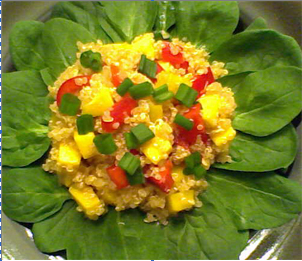
Quinoa Sunshine Salad with Asian Dressing

Ingredients:
Salad Ingredients
4 cups baby spinach
1 cup quinoa
1 cup red bell pepper, diced
1 cup yellow bell pepper, diced
1 cup mango, diced
½ cup green onion, chopped
Asian Dressing Ingredients
1/3 cup rice vinegar
¼ cup low-sodium soy sauce
1 tablespoon orange juice, freshly squeezed
2 teaspoons fresh garlic, minced
1 teaspoon fresh ginger, minced
1 teaspoon sesame oil
1 teaspoon sugar
¼ teaspoon orange zest

Directions:
1. Rinse quinoa thoroughly, place one cup quinoa in a sauce pan with two cups of cold water. Bring the mixture to a boil, cover and turn down the heat to a low simmer.
2. Let cook for about 15 minutes, or until all water is absorbed. Remove from heat. Fluff quinoa with a fork and set aside to cool.
3. In a small bowl combine all dressing ingredients and mix thoroughly.
4. In a large bowl combine quinoa, red bell pepper, yellow bell pepper and mango.
5. Pour dressing over salad and mix.
6. Let the salad sit for 15 minutes to allow the flavors to combine.
7. Serve salad on top of a bed of baby spinach and garnish with green onions.

Roasted Poblanos Stuffed with Cranberries, Pecans, and Quinoa

Ingredients:
8 poblano peppers
3 cups cooked quinoa
1/2 cup chopped pecans, toasted
1/2 cup dried cranberries
1/2 red onion, minced
1/2 cup cilantro, chopped
1 pound butternut or kabocha squash
2 Tablespoons maple syrup
1/4 cup nonfat sour cream
1-2 cups vegetable stock
1/2 teaspoon olive oil
Salt and freshly ground pepper

Directions:
1. Preheat boiler. Broil poblanos, turning once, until charred, about 10 minutes. Place them in a paper shopping bag or a bowl covered with plastic wrap to let them steam for about 10 minutes. Remove the charred skin when cool enough to handle. Slit lengthwise on one side, and remove the seeds.
2. Reduce the oven temperature to 400 degrees. Cut squash in half. Remove seeds. Brush the cut side with the olive oil. Roast it cut side down until tender, about 30 – 40 minutes.
3. Scoop the squash out of the skin. Puree in blender with maple syrup, sour cream, and vegetable stock. Add additional stock as necessary to reach a sauce-like consistency.
4. In a mixing bowl, combine quinoa, cranberries, pecans, onion, cilantro, and 1/2 cup of the sauce. Season to taste with salt and freshly ground pepper.
5. Stuff each pepper with a generous half cup of the mixture. Place in a baking dish, seam side down. Cover with aluminum foil and bake for 20 minutes.
6. Serve with the warm sauce.

Quinoa with Currants

Ingredients:
1/4 cup rinsed quinoa
1/8 tsp ground ginger
1/4 cup water
dash tumeric (optional)
Dash of salt
1/8 tsp pepper
1/3 red onion, finely diced
2 Tbs chopped fresh cilantro (or parsley)
1/8 tsp ground cumin
2 Tbs currants (or chopped raisins)
Dash ground cinnamon
1/4 tsp grated orange or lemon zest
Dash ground coriander

Directions:
1. Rinse quinoa with warm water and drain through a fine strainer.
2. Bring water and salt to a boil. Add the quinoa. Cover and reduce heat. Simmer for 10-15 min.
3. Meanwhile, heat a nonstick skillet. Add the onion, spices, and black pepper. Cook gently (low temp) until softened, about 5-10 minutes. Add a bit of water if needed to prevent burning.
4. Drain the quinoa when it's done and toss with the onion mixture along with the cilantro, currants, and orange or lemon zest. Serve hot or at room temperature.